
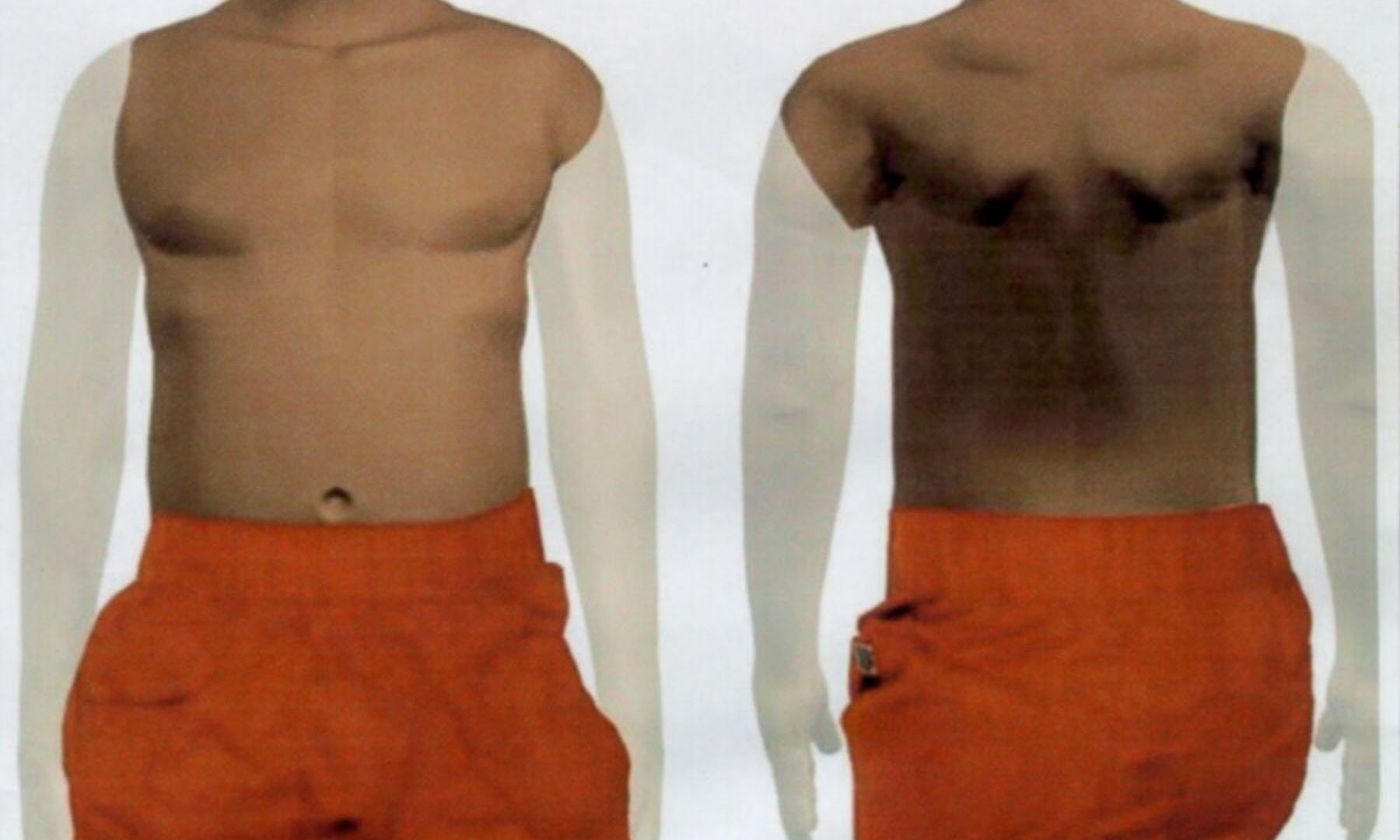
THE SMALL boy was paralysed but conscious, drugged by a potion containing the “Doomsday Plant”, when his life was drained from him in a voodoo sacrificial ceremony in London. Hanging upside down by his legs, his neck was cut from right to left to enable blood to flow from his body. It is 25 years since a child’s torso was discovered in the River Thames – and the murder remains unsolved Credit: Getty A police illustration of Adam’s mutilated torso showing the amputated body parts which were never found Credit: PA:Press Association Afterwards, the child’s head and limbs were skillfully dismembered and his 18-inch torso adorned in a pair of bright orange girls’ shorts. His mutilated body was then cast adrift into the Thames, possibly as a gift to a river god, and was eventually found near the Globe Theatre, near Southwark Bridge, 25 years ago on Monday. Sign up for The Sun newsletter Thank you! The barbaric killing of Adam — the name later given to him by detectives — is the only unsolved child murder on the books of the Met Police. Key potential suspects emerged during the investigation, and it is feared that further human sacrifices have been carried out in the intervening years. However, the probe brought pioneering scientific advances that are now widely used by police. Those ground-breaking tests could one day hold the key to stemming illegal immigration into the UK by proving someone’s true geographical origins through their hair and nails. It is unknown where Adam’s body was deposited in the river. Experts said he could have been put in the water anywhere between Chiswick, in West London, and the Thames Barrier, leaving no hope of CCTV being found. Most read in The Sun According to an oceanographer, two more turns of the tide would have propelled him to the Thames Estuary and his body would have been swept out to sea, lost for ever. Instead, City worker Aidan Minter was walking over Tower Bridge for a business meeting at 4pm on September 21, 2001, when he spotted what he believed to be a tailor’s mannequin floating in the river. As the “barrel-like” object passed under the bridge, Aidan reeled in horror when he realised it was a child’s headless and limbless torso. He phoned 999 and the Met’s marine unit was despatched from their nearby Wapping HQ. Detective Inspector Will O’Reilly was the Met’s on-call senior investigating officer for South London when the report of the gruesome find landed on his desk. He attended Wapping mortuary to see the body. The barbaric killing of Adam — the name later given to him by detectives — is the only unsolved child murder on the books of the Met Police Credit: Times Newspapers Ltd Police hoped that the label the pair of shorts could provide a clue into his identity Credit: Scotland Yard He says: “It became pretty obvious to me that this was a murder. The head and all four limbs were missing . . . there were no other injuries obvious that you would tend to get with a propeller or riverboat traffic. “We identified, at that stage, that it was a black male child. “My train of thought that day was that the child would be reported missing . . . it would probably be solved quite quickly. “But it was a very unusual case as people only do a five-point dismemberment for ease of transportation or to hide a body so there are no identifying marks. “In the case of a child so young, there seemed to be no point in that, and their DNA wouldn’t be on any database. It was also very rare for a child to be dismembered.” A post-mortem the next day saw the investigation take a bizarre turn. Pathologist Mike Heath established that death was caused by the cutting of his neck with a very sharp instrument. The head and limbs, which were never found, had been removed after death with a knife and cleaver. The boy was estimated to be aged between four and seven. Dr Heath said the body had been in the water between two and five days, and the shorts — which had a Kids & Company label — were placed on him after he died. He had an enlarged spleen and his stomach only contained traces of the cough medicine drug pholcodine, which suggested he had received some level of care but had not eaten for at least 24 hours before he died. Will said: “Dr Heath said that in his view, there was no blood left in the torso, and no bodily fluids. He said the child had been hung upside down and then his throat was split, as if it was a ritual slaughter of an animal. “After that he was drained of all his blood . . . the bruising in the neck was consistent with that.” City worker Aidan Minter spotted Adam’s body when he was walking over Tower Bridge in 2001 Credit: Linkedin Forensic scientist Ray Fysh traced Adam’s African roots Credit: Supplied There was no evidence of sexual assault. Will added: “It was Mike Heath who first raised the possibility there could be some degree of ritualism involved.” Adam’s body was discovered ten days after the 9/11 attacks in the US, so there was little media coverage about it. Police made an appeal for information on the BBC’s Crimewatch programme and a viewer called in about the orange shorts. The garment was Chinese-made, in a size 116 — age five to six in European sizes — and only sold in Germany and Austria. Enquiries established only 820 pairs had been bought in total. But at the time, the retail world was mainly cash-orientated so no leads emerged that could now be thrown up by electronic payments. The Met Police then put up a £50,000 reward for information, and officers gave the victim the name Adam. A South African expert in ritual murders, Dr Heinrich Sholtz, travelled to London, performed a second post-mortem and confirmed the injuries had all the hallmarks of a “Muti” witchcraft human sacrifice. Will said: “In such rituals, body parts are harvested for political reasons, for medicines or good luck, and these killings are not uncommon. “Sometimes body parts are used and buried under the footings of a church or a house. “Dr Sholtz was certain that Adam was the victim of such a ritual.” Adam’s atlas bone — at the top of the spine — was missing, which Will said is “also significant in ritualistic killings”. Detective Inspector Will O’Reilly and John Azah laid a wreath to celebrate the life of Adam, the name given to the torso. Credit: PA Sam Onogigovie was arrested and questioned over the body but was eliminated as a suspect Credit: Reuters In April 2002, Will and a police team travelled to South Africa to meet Nelson Mandela, who issued an appeal urging anyone with information to contact the Met. Meanwhile, the murder squad assembled a group of scientific experts under the direction of Ray Fysh, of the now defunct government-owned firm Forensic Science Service, who was a special adviser to police forces in southern England. Ray, who later wrote the book Shallow Graves, which features the Adam case, devised the world’s first ever familial DNA test to try to establish who Adam’s parents might be. It is now a commonly used forensic technique which has brought murderers and rapists to justice. Ray said: “It was the first case we ever tried it on. We did that and passed over 46 names — 35 males and 11 females — who we couldn’t exclude as being this child’s parents. “They were all eliminated through police inquiries.” In further ground-breaking work, scientists obtained mitochondrial DNA from Adam’s bone, passed down the maternal line, and the Y chromosome from the paternal ancestry. They built a database to make comparisons from around the world. Ray said: “It excluded South and East Africa. We did get matches around North West Africa around Nigeria, Cameroons, Togo. “But that child could have been brought up in Peckham with the same result. It gave us a little bit of an indication but not a firm one.” A major breakthrough came in July 2002 when social workers in Glasgow became concerned about the safety of two girls, and found ritualistic objects in their home. The children were taken into care but their mother, Joyce Osagiede, went to court and demanded them back so they could take part in a scheduled and innocent traditional African ceremony. Joyce Osagiede was a viewed as a suspect by police, she later died after being deported to Nigeria Credit: BBC Kingsley Ojo was arrested in London, but no proof could be found to link Ojo to Adam’s murder Credit: PA She also spoke about human sacrifices. She claimed to have been escaping from a ritual cult run by her ex-husband and said a child of hers had died in a ceremony. A cop at the hearing tipped off Will’s team, who searched her home and found Kids & Company clothing in the same size as Adam’s. Police also found mail from an address in Catford, South London. They spoke to a woman there who said someone matching Osagiede’s description had visited and told her she had just arrived from Germany — where the shorts came from. Osagiede was arrested but at that point denied any knowledge of Adam. DNA testing ruled out any family link to the boy. But Will said: “There was a link to the orange shorts and she later admitted she had bought a similar pair for her daughter.” Osagiede had applied for asylum in the UK, claiming to be from Sierra Leone, but detectives found she came from Benin City, Nigeria, and had lived in Germany for several years. It was established that she was still in Germany when Adam was killed in London. A social worker there had seen her with a young boy, raising suspicion it was Adam. Osagiede was placed in Home Office detention and later deported to Nigeria, where she later died. Will said: “My conclusion was that Joyce Osagiede was involved in the murder. Whether she unwittingly passed that child on or was involved in — or knew what was going to happen to him — I am convinced that she had that child in her possession at the time. “And many years later she came to admit that she did in fact have the boy in her possession.” One of the few contacts on her phone was a Nigerian people- trafficker named Kingsley Ojo, who was a practitioner of Muti rituals and also from Benin City. He was arrested for people- smuggling — for which he was later jailed for four and a half years. Will says: “I believe Kingsley Ojo was involved in the trafficking of Adam into the UK. “When we searched his house, potions, concoctions and skulls were found there. “A Nigerian movie found at the address featured a beheading. The film showed a man offering the head in a pot to his sick father. “It also came to our attention that while on remand at HMP Belmarsh, Ojo was acting as the witch doctor of his wing, promising all sorts of remedies for things.” Despite being questioned several times, no proof could be found to link Ojo to Adam’s murder. Osagiede’s husband, Sam Onogigovie, was wanted in Germany for people-trafficking. He was found in Dublin but eliminated as a suspect. Further innovative work was carried out by Ray to try to pin down where Adam came from by examining his bone. Ray explained that rocks break down to form soil, which plants then grow in. They are eaten by animals. Humans eat both the plants and animals. Thus chemicals within the rocks, called isotopes, eventually get into our bodies. Ray continued: “Once we have eaten them, they go into our system. We recognise they are foreign to our body and send them to long-term storage in our bones, fingernails or our hair. “So by looking at Adam’s bone, we can possibly determine where the geological rock was — which we did. We soon came up with the idea that Adam was not born and raised in London. “The one area that did have this pre-Cambrian rock is around the Cameroon and Nigeria area.” Ray, Will and Andy spent almost a month travelling 17,000 miles in Nigeria collecting bones and bush meat to pin down Adam’s origin. They established the most likely match was from material collected in Benin City — where Osagiede and Ojo came from. Ray said: “Within a year and a half we went from a body in the River Thames and not knowing anything about him to where he was born and raised — Benin City. Everything was pointing there.” Next, the team looked for tree pollen in Adam’s lungs to try to help identify his origin — but nothing was found. But they discovered some in his lower intestine — which matched samples found in London in September — as well as evidence of mud and vegetation, which they took to experts in Kew Gardens. There were minute traces of pure metals such as gold in the mud and the vegetation was identified as the calabar bean, known as the Doomsday Plant. Ray said: “The calabar bean contains a compound which, if it gets into the body, paralyses you but you remain conscious. “It meant someone made a concoction that was given to Adam 24 to 48 hours prior to his death. “He would have been conscious but paralysed when the knife went into him. “He was aware of everything that was happening to him. It’s a horrifying thought.” An inquest into Adam’s death in December 2004 recorded a verdict of unlawful killing. Immigration services later carried out a short-lived pilot project to see if the science gleaned could be used to tackle illegal immigration by determining the origins of migrants. But the project met resistance from academics on ethical grounds. Scotland Yard’s cold case team regularly look at Adam’s murder but there have been no new leads. Will says: “There are people alive who know what happened but we could not break down that barrier. “He was trafficked into the UK for ritualistic purposes and killed in a sacrificial ceremony with a number of people present. “The science which evolved from the case is now used in terrorist and murder probes and kidnap situations, with the hair of freed hostages able to point to locations. “I’m unaware of any other ritual murder in this country since Adam but they are happening globally and it would be wrong to assume they are not taking place here.” Comment now
Drugged but awake, tiny Adam was sacrificed & body thrown in Thames… inside London’s ONLY unsolved child murder 25yrs on
Full Article
Original Source
Read the full article at Thesun →KhanList aggregates and links to publicly available news content. We do not host full articles from third-party sources. Always verify important information with original sources.