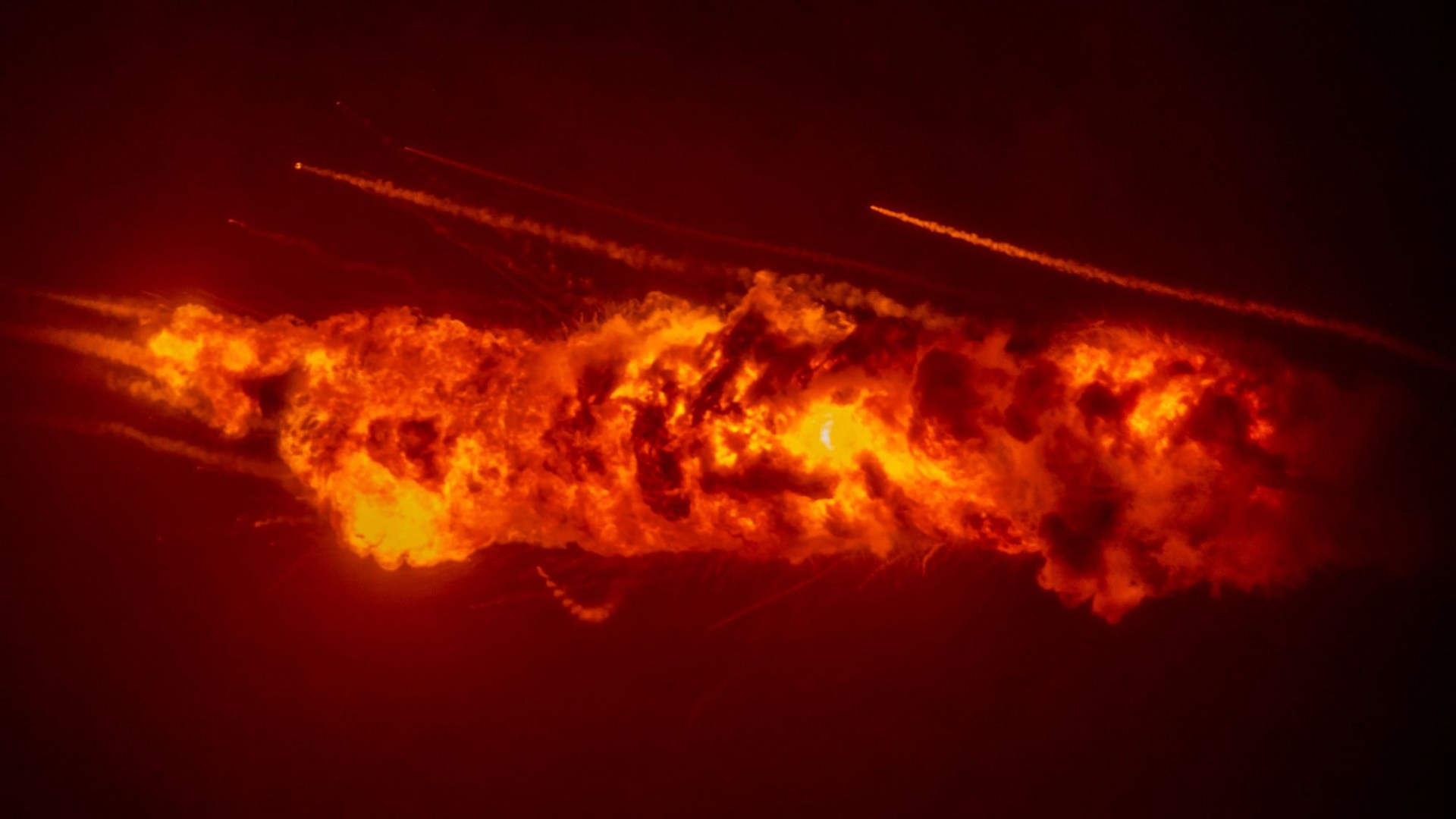
THIS is the shocking moment a Chinese rocket explodes after take-off as Xi Jinping races to keep pace with SpaceX and Elon Musk. Alarming footage shows the Long March 7A rocket erupting into flames just 85 seconds after lift-off from the Wenchang space launch site in Hainan on Monday. A Chinese rocket exploded 85 seconds after take off Credit: Getty The rocket reported an ‘in-flight anomaly’ but the exact cause of the explosion remains unknown Credit: Getty Thousands of excited spectators watched in horror as the night sky was suddenly illuminated by a huge fireball. The rocket was carrying the ChinaSat-4B communications satellite when it suffered an “in-flight anomaly”. Sign up for the Tech newsletter Thank you! Both the launcher and its payload were destroyed in the blast. The setback comes as Beijing pours billions into its ambitious space programme as Xi Jinping seeks to establish China as a global space superpower. This is the latest set back for the Chinese space programme as it tries to keep pace with SpaceX Credit: Getty Xi Jinping has invested billions of dollars in space technology in recent years Credit: Getty China has set its sights on becoming one of the world’s leaders in space technology by 2050. Numerous private and state-owned Chinese firms are working to close the gap with Elon Musk‘s SpaceX. Reacting to footage of the Chinese explosion on X, Musk wrote: “Rockets are insanely hard.” He later added: “I hope they have a speedy recovery.” Most read in Tech Monday’s failure was the first for the Long March 7A since 2020 and is expected to trigger a thorough investigation. However, experts said the failure does not appear likely to derail China’s wider launch programme. Blaine Curcio, founder of Orbital Gateway Consulting, described the accident as “not a great development” for the Long March 7A programme. The Long March 7A is primarily used to send communications satellites into high orbit, rather than deploying China’s huge constellations of satellites in low orbit. The doomed payload was identified as Zhongxing-4B, or ChinaSat-4B. It belongs to the same satellite series as ChinaSat-4A, which was launched in 2024. High-orbit communications satellites can beam broadcasting and telecommunications services across enormous areas, including remote regions beyond the reach of terrestrial networks. However, it is not immediately clear whether ChinaSat-4B had the same role, customers or capabilities as its predecessor. The Long March 7A is a medium-lift rocket specifically designed for missions requiring satellites to be placed into higher orbits. The failure comes at a crucial time for China’s space programme, with Beijing preparing for its ambitious Chang’e-7 lunar mission at Wenchang. Chinese authorities have said the mission is scheduled to launch in the second half of 2026, with observers identifying a possible launch window later this month. Chang’e-7 will target the Moon’s mysterious south pole, including permanently shadowed craters where scientists believe water ice could be trapped. But experts say Monday’s explosion is unlikely to have a major impact on the lunar mission. Chang’e-7 will use the much larger Long March 5 rocket, which is a different vehicle from the Long March 7A. The Long March 5 and the Chang’e-7 spacecraft are already at the Wenchang site as China prepares for one of its most ambitious lunar missions yet. The blast appears to be a serious setback for one part of Beijing’s launch programme – rather than a major blow to China’s wider space ambitions. Comment now
Dramatic moment Chinese rocket explodes seconds after takeoff as desperate Xi tries to keep up with Musk’s SpaceX tech
Full Article
Original Source
Read the full article at Thesun →KhanList aggregates and links to publicly available news content. We do not host full articles from third-party sources. Always verify important information with original sources.