
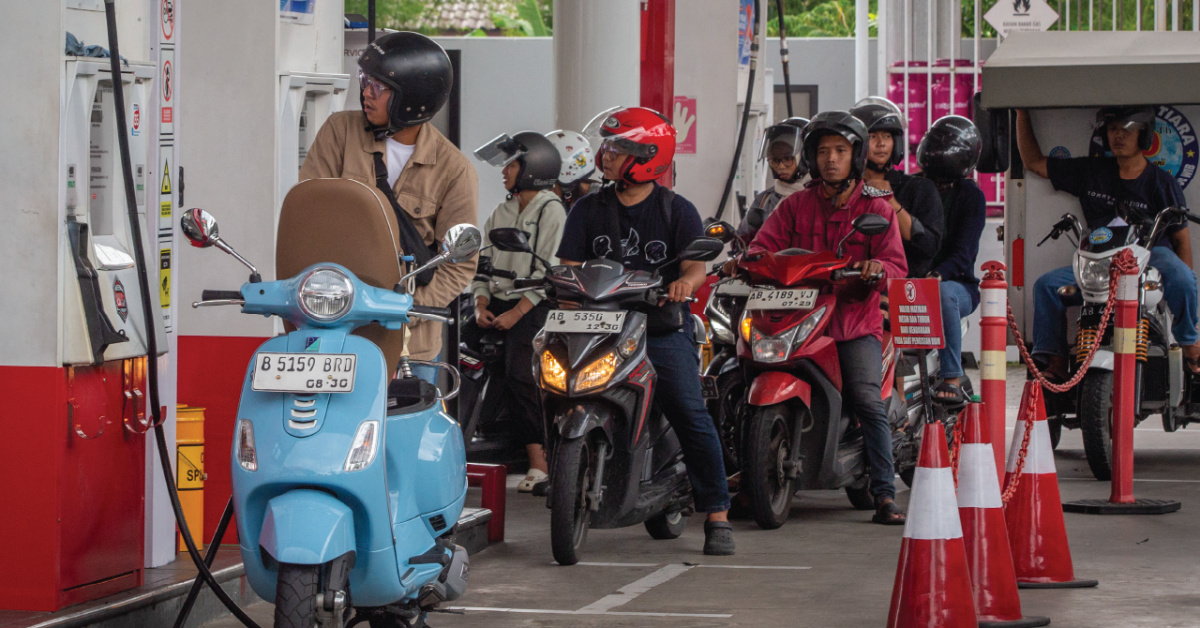
Motorcyclists line up to refuel at a gas station in Yogyakarta, Indonesia, on March 28, 2026. (Devi Rahman/AFP via Getty Images) More than 100 countries have taken policy steps to address rising energy costs and other effects of the conflict in the Middle East, according to the International Energy Agency (IEA). As of the IEA’s most recent update on June 12, a total of 113 countries – as well as the European Commission, the main executive body of the European Union – have made at least one such policy change in response to the war: Many countries have lowered energy taxes in response to Iran war Number of countries that have enacted each of the following types of policy, by IEA category PEW RESEARCH CENTER Many countries have lowered energy taxes in response to Iran war Number of countries that have enacted each of the following types of policy, by IEA category Policy typeNumber of countriesGroupConsumer support92Consumer supportTaxation55Consumer supportFuel subsidies32Consumer supportPrice caps23Consumer supportOther41Consumer supportEnergy conservation58Energy conservationCampaign40Energy conservationTransport25Energy conservationGovernment travel20Energy conservationWork from home17Energy conservationCooling8Energy conservationSchools and universities7Energy conservationStructural policies28Structural policiesElectrification19Structural policiesEnergy efficiency12Structural policiesOther10Structural policies PEW RESEARCH CENTER The most common of these has been adjusting taxes, a step taken by 55 countries. Turkey, for instance, lowered its fuel tax on oil. 40 countries have launched public awareness campaigns, asking or requiring people to limit their energy use. In Ireland and Japan, for example, the government has encouraged energy conservation, while the Philippines and other countries have declared national energy emergencies. 32 countries have added new fuel subsidies or expanded existing ones. Fiji, for example, instated a diesel rebate for its main electricity provider. In Mozambique, the government began subsidizing public transit. 28 countries have pursued structural policies focused on long-term change, related to improving energy efficiency or reducing fossil fuel dependency. For example, the Netherlands accelerated the trade-in of internal combustion engine vehicles for electric vehicles and the replacement of at-home gas boilers with heat pumps. About this research This Pew Research Center analysis examines how countries have responded to rising energy costs and other effects of the Iran war. Why did we do this? How did we do this? We relied on data from the International Energy Agency’s 2026 Energy Crisis Policy Response Tracker. For the purpose of category totals, countries are counted once per occurrence per category, even if they enacted multiple policies that fall into that category. In Spain, for example, the following fall under “Taxation”: cut fuel value-added tax, including vehicle fuel and liquefied petroleum gas; suspend the hydrocarbon excise duty; cut electricity tax. Related: Worldwide, a quarter of new car sales are electric vehicles or hybrids Many countries – predominantly in Asia – have responded with more than one of these initiatives. Cambodia, India, Indonesia, Laos, Malaysia, Pakistan, the Philippines, Singapore, South Korea, Sri Lanka, Thailand and Vietnam have enacted at least six types of energy-focused policy changes to address effects of the Iran war. Laos has enacted nine types of policies, more than any other country. The United States is not among the countries that made nationwide energy policy changes in response to the war, though President Donald Trump in May floated the idea of suspending the federal gas tax. Georgia, Indiana, Kentucky and Utah have provided some form of relief from state gas taxes. Related: What to know about U.S. oil production and consumption in 6 charts Asia, Europe stand out for policy responses Energy policy responses to the Iran war have been most common in the Asia-Pacific region, where 29 countries have enacted 124 such changes (counted once per occurrence per category). In Bangladesh, for example, lawmakers have made four types of policy changes: limiting air conditioning temperatures, closing public and private universities, asking people and businesses to save energy, and capping fuel purchases for vehicles plus promoting public transportation. In Europe, 30 countries and the European Commission have enacted 86 energy policy changes. For example, Sweden made four types of changes: halving the price of public transport passes, extending reductions on gas taxes, accelerating the electrification of public vehicles like police cars, and providing crisis support for the farming and fishing industries and assistance for electricity bill payments. Several countries in the Asia-Pacific region have taken numerous policy steps in response to Iran war Number of policies enacted, by country Note: The European Commission, which is not shown, has enacted three policies. PEW RESEARCH CENTER Several countries in the Asia-Pacific region have taken numerous policy steps in response to Iran war Number of policies enacted, by country Country/RegionISONumber of policiesAlbania81Argentina322Australia365Austria402Bangladesh504Barbados523Belgium564Belize843Botswana722Brazil762Brunei961Bulgaria1002Cabo Verde1322Cambodia1167Canada1242Chile1525China1561Colombia1701Comoros1741Croatia1914Cyprus1962Czech Republic2032Dominican Republic2142DR Congo1801East Timor6262Ecuador2182Egypt8186Estonia2331Ethiopia2313European Commission3Fiji2423France2503Gambia2703Germany2762Ghana2881Greece3002Grenada3082Guatemala3201Guinea-Bissau6241Guyana3282Haiti3321Honduras3401Hungary3482Iceland3523India3568Indonesia3608Iran3641Ireland3725Italy3802Ivory Coast3841Jamaica3881Japan3923Jordan4003Kenya4043Kuwait4141Laos4189Latvia4281Lithuania4403Luxembourg4426Madagascar4501Malaysia4587Maldives4621Marshall Islands5842Mauritania4782Mauritius4801Mexico4842Montenegro4992Morocco5041Mozambique5082Myanmar1043Namibia5161Nauru5201Nepal5245Netherlands5286New Zealand5541Nigeria5661Norway5781Pakistan5866Panama5912Papua New Guinea5981Peru6042Philippines6088Poland6163Portugal6202Romania6422Rwanda6462Saint Kitts and Nevis6592Saint Lucia6622Sao Tome and Principe6781Senegal6861Serbia6882Seychelles6904Sierra Leone6941Singapore7026Slovakia7031Slovenia7052Solomon Islands901South Africa7101South Korea4107South Sudan7281Spain7245Sri Lanka1447Suriname7402Sweden7524Tanzania8342Thailand7647Turkey7921Tuvalu7981United Kingdom8266Uruguay8582Vanuatu5481Vietnam7048Zambia8941Zimbabwe7161 Note: The European Commission, which is not shown, has enacted three policies. PEW RESEARCH CENTER Andrew Prozorovsky is a research assistant at Pew Research Center.
Dozens of countries have lowered energy taxes or taken other policy steps in response to Iran war
Full Article
Original Source
Read the full article at Pewresearch →KhanList aggregates and links to publicly available news content. We do not host full articles from third-party sources. Always verify important information with original sources.