
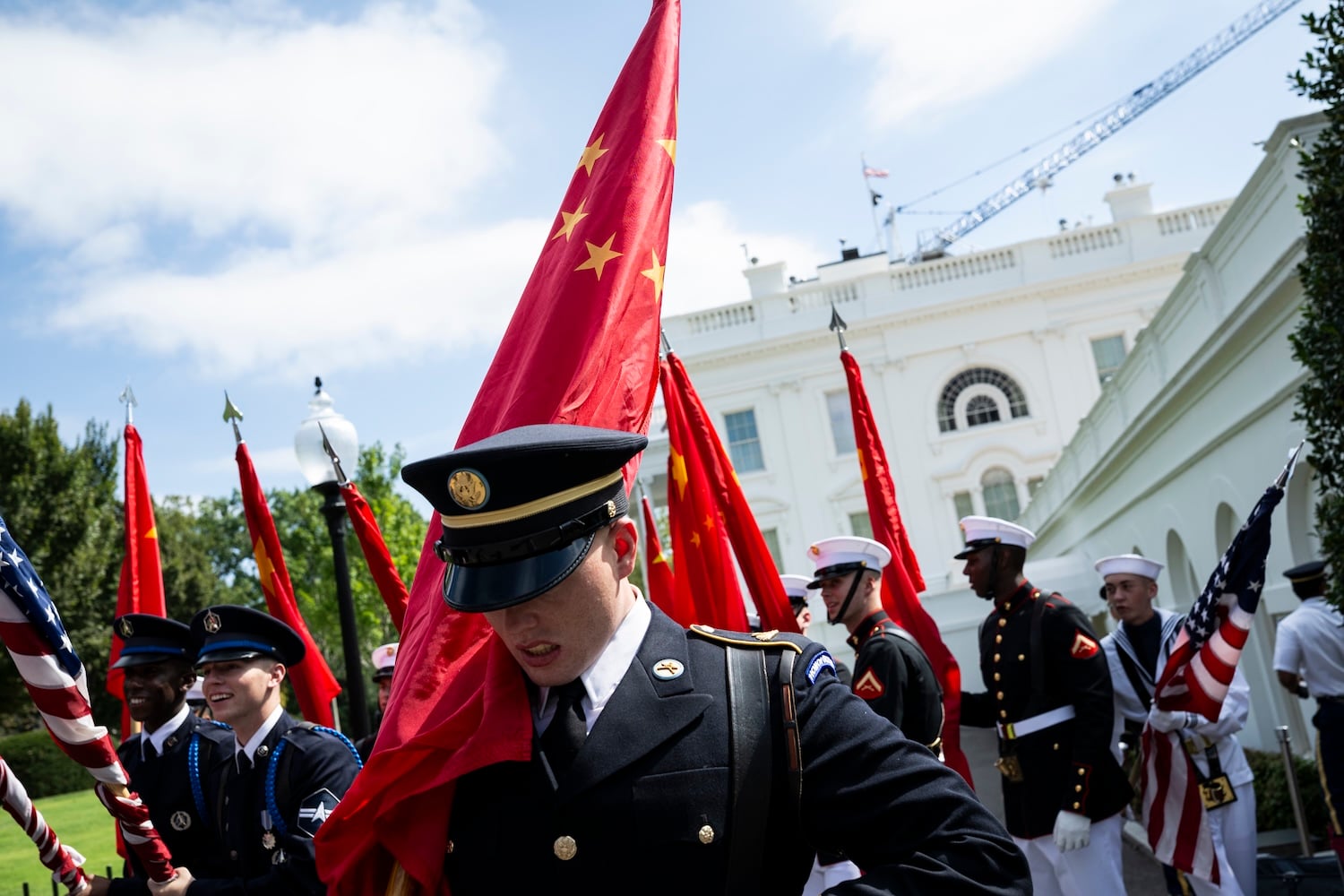
Welcome to Foreign Policy’s China Brief. The highlights this week: Chinese President Xi Jinping and U.S. President Donald Trump prepare to meet in Washington, purged Chinese military leaders are officially expelled, and the United States dismantles some of its top China-focused think tanks. Welcome to Foreign Policy’s China Brief. The highlights this week: Chinese President Xi Jinping and U.S. President Donald Trump prepare to meet in Washington, purged Chinese military leaders are officially expelled, and the United States dismantles some of its top China-focused think tanks. Trump-Xi Summit Preview This week, U.S. President Donald Trump sat down with the socialist leader of a major economy who he desperately wishes to impress. Oh, and on Thursday, he will meet with Chinese President Xi Jinping. Jokes aside, I don’t expect much to come of the summit. For one, the White House’s preparation for the trip has been unsurprisingly chaotic and incompetent. More fundamentally, neither side is in a position to try anything dramatic. Trump is increasingly weak on the home front, chastened by Beijing’s decision last year to tighten the screws on critical mineral exports. Meanwhile, China is still reeling from its property crisis and has no appetite for a bigger economic fight, having just staved off Trump’s trade war. Xi’s task is simply to signal business as usual and avoid setting off a Trump outburst. He has never had much trouble managing the U.S. president, and there is no reason to expect that to change now. There is no official agenda for the meeting yet, but the top priorities are likely to include managing the trade relationship and securing the supply of Chinese critical minerals. Artificial intelligence is also expected to be on the table, especially after the United States almost seized a Chinese ship last week based on a mistaken intelligence report produced with AI. I’ve already laid out why I don’t think agreement between China and the United States on AI safety is possible, although narrower cooperation might be doable. One point worth adding—the U.S. tech industry is pushing for a safety framework based on alignment, getting hypothetical superintelligent AI systems to internalize human values. But China favors an approach that is anathema to Silicon Valley: holding companies and executives directly responsible for what they create. That makes agreeing on shared regulatory standards difficult. I don’t expect the Iran war to be on the agenda. Trump has pulled back from confronting China over its alleged support for Iran, and Xi has no incentive to bring it up. If he intended to use his U.S. trip to position Beijing as a peacemaker, then Xi would presumably be speaking at the United Nations General Assembly—not skipping the in-person convening yet again, as he has since 2015. Xi will probably press Trump on Taiwan. I would not be surprised if, coming out of the summit, Trump parrots the language of the last impressive person he spoke to, brushes past the United States’ careful ambiguity on Taiwan, and says something he shouldn’t. This would trigger another wave of panic in Taiwan over the potential of U.S. abandonment. That fear isn’t unfounded, but it cuts both ways politically. Taiwan’s reliance on the promise of U.S. protection has often kept it from taking its own defense seriously and carrying out reforms. It is also worth noting that 2027—which U.S. officials once cited as Xi’s deadline for the Chinese military to be ready to invade Taiwan—is now less commonly mentioned in U.S. security discourse. That could reflect growing uncertainty about Trump’s commitment to Taiwan—or it may simply mean that the claim, which roughly 83 percent of China experts surveyed in 2022 disagreed with, was never well-founded in the first place. What We’re Following Purged generals expelled. One reason for the pullback on the 2027 prediction is the sheer scale of China’s ongoing military purges. Xi has carved holes into the People’s Liberation Army (PLA) leadership, leaving the military unfit for any serious campaign in the near term. The latest development is the formal expulsion of Gens. Zhang Youxia and Liu Zhenli. Zhang and Liu, two of the military’s top-ranked leaders, were originally detained in January. The gap between detention and formal expulsion is standard in China; criminal charges and a show trial typically follow. What is more revealing is the language of the expulsion announcement—notably, that the accusations of political disobedience came before routine corruption charges. Their downfall is cast as something close to a personal betrayal of Xi-ism. The phrase “betray their original aspiration and mission” in the charges derives from Xi’s 2019 military propaganda campaign, which reasserted the principle of the Chinese Communist Party controlling the military. As exiled Chinese scholar Deng Yuwen wrote in February, Xi has trapped himself in a cycle of disappointment, promoting new officers to replace the purged only to find that he can never get the loyalty that he wants. China think tanks dismantled. China isn’t the only superpower capable of self-destructive purges. The U.S. military is reportedly dismantling a cluster of China-focused think tanks, including the Navy’s China Maritime Studies Institute and its counterparts in other services, in early October. These institutions have studied the Chinese military for decades, producing some of the field’s most authoritative work. The move follows the Trump administration’s gutting of much of the civilian infrastructure for China studies last year. It is unclear why the administration is targeting these groups, though it may be part of a broader ideological assault on military education. Destroying some the best sources of insight into a main rival is a curious choice, especially given that the U.S. military is struggling to defeat an opponent far weaker than China. FP’s Most Read This Week China, Not Iran, Is Trump’s Real Foreign-Policy Debacle by Nicholas Bequelin and Yaqiu Wang How Could Iran Happen? An Autopsy. by Ariane Tabatabai and Julia Curlee The Houthi Advance Is About More Than Just Iran by Marc Lynch Tech and Business Tung Chee-hwa funeral. Former Hong Kong chief executive and billionaire Tung Chee-hwa received a state funeral on Sunday following his death at 89 on Sept. 8. Tung was Hong Kong’s first postcolonial leader and one of China’s most effective united front figures, extremely skilled at selling China’s narrative to Western counterparts. Foreign Policy reported on Tung’s efforts to influence Washington back in 2017. Powerful U.S. figures such as John Podesta and Henry Paulson stayed close to him despite repeated warnings from China experts and U.S. intelligence about his ties to Chinese intelligence. Xianyu crackdown. Xianyu, the online secondhand goods marketplace run by Alibaba, is in trouble. A television investigation found extensive advertising for sex work on the platform using coded terms, as well as possible ads for underage sex trafficking. Xianyu has apologized but is likely to face regulatory punishment; this isn’t the first time this has happened. China maintains a strict anti-pornography regime online. However, the country’s extensive—and often abusive—sex trade ranges from ubiquitous massage parlors to high-end brothels operating out of PLA-run compounds. Unsurprisingly, sex workers have long used online platforms to advertise in barely concealed language.
Don’t Expect Fireworks From the Trump-Xi Summit
Full Article
Original Source
Read the full article at Foreignpolicy →KhanList aggregates and links to publicly available news content. We do not host full articles from third-party sources. Always verify important information with original sources.