
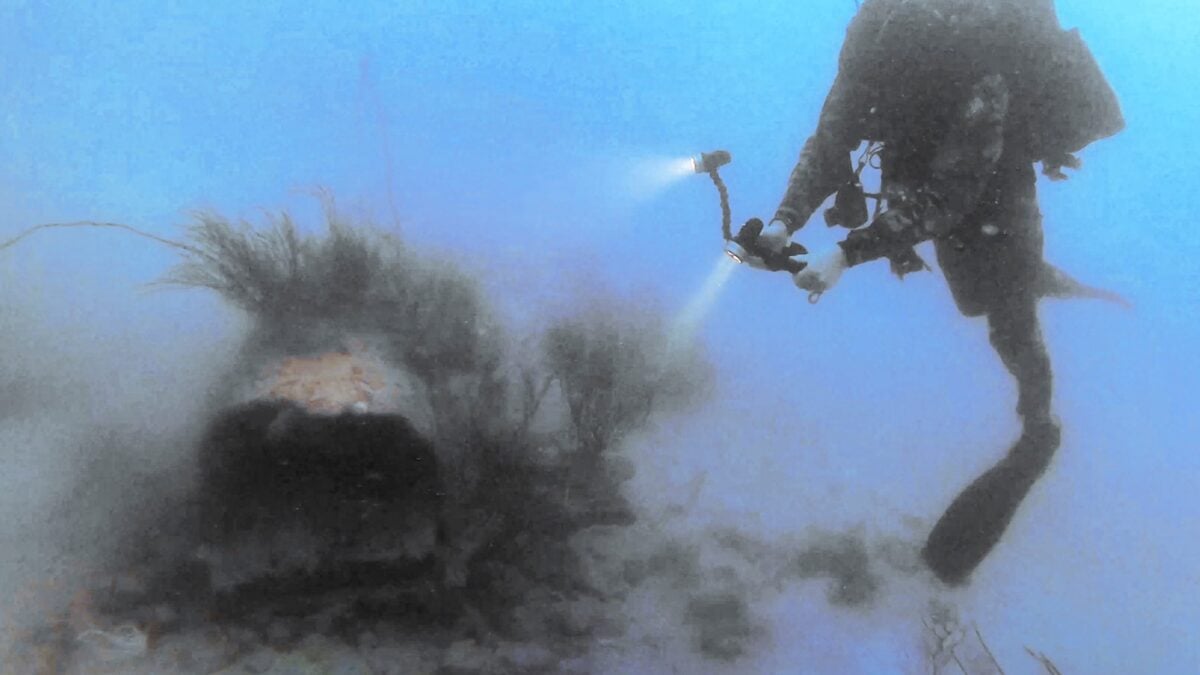
Fearing an Imperial Russian fleet based in the Far East during the Crimean War, Australia’s colonial leadership commissioned its first ever warship in 1855: the HMCS Spitfire, a 51-foot (16-meter) wooden gunboat with a hull sheathed in protective copper. For over four decades the Spitfire sailed the Pacific, first on naval missions, later on fishing expeditions, before repeated damage from cyclones and other hazards ultimately sank this historic vessel on August 21, 1898. But this year—thanks to Royal Australian Navy (RAN) divers and archaeologists with the Australian National Maritime Museum—the Spitfire wreck has been finally located, almost completely buried in a seabed off the coast of Far North Queensland. That encasement has been a remarkable boon for the ex-HMCS Spitfire as an artifact. Despite spending over a century marinating in warm tropical waters, and despite a construction largely of ironbark and blackwood, the warship’s hull has remained “very well preserved,” according to James Hunter, a maritime archaeologist with the museum who collaborated on the project. “Literally, from the day it sank, no humans have interacted or intervened with it in any way, shape, or form,” Hunter said in a video put out by the museum this Wednesday. This “really unique” aspect of the wreck, Hunter noted, makes the Spitfire something of a time capsule for the rare cultural artifacts left behind by the crew who operated it during the warship’s second life as a bêche-de-mer fishing vessel harvesting sea cucumbers off the coast. “Its crew […] were predominantly either Aboriginal or Torres Strait Islander or Pacific Islander people,” Hunter explained. “So, what this site represents is an opportunity for us to potentially investigate that and learn more about these First Nations people.” Close-up inspection of the shipwreck was also conducted by remotely operated vehicles (ROVs). Credit: Australian National Maritime Museum Reliable reporting The hunt for the Spitfire proved to be a month-long endeavor this summer with RAN clearance divers, trained to defuse underwater mines, onboard Australia’s Huon-class minehunter vessel the HMAS Diamantina working in coordination with maritime archaeologists. Two sites had been reported as the warship’s final resting place—one reef listed in a government registry for insurance purposes and another listed in contemporaneous newspaper accounts of the shipwreck. I am happy to report that the journalists were correct and official records were wrong. Hunter said the sonar team onboard the HMAS Diamantina was the first to notice the “acoustic anomaly created by the wreck,” which was later confirmed via imagery collected by divers and remotely operated vehicles. A key part of this painstaking process involved comparing the wreck to the only known photograph of Spitfire—which matched exposed features, like the placement of its cookstove and crane-like davit devices. “With some help from Michael Rampe, who the museum collaborates with on 3D models, we were able to generate a scaled photogrammetric 3D model of the wreck site,” Hunter added, referencing a method that converts flat images into accurate three-dimensional depictions via parallax effects. “I can actually look at it at my desk and do some analysis and some assessment and work out what’s there and what we’re dealing with,” Hunter said. Buried treasure Although plans are not yet solidified, the researchers hope that their next steps will involve the digging of an “excavation trench” undersea in an effort to gain access to material not currently exposed at the wreck site. Hunter noted that this work would likely be conducted in collaboration with his colleague Celeste Jordan, a maritime archaeologist and principal heritage officer with Queensland’s Department of the Environment, Tourism, Science and Innovation. “[It] would be great to go back, hopefully with Celeste and other colleagues, and do some more in-depth, detailed survey work […] remove some sediment, expose the hull, expose the artifacts, and recover a whole lot more information that can tell us about Spitfire and about the people who operated it,” Hunter said.
Divers Found the Wreck of Australia’s First Naval Warship—and Old Newspapers Had It Right All Along
Full Article
Original Source
Read the full article at Gizmodo →KhanList aggregates and links to publicly available news content. We do not host full articles from third-party sources. Always verify important information with original sources.