
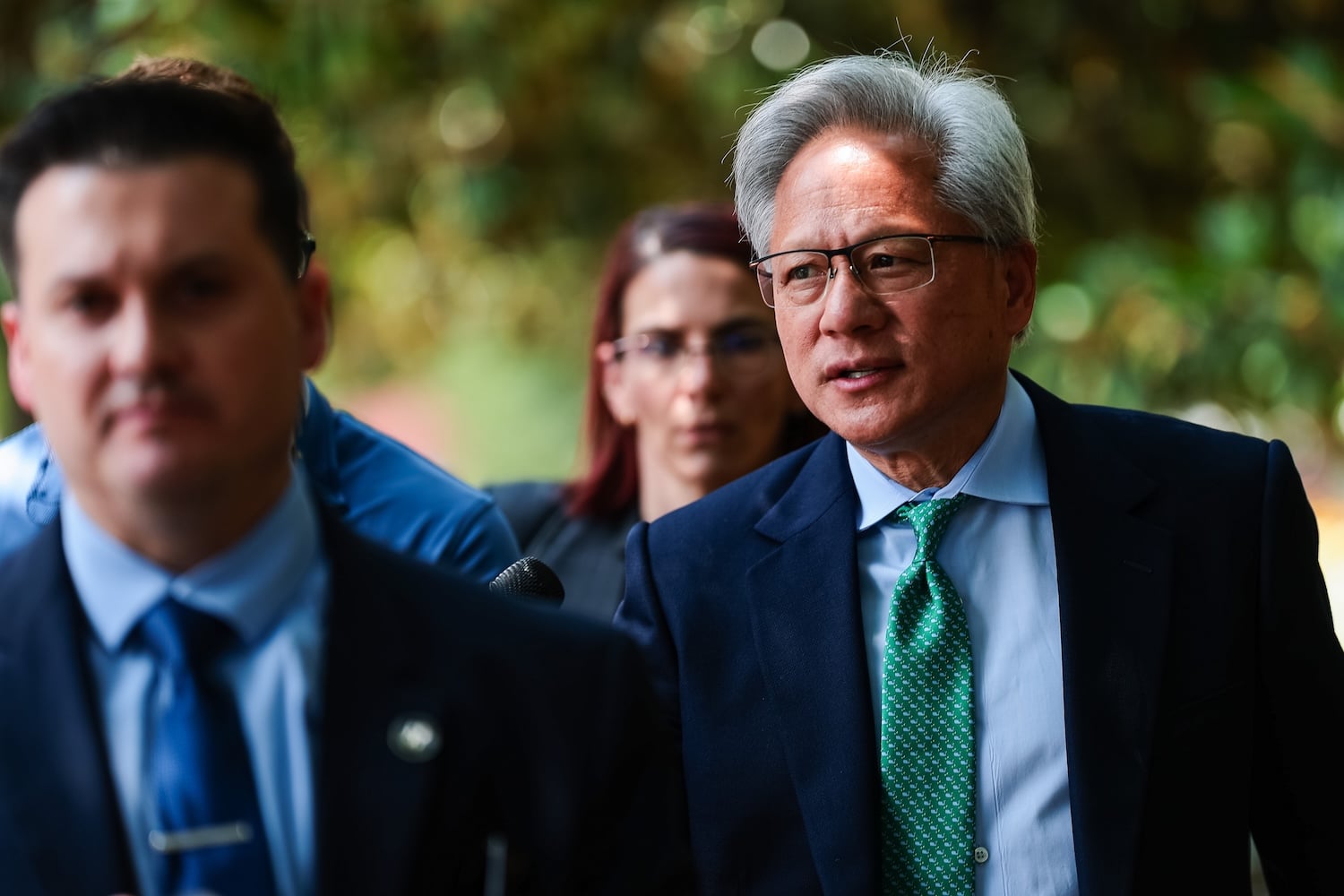
Welcome to Foreign Policy’s China Brief. The highlights this week: Nvidia CEO Jensen Huang is accused of having an affair with a Chinese spy, Chinese marriage registrations drop, and the United States and China extend their trade truce ahead of an expected meeting between their leaders. Welcome to Foreign Policy’s China Brief. The highlights this week: Nvidia CEO Jensen Huang is accused of having an affair with a Chinese spy, Chinese marriage registrations drop, and the United States and China extend their trade truce ahead of an expected meeting between their leaders. The Mysteries of the Jensen Huang Affair Nvidia CEO Jensen Huang’s connections to Alice Huang, a Chinese businesswoman who U.S. officials believe was working for Beijing, exploded into a major scandal this week. On Sunday, he admitted to having an extramarital affair, Nvidia stock dropped, and the company announced it was launching an investigation. Alice Huang, who is of no relation, is a former executive at Megaspeed—a Singapore-based, China-linked cloud-computing company that is Nvidia’s largest chip customer in Southeast Asia. She became Megaspeed’s controlling shareholder in 2023, shortly after the United States under President Joe Biden imposed sweeping chip restrictions on China. Megaspeed has been under scrutiny since 2024, when the U.S. Commerce Department opened a probe into whether it was diverting Nvidia chips to China. Yet late last year, Jensen Huang convinced U.S. President Donald Trump to allow exports of Nvidia’s advanced H200 chip to China, with the White House taking a 25 percent cut. Many of these chips seem to have been sold to Chinese shell companies. All of this happened even though both Nvidia and the White House seemingly knew about the risks surrounding Alice Huang for months. Trump administration officials were reportedly warned about her connection to Jensen in a classified memo this spring but took no action. Nvidia, meanwhile, hired a public relations firm specializing in sex scandals last year. So, how did this happen? It’s possible that Alice Huang is an agent for China’s Ministry of State Security and was tasked with honey trapping Jensen Huang. That would suggest Megaspeed, which has denied all allegations that it engaged in misconduct, was repurposed or even created as a vehicle for intelligence gathering and for illicitly obtaining U.S. chips. But it’s equally plausible that the relationship came first. Alice Huang’s resume is hard to verify, but she seems to have worked in finance and tech for at least a decade. It wouldn’t be the first time that a billionaire businessman got involved with a younger woman who he convinced himself was a brilliant up-and-comer. If that is the case, either Chinese intelligence became aware of the relationship between Alice Huang and Jensen Huang and pressured her to let them exploit it, or she took it to them herself. As I have noted before, China’s intelligence apparatus is messy, with multiple competing groups inside the government. That leaves room for outsiders to act as intelligence entrepreneurs. Alice Huang may have been working both Jensen Huang and the Chinese government for her own business edge. Other questions remain unanswered. One is whether Alice Huang persuaded Jensen Huang to do anything on behalf of the Chinese state that he wouldn’t have done anyway, since Nvidia has a vested interest in access to the Chinese market. That said, Nvidia’s intervention to help halt the Commerce Department investigation into Megaspeed looks suspicious. (Megaspeed remains under investigation by the U.S. Justice Department.) Of course, China also benefits from having a line into White House discussions, and we can’t know what Jensen Huang has told Trump about China behind closed doors. Trump’s China policy has certainly been soft, and he has blithely dismissed this week’s revelations. But why did the Trump administration disregard the warning from U.S. Secretary of State Marco Rubio about Huang’s connections to Chinese intelligence? And who leaked the story to the press, whether out of patriotic feeling or a desire to disadvantage a rival? It’s certainly a convenient moment for U.S. politicians to distance themselves from the White House and an increasingly unpopular tech sector. A tougher stance on China may become a distinguishing mark for aspiring Republican leaders. Democrats are also seizing on the news as an example of the White House’s tolerance of corruption and foreign influence, and they will likely push for stronger chip restrictions in the new Congress. Whatever the outcome of the Huang affair, the state of counterintelligence and cybersecurity under Trump remains dire, underscoring a need for root-and-branch reform. What We’re Following Marriage registrations drop. China’s demographic crisis remains its biggest long-term problem, and the news keeps getting worse. New data shows marriage registrations falling to an 18-year low for the January-to-September period, with 4.65 million couples tying the knot, a nearly 10 percent drop. For comparison, the United States sees around 2 million marriages in a full year with a population one-quarter the size of China’s. Childbearing is closely tied to marriage in China, so a low marriage rate also means a low birth rate. Children born outside of marriage and their single mothers still face legal and social obstacles, though their situation has improved in recent years. Hong Kong dissident receives longer sentence. A Hong Kong court has sentenced Joshua Wong, the imprisoned young activist who became the face of the city’s democracy movement more than a decade ago, to another 10 years for supposed collusion with foreign powers. Wong was due for release in January. Beijing has an interest in portraying Hong Kong’s democracy activists as tools of outside agents. Wong, however, is a cause célèbre among Western politicians—unlike other equally persecuted dissidents such as Macao’s Au Kam San. If the incoming U.S. Congress chooses to take up human rights issues again, Wong’s case will likely return to the spotlight. FP’s Most Read This Week Why Kushner and Witkoff Keep Failing by Stephen M. Walt The Beginning of the End of Trumpism by Ravi Agrawal Where Democrats Can Thwart Trump’s Foreign Policy by John Haltiwanger Tech and Business U.S.-China trade truce extended. The U.S.-China trade truce was formally extended by another two months on Monday, running through Jan. 10, 2027. In theory, that leaves room for Chinese President Xi Jinping and Trump to ink a more permanent deal if they meet at the Asia-Pacific Economic Cooperation summit in Shenzhen, China, next week. Xi is well aware of Trump’s need for some kind of victory, and as a result the Chinese leader is likely to come out ahead in any agreement. Whatever deal they reach may not last long: Domestic political pressure in the United States could blow it up before it is in place, especially in the wake of the Huang case. Japan squabble deepens. Beijing’s relations with Tokyo remain frozen nearly a year after Japanese Prime Minister Sanae Takaichi said Japan might be obliged to come to Taiwan’s aid if China invaded the self-ruled island. Even at the provincial level, Chinese officials are competing to look tough on Japan. That is a perennial popularity-booster with both the Chinese Communist Party and the public, for whom the trauma of Japan’s brutal invasion lingers eight decades on. Now, flights between the two countries are being slashed. Airlines, mostly Chinese, have scheduled nearly 700,000 fewer seats on China-Japan flights this winter, a drop of around 20 percent compared to last year. Takaichi’s stance remains popular at home, and she may be emboldened if a tougher U.S. policy toward China emerges next year.
Did China Play Jensen Huang?
Full Article
Original Source
Read the full article at Foreignpolicy →KhanList aggregates and links to publicly available news content. We do not host full articles from third-party sources. Always verify important information with original sources.