
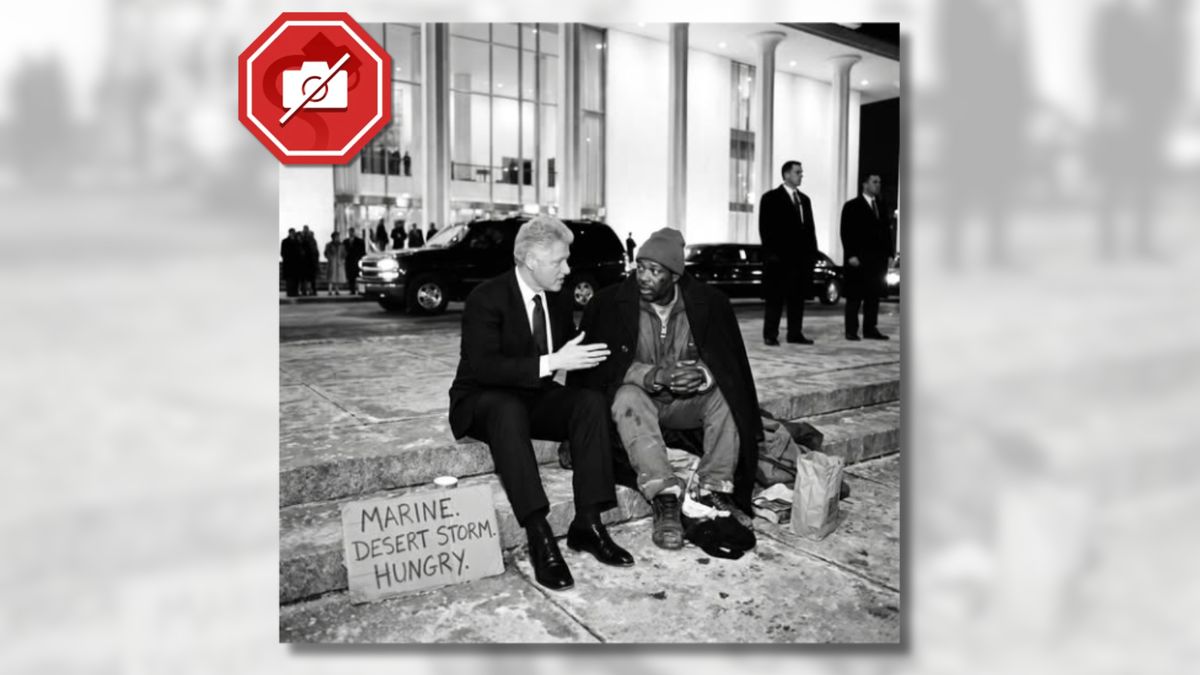
Claim: In 1997, then-U.S. President Bill Clinton helped a homeless veteran named Marcus Williams outside Washington, D.C.'s John F. Kennedy Center for the Performing Arts in 1997. Rating: In November, right around Veteran's Day, posts online claimed to show former U.S. President Bill Clinton personally helping a homeless veteran outside The John F. Kennedy Center for the Performing Arts in 1997. According to the tale, Clinton offered the man, Marcus Williams, his coat, before asking him questions about his service. He then supposedly ordered a Secret Service agent to get Williams food, and personally contacted the Department of Veterans Affairs to help Williams get back on his feet. The posts began: "On a freezing December night in 1997, President Bill Clinton was leaving a holiday concert at the Kennedy Center when he noticed a homeless veteran sitting near the entrance. The man wore a thin jacket and was shivering in the cold. In his hands, he held a piece of cardboard with a simple message written on it: "Marine. Desert Storm. Hungry." What happened next caught the attention of people in the presidential motorcade. Clinton stopped, took off his own coat, placed it around the veteran's shoulders, and sat beside him on the icy concrete. The veteran, 42 year old Marcus Williams, later told reporters that the President never questioned how he had ended up on the street or lectured him about his choices. Instead, Clinton asked about his military service, the battles he had experienced, and whether anyone had ever properly thanked him for what he had done. According to Secret Service agent Larry Cockell, who later wrote about the encounter, Clinton stayed with Marcus for nearly 25 minutes despite the freezing temperatures. When Marcus admitted that he had not eaten in two days, Clinton sent an agent to a nearby restaurant to get him food. He refused to leave until Marcus had finished his meal. The posts were accompanied by images supposedly showing the two meeting as well as Williams holding a cardboard sign reading "Marine. Desert Storm. Hungry." Snopes readers contacted us to ask whether the story and images were real or fake. We first uploaded the images into Google Lens to perform a reverse image search. Next, we used search engines such as DuckDuckGo, Google and Yahoo with phrases such as "Bill Clinton Marcus Williams Homeless Veteran" to see whether any reputable news outlets had documented the events. If the scene had occurred and the images were real, we would find evidence in newspapers and media archives like Getty Images. That was not the case. We did not locate any examples of credible outlets publishing the images, nor reporting on the alleged meeting. We found that neither the story nor the images were real, and that they were generated using artificial intelligence tools. Therefore, we've labeled the claim false. We uploaded the images accompanying the story into several tools that screen visual media for signs of AI: Sightengine, Hive Moderation, and Google's integrated SynthID detector. The first two found a high likelihood that the images were AI-generated, and the SynthID detector found the invisible watermark indicating Google's AI tools generated the images. We also ran the story through the AI text detection tool Pangram, which also determined that all of the text was written using a large language model such as ChatGPT. Let us note here: These types of AI detection tools are fallible. Snopes cautions people against using them for definitive answers on media's authenticity without supporting evidence. Detecting that the image was fake without using those tools was more difficult, given it was grayscale and grainy, but not impossible. We noticed that the writing on the cardboard sign looked too perfect, the cardboard itself looked unusually bright and the supposedly parallel sidewalk cracks didn't form straight lines or meet at a single vanishing point. Our searches also uncovered a January article written by the fact-checking organization Lead Stories debunking the exact same story, though featuring a real archival image of Clinton instead of an AI-generated one. That fact-check also noted some factual errors in the text, most prominently that one of Clinton's Secret Service agents wrote about the encounter in a memoir. (No such memoir existed.) Because the exact claim was also previously been fact-checked almost a year ago, we concluded that users posting the claim in October and November were doing so in an attempt to make money. The fictional story is an example of glurge, which Dictionary.com defines as "stories, often sent by email, that are supposed to be true and uplifting, but which are often fabricated and sentimental." These types of low-quality posts often use standard or template language, making small tweaks in an attempt to game the social media algorithms. They rely on social media users' willingness to believe and share the made-up stories and hope to generate a profit from advertising revenue if the posts go viral. Snopes previously explained the ongoing trend of politically motivated, AI-generated slop content similar to the claim debunked in this article.
Did Bill Clinton help homeless veteran outside Kennedy Center?
Full Article
Original Source
Read the full article at Snopes →KhanList aggregates and links to publicly available news content. We do not host full articles from third-party sources. Always verify important information with original sources.