
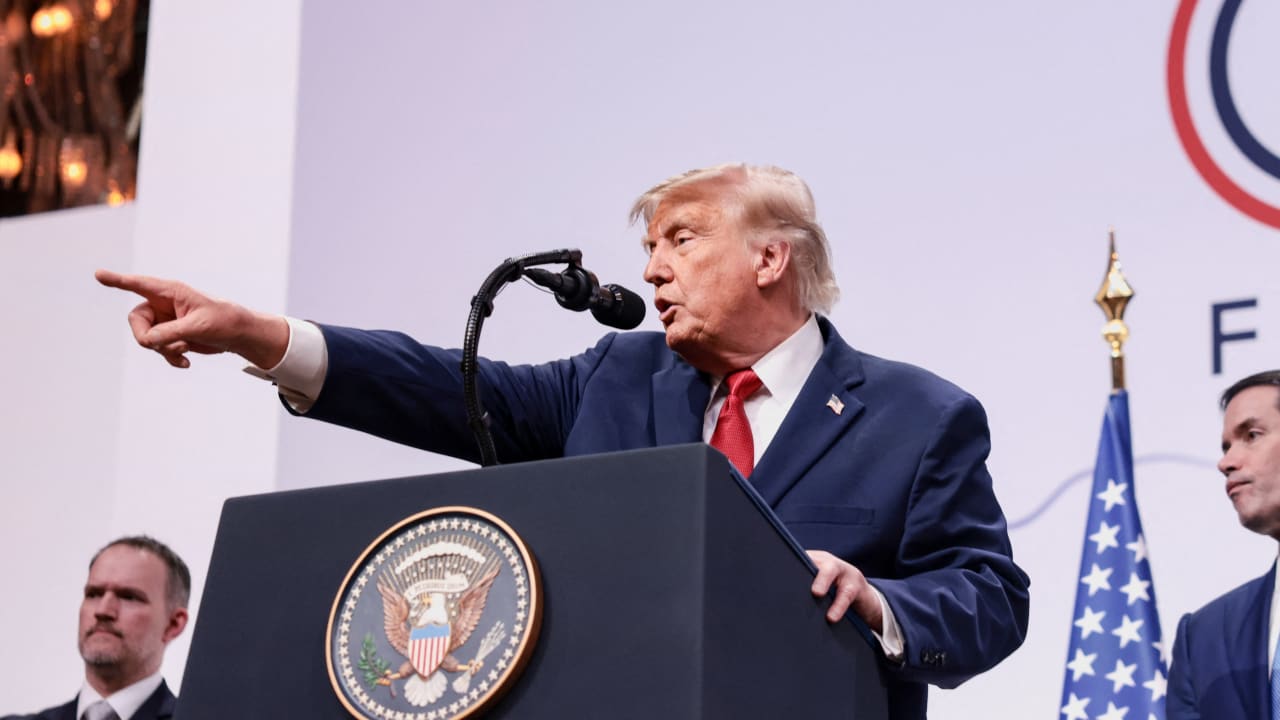
US President Donald Trump revealed Thursday that several Gulf states, led by Saudi Arabia, had asked him to refrain from escalating military operations against Iran, even though he claimed the United States could destroy the country's critical infrastructure in just three days, in an interview with commentator and political analyst Stephen A. Smith.The interview was released against the backdrop of a sharp change in Trump's approach to Iran earlier Thursday.The president announced that the US no longer needed an agreement with Tehran and instructed Vice President JD Vance, who had been leading diplomatic efforts with Iran, to redirect his attention to investigating corruption in Democratic-controlled states and cities."We don’t need a deal with Iran. Those days have long since passed. We’ve got their money, Hundreds of Billions of Dollars, and we’ve got their Strait!" Trump wrote on Truth Social.Trump says Gulf states asked him to hold back on IranSpeaking to Smith, Trump explained why the war was continuing despite his repeated declarations of American victory.US TV personality Stephen A. Smith stands outside the White House, after meeting with President Donald Trump, in Washington, DC, US, November 12, 2026. (credit: Reuters/Kylie Cooper)"I could end it immediately," he said."At the request of the nations that I’m looking to protect. We are doing it a little bit longer way, a little bit more civilly."Trump then identified the countries that had asked him to exercise restraint."Saudi Arabia has asked me to please just let it be the way it is now for a while because they’re disintegrating," he said, referring to the Iranians."Qatar, if you look at that. Kuwait, UAE, Bahrain. All of them would rather, would much prefer the waiting period."Trump acknowledged that he was not entirely convinced the delay was the right course."So they’ve asked me to do that and I’m doing that. I’m not sure I agree with it, but we’ve taken them largely out."Asked whether he would already have intensified the military campaign if not for the requests from regional countries, Trump answered in the affirmative.He also explicitly included Israel among the countries the United States was seeking to protect."Because the people that we’re looking to protect, and that includes Israel, the people that we’re looking to protect, which is basically the Middle East," he said.However, unlike the Gulf states he specifically named, Trump did not say that Israel had requested a delay in further strikes.'It would only take me three days. One day each'Trump detailed the Iranian infrastructure that he said American forces had deliberately left largely untouched."We’ve gone very far. We’ve attacked them pretty far, but we, for the most part, left their bridges alone. We took out one big bridge because they behave very badly," he said."And we’ve let their electric, you know, manufacturing capability survive, and we haven’t attacked their energy at all. We haven’t attacked their energy."The president then described how quickly he believed the United States could destroy those remaining targets."If I want to take them out, I hit there in one day. Their energy is gone. In one day, their bridges are gone. And in one day, their manufacturing capability is gone."It would only take me three days. One day each."US PRESIDENT Donald Trump makes a point as he signs the Establishment of the Oval Office National Monument proclamation, at the White House in Washington, Nov. 5. (credit: Elizabeth Frantz/Reuters)Trump also raised the possibility of striking an Iranian nuclear site known as Pickaxe Mountain."Now we have a site called Pickaxe Mountain, which I may do or may not do. They haven’t been very active there, but if they are, we’ll bomb that one too," he said.The president again claimed that Iran had been close to developing a nuclear weapon and argued that Tehran would have used it against countries throughout the Middle East and potentially beyond.Those assessments were presented as Trump's claims; no new intelligence evidence was provided during the interview.Trump admits Iran war hurt Republicans in midtermA significant portion of the conversation focused on Republicans' heavy losses in the midterm elections.Smith confronted Trump with the scale of the defeat, citing lost governorships, substantial projected losses in the House of Representatives, and Democratic gains in state legislatures."I wasn’t on the ballot," Trump repeatedly insisted.Smith challenged the explanation, reminding the president that he had explicitly urged Republican candidates to make him central to their election campaigns.When Smith asked whether the Iran war, tariffs, and rising living costs had contributed to the Republican defeat, Trump conceded that more than one factor was involved."I think it’s both," he said.Trump then offered one of his clearest explanations yet for how the war affected the election."Maybe the war was not unpopular as a war, but unpopular because of the fact that the gasoline prices were higher, the oil prices," he said."And I actually thought that that was something that people would be able to handle pretty well."He defended the economic consequences as a necessary price for confronting Tehran."It’s not a big price to pay for stopping the number one state sponsor of terror, which is the Islamic Republic of Iran, and stopping them from having a nuclear weapon."Nevertheless, Trump acknowledged the electoral consequences."But short term, I guess it is tougher politically. I knew that," he said.Later in the interview, he expressed frustration with Americans who had focused on rising energy costs."I’m disappointed in people because I really think it’s a very small, it’s really a very small thing to pay to get rid of a country that would absolutely, in my opinion, use nuclear weapons on us, on others, but also on us."Smith repeatedly pressed Trump on the contradiction between his claim that he had not personally been on the ballot and his extensive campaigning for Republican candidates.Trump suggested that some voters simply had not liked the candidates."Some of them I like. Some of them I like less," he acknowledged.He also conceded that some Republicans had made a mistake by avoiding candidate debates and relying too heavily on his endorsement."A lot of them thought if they get my endorsement, they don’t have to debate," Trump said."I think getting the endorsement with some hurt them because it didn’t hurt them, but they didn’t work as hard as they should have worked."The comments came amid broader tensions within the administration over the war's political consequences. Vance had reportedly linked the Iran conflict to Republicans' disappointing election performance and had been exploring renewed diplomatic engagement with Tehran.Trump's new directive to the vice president raised questions about the future of those efforts, although Vance was not mentioned by name in the Smith interview.Trump rejects revenge as motive for continuing Iran warOne of the interview's most personal exchanges came when Smith asked whether Iran's alleged assassination efforts against Trump had influenced the president's decision to prolong the military campaign.Smith suggested that Trump's feelings toward his enemies might be shaping his approach to Tehran."Well, it’s a human reflex. I mean, I feel that way," Trump acknowledged."I hate my opponents. It’s not a question of opponents. I hate certain people."He then clarified that his hostility did not extend to everyone who disagreed with him."I don’t hate all my opponents. I respect a lot of my opponents. But there are some that I think were way across the line."However, Trump rejected the suggestion that personal revenge explained why the war was continuing."That has nothing to do with why you’re still there," he said."I certainly don’t hate the people of Iran, but I think their leadership has been a horrible, horrible thing."He also pointed to the Iranian leadership's hostility toward both the United States and Israel."They hate us. They say death to America constantly. They say death to Israel."Trump says he would beat Obama 'easily' in hypothetical electionAnother striking exchange came when Smith presented Trump with a hypothetical presidential showdown against former president Barack Obama.Setting aside the 22nd Amendment, which limits presidents to two terms, Smith asked, "If you could run for president again, so could Barack Obama. What would Donald Trump do if he had to square off against Barack Obama for the presidency of the United States?"Trump initially argued that he had received more votes than Obama and held voting records in major states, including Texas and Florida.When Smith pressed him directly, asking, "Are you saying you would beat Obama?"Trump responded without hesitation: "Yeah, I think I’d beat him easily, yeah."He then dismissed his predecessor's reputation."I think he’s highly overrated," Trump said. "I didn’t think he was a good president. I thought he was a divider."Smith challenged him again: "And what would you classify yourself as being?"Trump replied: "As a person that brings people together."Asked how, exactly, he brought people together, the president answered: "Through success."Trump questions why Black and Jewish Americans vote DemocraticAnother sharp exchange between Trump and Smith, one of America's most prominent Black media personalities, focused on the president's relationship with Black voters and their continued support for the Democratic Party.Trump presented a lengthy list of what he described as his administration's accomplishments for African Americans, including increased support for historically Black colleges and universities, criminal justice reform, tax benefits, and economic initiatives.He then made a striking declaration."I don’t understand how any black person that votes for a Democrat, I don’t understand it," Trump said.The remark echoed comments he had made earlier Thursday in a separate interview with Salem News Channel, where he expressed disbelief over the voting behavior of Jewish Americans.Referring to the Michigan election involving Democratic candidate Abdul El-Sayed, Trump complained that Jewish voters had supported the Democrat over his Republican opponent."If you look at Al Saeed in Michigan, he got more votes than the Republican candidate got by quite a bit from, from Jewish people," Trump said."I can’t, it’s not even understandable. It’s a tough group to get."Trump's assertions about the voting patterns of Jewish Americans were not independently substantiated in the interviews.Smith challenged Trump's portrayal of his record with Black Americans, pointing to significant federal job losses among Black women and questioning the president's claim that displaced workers were finding better-paying positions in the private sector.Trump defended the reductions in the federal workforce, insisting that many former government employees had obtained better jobs.The discussion also highlighted a broader disagreement over whether Trump's economic and social policies had produced the benefits he claimed.Trump prepares for Democratic Congress, floats Tim Cook for NvidiaLooking ahead to the remaining two years of his presidency, Trump made clear that he was preparing for confrontation with a Democratic-controlled Congress."I’m going to be vetoing a lot of things that they’re going to send me initially that are bad for the country," he said.Nevertheless, Trump predicted that Democrats would eventually seek agreements with the White House."And I think eventually they’re going to call in. They’re going to say, let’s make a deal."He suggested that cooperation could emerge on healthcare and prescription drug prices.Smith also questioned Trump about his decision to appoint Stephen Miller as White House chief of staff, citing Miller's role in the administration's aggressive immigration enforcement policies, including family separations during Trump's first term.Trump defended Miller and his immigration record, arguing that the administration had removed dangerous criminals from the country.Toward the end of the interview, the conversation shifted to the technology industry and the resignation of Nvidia CEO Jensen Huang.Trump praised Huang's achievements and revealed that he had spoken with him on Wednesday."I always thought of him as a fine man. He’s — I spoke to him yesterday. He’s going through hell," Trump said.Asked about a possible successor, Trump unexpectedly raised the name of Apple's Tim Cook."I think Tim Cook would be a great candidate to run NVIDIA," the president said.
Trump says Gulf allies urged restraint on Iran, admits war hurt Republicans in midterms
Full Article
Original Source
Read the full article at Jpost →KhanList aggregates and links to publicly available news content. We do not host full articles from third-party sources. Always verify important information with original sources.