
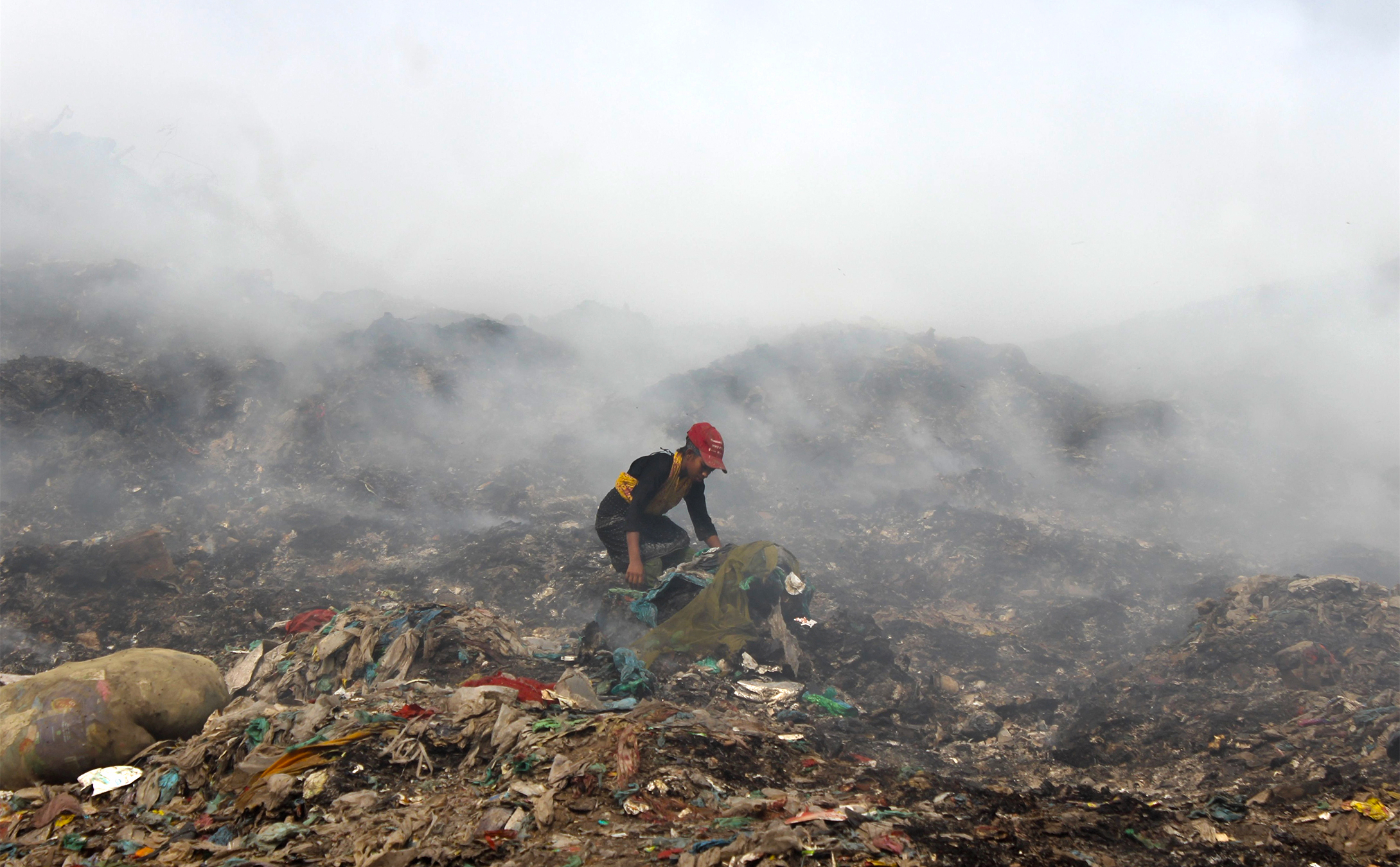
Bangladesh is building a 42.5-megawatt power plant that will burn waste from the main Dhaka landfill as fuel.The so-called waste-to-energy plant will burn up to 3,000 metric tons of municipal waste daily, doubling as a solution to the city’s growing waste problem.However, residents living near the landfill say they’re worried about air pollution from the incineration, given that smoke from smaller-scale burning by waste collectors is already a problem.Despite their objections, the project is proceeding, with the government even loosening incineration rules to allow it to go ahead. At years old, Yeasmin Begum has lived near the Amin Bazar landfill on the outskirts of Dhaka her whole life. She says the stench often triggers allergies, including colds and coughing. “Sometimes it is quite difficult for us to breathe when waste collectors burn the waste under the open sky. Smoke and ashes envelop our home and surroundings,” she says. That’s a problem that could get worse under a plan by municipal authorities to burn trash on a much larger scale. A so-called waste-to-energy project would incinerate up to 3,0000 metric tons of trash daily to heat a boiler, which would then produce steam to drive a turbine, thereby generating electricity. This would be the first-ever waste-to-energy project in Bangladesh, part of an effort to tackle the increasing volume of municipal waste. But the 42.5-megawatt North Dhaka project has raised concerns among nearby communities that have long suffered from exposure to polluted air, water, and soil. Dhaka North City Corporation is the municipal authority overseeing the project, which is owned by the China Machinery Engineering Corporation. Some of the total $467 million in total funding has been pledged by multilateral lenders including the Asian Infrastructure Investment Bank and the New Development Bank, both headquartered in China. The project is due to be completed by December 2028, four years later than initially planned. For nearby residents like Yeasmin, the prospect of thousands of tons of municipal waste every being burned every day, potentially releasing toxic substances like heavy metals and dioxins, isn’t something to look forward to. “It will be more troublesome for us to live here if the waste is burned daily for power generation,” she said. Mountains of solid waste rise at the Dhaka North City Corporation’s Aminbazar landfill in Savar, the primary disposal site. A waste-to-energy plant next to Aminbazar landfill stands largely idle. Development work remained halted for years pending final environmental clearance from the Department of Environment. Image by Md Jahidul Islam. Development work on the long-delayed waste-to-energy project at the Aminbazar landfill. Empty ground and limited activity mark the project area, where Chinese firm CMEC is set to process around 3,000 tons of waste daily. Image by Md Jahidul Islam. From ashes to gases According to the environmental impact assessment for the project, once the power plant is up and running, it will produce 74.8 metric tons daily of fly ash, the kind that’s fine enough to get airborne. Together with particulate matter and bottom ash, the kind that sinks to the bottom of the furnace, that works out to 73,576 metric tons of solid waste from the plant annually, according to an analysis by environmental groups. The groups also say the plant will release 39.56 metric tons of toxic substances, including heavy metals, dioxins and furans, and 1.17 tons of harmful gases, including nitrogen oxides, sulfur oxides, carbon monoxide, and hydrogen chloride. According to a Global Alliance for Incinerator Alternatives (GAIA) report released in 2019, studies provide sufficient evidence of direct health impacts from the operation of incinerators, which range from neoplasia to congenital anomalies, infant deaths, and miscarriage. A risky project in a densely populated area The North Dhaka waste-to-energy project is being implemented in an area surrounded by densely packed communities. To the northwest lie the communities of Boliarpur and Konda, home to hundreds of families. There are also several schools within less than a mile of the project site. Even before the plant has been built, local farmers say they’re already suffering from the smoke produced by small-scale burning at the landfill, when waste collectors incinerate stockpiles of trash. “We can’t breathe when waste is burned in the dumping station,” said Md Naim, 35, who grows rice and vegetables nearby. “Our nose closes with ashes, and we feel a headache from the smoke while working on the field.” Hasan Mehedi, secretary of the Bangladesh Working Group on Ecology and Development (BWGED), said emissions from waste burning are linked to cancer and cardiovascular and respiratory diseases. “If the power plant is built and run regularly, local residents, especially children and elderly people, will face more respiratory and lung-related problems, eye irritation, fatigue, and long-term health issues due to chronic exposure to air pollution,” he said. A mountain of waste rises at the Aminbazar landfill in Savar, the primary disposal site for Dhaka North City Corporation. Trucks from various parts of Dhaka North converge here, waste has been dumped at this location for decades. Image by Md Jahidul Islam. The Delhi example Proponents of the North Dhaka project argue that incineration plants are common around the world as a solution for addressing growing volumes of urban waste, reducing the use of farmland or wetlands for landfilling, and generating electricity at a local scale. But the experience from neighboring India shows that such projects can worsen, rather than reduce, urban air pollution. In Delhi, German state media DW reported that burning mixed waste releases dangerous heavy metals like cadmium, lead, arsenic, and manganese into the surrounding air. Improper handling and open transport of toxic fly ash has also led to localized soil and neighborhood contamination, it reported. According to Indian media reports, residents living near Delhi’s waste-to-energy plants also complain of air pollution and the impacts on their health. Authorities say project will proceed In Dhaka, many residents of the Boliarpur and Konda communities have called for the immediate cancellation of the North Dhaka project. The BWGED, a coalition of organizations and activists advocating for community protection from the impacts of development projects, has echoed this call. However, government officials appear resolute on pushing ahead with the project. During a site visit on July 1, Mir Shahe Alam, the state minister for local government, rural development and co-operatives, said, “The municipal waste has now become a chokepoint of Dhaka city. At any cost, we need to ensure waste management, whether it is through waste-to-energy, bio-compost fertilizer or chemical production; we need to use this huge pile of waste.” In a bid to expedite the project, the government has also revised Bangladesh’s Air Pollution Control Rules 2022, which previously require waste to be incinerated at 1,000° Celsius (1,832° Fahrenheit). Under the amended rules, the Department of Environment has lowered this minimum incineration temperature to 850°C (1,562°F), which would lower the plant’s operating costs but potentially yield more particulate matter. Environmental activists have criticized the move, saying a lower burning temperature would generate more fly ash, which would badly affect the environment and public health. However, Shaikh Faridul Islam, the state minister for environment, forest and climate change, told Mongabay the lower temperature is appropriate for household waste, while the higher temperature would be applicable if medical and electronic waste were also being burned. “Our local experts wanted to burn the waste at 1,000-1,100° Celsius due to the mixture of e-waste [discarded electrical or electronic devices] and medical waste,” he said. “But once we found out that our daily kitchen waste is enough to run the plant, we lowered the requirement for the boiler temperature. “If e-waste and medical waste are not burned, there will be no harm,” he added. Banner image: A waste picker works amid thick smoke rising from the vast garbage mounds at Dhaka North City Corporation’s Aminbazar landfill in Savar. She was looking for plastic or other valuable recyclable items. Image by Md Jahidul Islam. Bangladesh struggles to enforce ‘polluter pays’ principle amid legal delays Bangladesh shipbreakers push back against stricter environmental standards Feedback: Use this form to send a message to the author of this post. If you want to post a public comment, you can do that at the bottom of the page. Credits Topics
Dhaka’s waste-to-energy project faces opposition from pollution-weary residents
Full Article
Original Source
Read the full article at News →KhanList aggregates and links to publicly available news content. We do not host full articles from third-party sources. Always verify important information with original sources.