
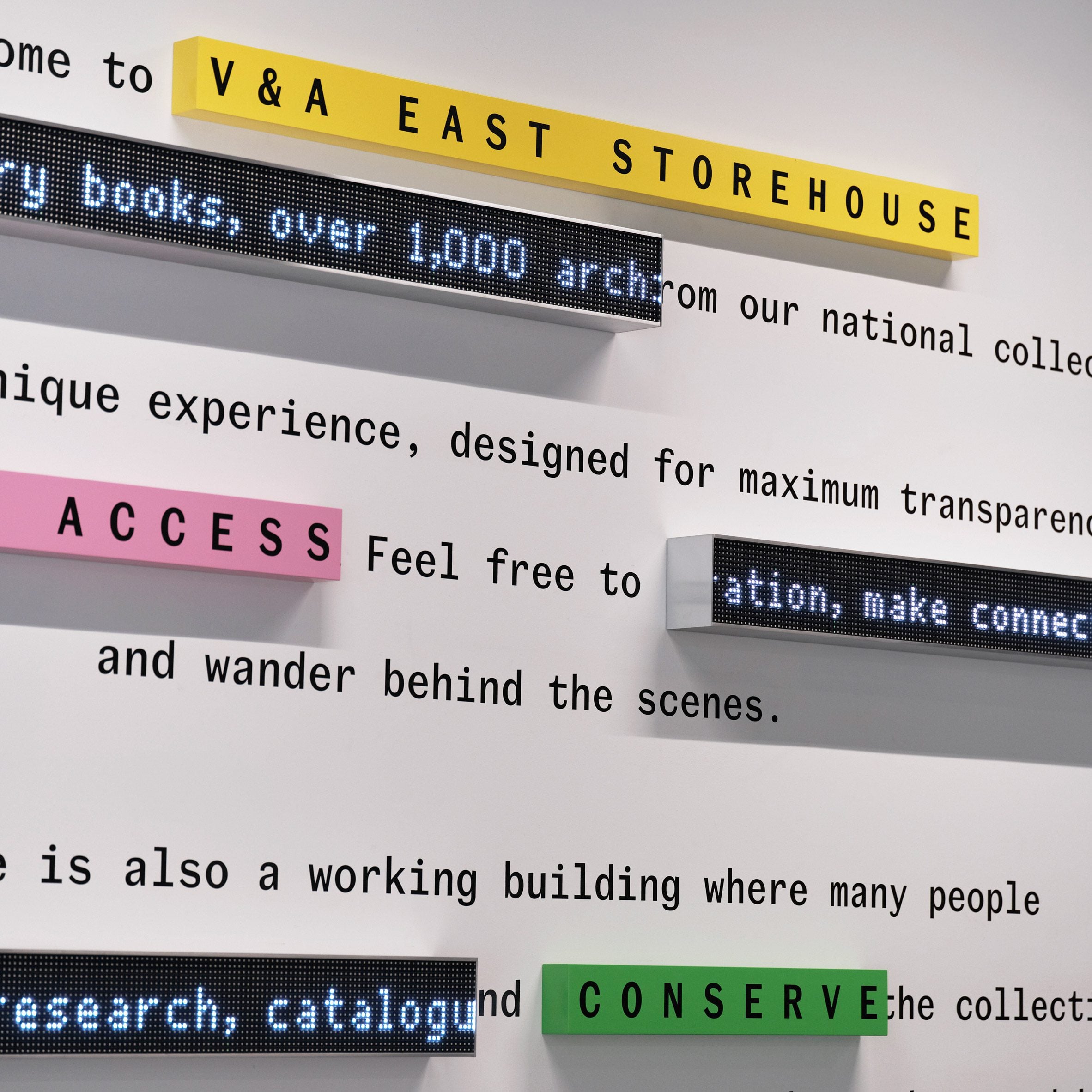
The wayfinding scheme for London‘s V&A East Storehouse has won Dezeen Awards 2026 design project of the year following the announcement of all 16 design category winners at a party in London. The 16 winners awarded in Dezeen’s annual awards programme include designs by Laurids Gallée and John Tree, as well as Foster + Partners and Kettal. Fieldwork Facility’s graphic identity for the V&A East Storehouse experience won the design project of the year award and was also named graphic design of the year. Design project of the year unveiled V&A East Storehouse by Fieldwork Facility The master jury cited the project as a “sophisticated wayfinding scheme that demonstrates how signage can do far more than direct: it can define identity, shape experience and establish a sense of place”. The judges praised the design for its “clarity, confidence and restraint, seamlessly guiding visitors through the V&A East Storehouse while adding to the character of the building”. V&A East Storehouse was up against designs that included a constellation of gloopy-looking polished resin lights, an electric cargo bike with the carrying capacity of a small van and a low-carbon, concrete-like floor tile strengthened by bacteria. Read more about all the winning design projects below: Photos by Thomas Adank Design project of the year and graphic design of the year: V&A East Storehouse by Fieldwork Facility Design studio Fieldwork Facility was challenged with navigating visitors to the V&A’s storage vault, including 250,000 historic art, craft and design objects – especially a younger, more diverse crowd who might normally feel excluded from museums. The Hackney design studio looked to an unexpected source of inspiration when creating wayfinding for London’s V&A East Storehouse: Gen-Z apps and services. “This fun and informative signage and wayfinding perfectly embraces the changing nature of the V&A East Storehouse,” said the master jury. “As the displays change, the signage, captions and general wayfinding can be updated efficiently, embracing the adaptability and lack of formality of the museum.” Photos by Allen Kaufmann Studio Furniture design of the year: Dado Series by Allen Kaufmann Objects Berlin studio Allen Kaufmann Architekten won furniture design of the year for its Dado series of tables and shelves. The practice adapted a traditional woodworking joint to create a flat-pack range that can be assembled completely without tools nor glue, screws, brackets or other fasteners. “What is simple in appearance is underscored with a well-resolved and detailed construction made from a monomaterial,” the judges said. “The shelving is satisfying to assemble and demonstrates everything furniture needs to be, and no more.” The project also won its category for the 2026 public vote. Photos by Pablo Castillo Design Seating design of the year: Kino by Pablo Castillo Design Barcelona-based designer Pablo Castillo won seating design of the year for Kino, a cantilevered 3D-printed chair for Decibel. The designer’s aim was to create a recognisable chair silhouette, while also responding to the specificities of the 3D printing process. Its entire form is printed from PLA, the most common bioplastic, although the material is reinforced with cellulose plant fibres. This increases its strength, enabling the cantilevered seat. “The 3D printing of furniture is becoming more refined and this is a strong example of that,” said the master jury. “The mono-material construction is sophisticated and has a strong aesthetic profile,” they continued. “Modern shapes meet zero-waste manufacturing; surely the future.” Photos by Mathijs Labadie Collectible design of the year: Lima Charlie by Studio Laurids Gallée Austrian designer Laurids Gallée won collectible design of the year for Lima Charlie, a series of five colourful, sculptural lamps. The lighting collection comprises five hand-cast resin light works and machined aluminium pieces. First, the designer used digital processes to determine each composition. Then, casting solid blocks of the material before colouring, cutting and sculpting them into shape. Each piece was meticulously sanded and polished to arrive at the desired smooth surface. “Mesmerising, intriguing and evocative, these lights are truly original and demonstrate a high level of care in their meticulous craftsmanship,” praised the judges. “Beautiful treasures to enhance any space.” Photos by Studio Maarten Baas Bespoke design of the year: Real Time Schiphol People’s Clock by Maarten Baas Dutch designer Maarten Baas won bespoke design of the year for The People’s Clock, a choreographed representation of the passage of time at Amsterdam’s Schiphol Airport. Baas recruited 1,000 participants – the majority being airport employees – to form the hands of The People’s Clock and move in sync, forming the hour and minute hands. The second hand comprises a single person running a lap of the circular perimeter each minute. “This timepiece in Amsterdam’s busy airport momentarily takes users away from the efficient functionality of the space by providing a reference to the time in a more playful and poetic way,” said the master jury. “It was an ambitious undertaking to make the piece, which celebrates and gives ownership to the airport workers.” Photos by Jussi Puikkonen Lighting design of the year: Hoop Table Lamp by John Tree for Vaarnii Designer John Tree won lighting design of the year for the Hoop Table Lamp for Finnish brand Vaarni. The monolithic light combines a block of solid pine wood – synonymous with the Finnish brand’s designs – with a hooped shade of thin pine veneer, sourced from a sustainably managed forest. “We were all drawn to the simple and characterful gestures of this table lamp, which embraces warmth from a common timber,” the judges said. “There is a confidence in the minimal use of materials and a cuteness in the ensuing form.” Photos by HGEsch Photography Architectural lighting design of the year: Cologne Cathedral by Licht Kunst Licht Lighting design studio Licht Kunst Licht won architectural lighting design of the year for its illumination of Cologne Cathedral’s historic facade. The lighting scheme used more than 700 surface-mounted LED luminaires to transform nighttime views of the world’s tallest cathedral without drilling a single hole in its delicate stonework. “This well-considered lighting scheme successfully highlights Cologne’s monumental cathedral as a jewel on the night skyline,” the judges praised. “The light sources are subtly integrated and have managed to reduce energy consumption while creating maximum impact for this city landmark,” they added. The project also won its category for the 2026 public vote. Photos by Marcel van der Burg Surface design of the year: Basic Third by Pretty Plastic Dutch manufacturer Pretty Plastic won surface design of the year for its Basic Third tiles. The cladding material was developed by the Pretty Plastic company, started by architecture studios Overtreders W and Bureau SLA. The tiles, which were made from 30,987 kilograms of post-consumer plastic waste, have been applied as cladding for Plus Ultra III, the first timber laboratory building in the Netherlands. “Pretty Plastics has chosen to work with the worst kind of plastic – PVC – and found a way to repurpose the material into tiles,” said the judges. “The material is already fire-compliant and UV stable, making it a worthy contender for the cladding of buildings,” they continued. “There is an inherent beauty and honesty to the product, adding texture and depth to the architecture.” Looking ahead, the judges said “its impact will be proven by how easy it is to scale.” Photos by Bianca Streich Textile design of the year: Bianni Wool Paper by Arudeko Mexican design studio won textile design of the year for Bianni, a paper-like material made from colourful waste wool. Sourced from the off-cuts of handmade carpets and cushions crafted by local weaving communities in Teotitlán del Valle, Mexico, Arudeko saw the potential to use the surplus material and save it from being discarded. Bianni can be sculpted into everything from lampshades to room dividers. “With so much wool waste in the world, this new material adds value to the waste,” the judges commended. “Furthermore, the processing provides employment to skilled locals, the outcome being an interesting and beautiful paper alternative to be applied to other products,” they said. “There is much potential for further exploration across the world.” Photos by Salva López Workplace design of the year: Area by Foster + Partners and Kettal Foster + Partners and Kettal won workplace design of the year for their modular Area table system. Designed to be durable and adaptable, Area combines aluminium columns, a panoply of tabletop options and concealed power. The aluminium columns anchor the design, serving as both structural support and discreet container for power cables and electrical components. “There is an appealing monumentalism to this office desk and a tactility in the simplicity and richness of the material composition,” said the judges. “There are sophisticated elements and thoughtful hidden details for integrating technology into an otherwise minimalist design,” they continued. Photos by Sean Heaney & Gulraiz Hassan Product design (consumer design) of the year: Pedal 4 by Minimal British start-up Minimal won product design (consumer design) of the year for Pedal 4, an electric cargo bike with the carrying capacity of a small van. The four-wheeled, pedal-assist cargo vehicle was built to take up less room on the roads and evade traffic even on London’s crowded and complex streets. It is now operating in London with delivery companies Royal Mail and Evri. “A smart new vehicle typology that addresses the challenges of inner city deliveries,” praised the judges. “This is a great ‘last mile’ replacement for large polluting vans. The slender design manoeuvres easily in city streets while the electric motor emits no noxious pollutants,” they continued. “The vehicles’ local assembly also allows it to be easily repaired.” Photos by Studio Aslak Siimes Product design (health, wellbeing and wearables) of the year: CurifyLabs PharmaPrinter Aurum by Studio Aslak Siimes Industrial design firm Studio Aslak Siimes and Finnish startup CurifyLabs won product design (health, wellbeing and wearables) of the year for pharmaceutical compounding system, PharmaPrinter Aurum. The system is designed to improve the process of creating patient-specific medicine, born from the realisation that almost 30 per cent of all medication requires personalisation rather than being mass-manufactured, according to studio founder Aslak Siimes. “This device offers a real innovation in precision healthcare and decentralises the production of pills,” the judges said. “Precise medical doses are prepared bespoke for each customer, reducing waste and eliminating human error.” “Furthermore, it’s refreshing to see something so functional having also been aesthetically considered,” they added. Photos by Kohler Health Product design (bathroom) of the year: Dekoda by Kohler Health Kohler Health won product design (bathroom) of the year for Dekoda, a health tracker specifically for the toilet. Designed to be discreet and intuitive, the tracker clips to the side of the toilet bowl to give insights on gut health and hydration levels, and to detect the presence of blood. “This is an innovative, early-diagnostic device for ongoing monitoring of health conditions,” the judges said. “The design of the device is discreet and visually passive, making it suitable for its function in the bathroom.” Photos by Boris Acket Installation design of the year: Einder for USB002 Tour by Boris Acket and Fred Again Visual artist Boris Acket won installation design of the year for Einder, which featured as the standout show design for DJ Fred again..’s USB002 Tour. The installation features a large suspended sheet of fabric which floats above the audience like a transparent, breathing roof. Throughout the concert, the sculpture wafts and moves across the audience, creating smaller and larger spaces, static spatial gestures, storms, and water surfaces. The judges summed up the project as “stunning, emotive, immersive, dynamic, simple”. “This lightweight and flexible installation uses minimum material to maximum effect, making it evocative while sustainable. More please!” Photos by Datecrete Studio & Lab FZC Sustainable design of the year: Datecrete by Datecrete Studio Architect Sara Abu Farha and engineer Khaled Shalka won sustainable design of the year for Datecrete, a concrete-style material developed by Abu Farha and Shalka formed from crushed dates. The project aims to demonstrate how the abundant regional byproduct can become part of an architectural material language. Patent-pending, Datecrete can be produced as floor and wall tiles, cladding, furniture, lighting elements and smaller design objects. “This is a necessary regional innovation, repurposing an abundant waste material (date pits) into a local construction material, and providing a welcome alternative to concrete,” said the master jury. “The processing of the pits is decentralised, so it has the potential to scale in communities across the date-growing region.” Photos by Front Material innovation of the year: Mimmik Tile by Front Dutch sustainability platform Front and biotechnology company Biomason won material innovation of the year for Mimmik, a low-carbon, concrete-like floor tile strengthened by bacteria. Front believes Mimmik is the first bacteria-grown tile to be industrially produced, making a sustainable technology available to a wide market of specifiers looking to reduce the carbon footprint of their commercial projects. “This tile design is genuinely pushing innovation forward in its creation; collaborating with bacteria as a sustainable alternative to concrete,” praised the judges. “As such, the embodied carbon is greatly reduced,” they noted. “The production is scalable and could shift the dial in the future production of tiles and paving.” Dezeen Awards 2026 in partnership with TrimbleDezeen Awards is the ultimate accolade for architects and designers worldwide. The ninth edition of the annual awards is in partnership with global technology company Trimble. Through connected hardware and software solutions, Trimble helps designers to transform the way they shape spaces and buildings as well as drive productivity in the process. Trimble’s collaboration with Dezeen Awards demonstrates its ongoing commitment to inspiring and supporting creative excellence across the globe. Read more
Dezeen Awards 2026 design project of the year winner named
Full Article
Original Source
Read the full article at Dezeen →KhanList aggregates and links to publicly available news content. We do not host full articles from third-party sources. Always verify important information with original sources.