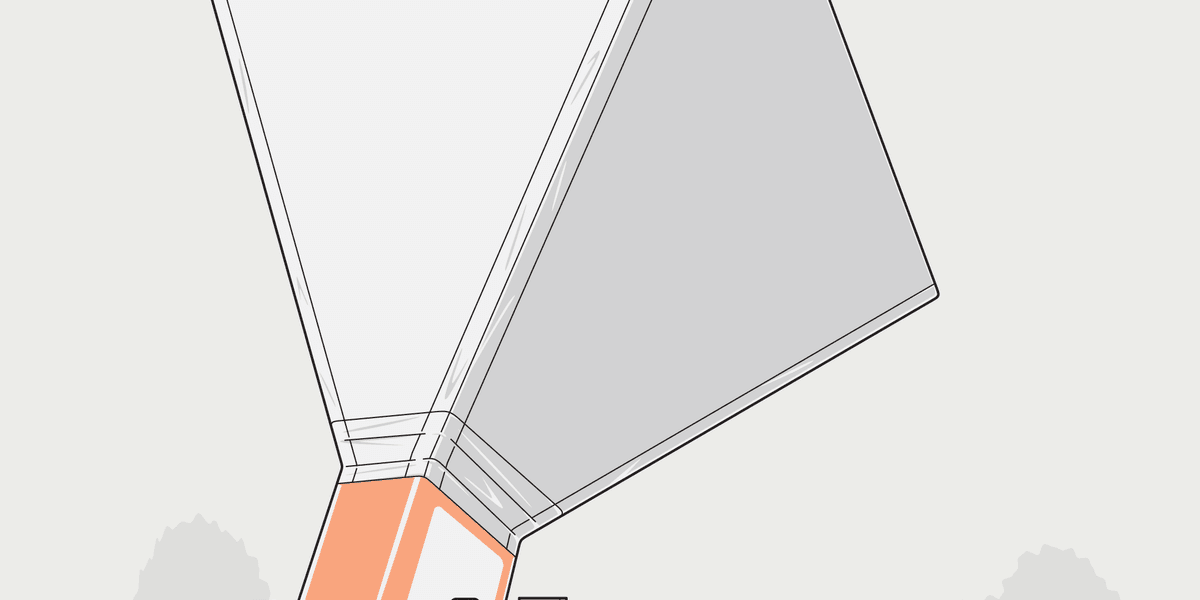
If you’re wondering what dark matter is, you’re not alone. Astronomers don’t know. But they’ve determined that this invisible material must be far more abundant than the stars and nebulas that they can see. They’ve surmised as much from observing the gravitational effects of all this perplexing dark stuff, launching a decades-long campaign to understand its nature.I recently learned that it is possible to sense the presence of dark matter using a small radio telescope such as the Discovery Dish covered in these pages last year. The trick is to know what observations to collect and how to analyze them. I’ll sketch that out below, but first let me describe the homemade radio telescope I put together for this project.It’s a pyramidal-horn antenna, not unlike the horn antenna first used in 1951 to detect the 1,420.4-megahertz radio emissions from interstellar clouds of neutral hydrogen in space. These emissions hold the key to confirming the presence of dark matter because such clouds can be found all over the galaxy, and their motions reflect what’s happening in different parts of the Milky Way.I used an online calculator to help me design my antenna, adopting dimensions I knew I could achieve using a US $25 10-by-2-foot roll of roof flashing and an emptied one-gallon paint-thinner can. (Next time, I’ll just buy an empty F-style can.) The horn antenna is made from tape, an empty paint can, and a roll of metal roof flashing [bottom row]. Signals are picked up with a low-noise amplifier [top middle], and passed to a software-defined radio receiver [top left].James ProvostConstruction of the antenna itself was similar to that of the slightly smaller horn antenna I described in these pages in 2019. I made my new antenna bigger, though, because I needed better angular resolution, allowing me to scan smaller regions of the sky.To pick up the emissions from interstellar hydrogen, I used Nooelec’s $45 SAWBird+ H1, a device that combines two low-noise amplifiers with a standing-acoustic-wave filter centered on 1,420 MHz, in combination with a RTL-SDR V4 dongle. So it’s not too hard to put together the hardware needed to measure signals from hydrogen clouds. But how do you pull the signature of dark matter out of those signals?The answer is that you use such measurements to gauge the speed at which clouds located at different distances from the center of the Milky Way are moving in their orbits.You just have to show that the speed at which material orbits the center of the galaxy doesn’t fall off with distance.You might think that these clouds circle around the galactic center in the same way that planets orbit the sun or satellites orbit the Earth, with objects close in orbiting faster than those farther out. Mercury, for example, zips around the sun at 47.4 kilometers per second, whereas Neptune lumbers along at a leisurely 5.4 km/s.The Milky Way contains a central bulge of stars surrounding a supermassive black hole. So at first blush, the mass of the galaxy appears to be concentrated near its center. If that were the case, stars and clouds of other material would orbit more slowly as their distance from the center increases. If, however, there were enormous amounts of invisible matter present throughout the galaxy, you wouldn’t expect orbital velocities to diminish in this way.How Do You Measure the Speed of Interstellar Clouds?So to detect dark matter, you just have to show that the speed at which material orbits the center of the galaxy doesn’t fall off with distance. And radio observations are the easiest way to do that, because you can gauge speeds by measuring how much the signal from hydrogen clouds is shifted by the Doppler effect.By pointing your radio telescope at different parts of the sky, you pick up emissions from clouds located at various distances from the galactic center. The frequency offset of these emissions from 1,420 MHz reflects the speed of approach or recession of those clouds relative to Earth.You need measurements from the plane of the galaxy, at galactic longitudes between 0 and 90 degrees (a galactic longitude of 0 degrees points directly toward the center of the galaxy and 180 degrees directly away from it). Applying some high school trigonometry lets you convert these figures into orbital speeds around the galactic center, a technique known as the tangent-point method. In any group of clouds, the one with the highest velocity as seen from Earth will be the one lying closest to a tangent point along its orbit around the galaxy. This allows its distance from the galactic center to be determined through trigonometry [top]. The bottom graph shows the astronomical community’s measurements for velocities around the galactic center [in black], with the author’s results plotted in filled and open red circles.James ProvostExperiments aiming my horn antenna at an Inmarsat geostationary satellite revealed that the angular resolution of my little radio telescope is about 20 degrees. So with the help of the planetarium program Stellarium, I pointed my antenna in the plane of the galaxy at galactic longitudes of about 15, 30, 45, 60, 75, and 90 degrees, spacing things out in an effort to make each set of measurements largely independent.I used the SDR# software with a plug-in called IF Average to read the raw measurements coming in from the antenna. This plug-in stacks up data received over a few minutes, allowing a weak signal to emerge and produce a clean radio spectrum that shows the 1,420-MHz line. In reality of course, it looks more like a bump, or even a set of bumps due to Doppler shifted emissions from multiple clouds, located at different distances from the galactic center. Fortunately, you only have to care about the cloud that’s receding the fastest—the one with the largest redshift, in astronomer-speak.I used Microsoft Excel to analyze the shapes of radio spectra I gathered, modeling them as the sums of individual bell-shaped contributions from different clouds. That allowed me to estimate the largest redshift for each galactic longitude I probed. Then, again using Excel, I applied formulas that transformed those six redshift values into six pairs of orbital velocities and distances from the galactic center.The plot of my results matched reasonably well with a recent paper, “The Inner Rotation Curve of the Milky WayInner Rotation Curve of the Milky Way,” in Publications of the Astronomical Society of Japan. Two innermost points, which showed anomalously low orbital velocities. Another shot at curve fitting in Excel brought these results closer to expectations, but they were still somewhat off.In any case, the orbital velocities I estimated did not diminish with distance from the galactic center—quite the opposite. Something out there is putting its stamp on how the Milky Way turns. And that basic observation is what allows me to say that, with the help of some roof flashing and a paint-thinner can, I’ve been able to detect dark matter from my backyard.
Detect Dark Matter’s Mark From Your Backyard
Full Article
Original Source
Read the full article at Spectrum →KhanList aggregates and links to publicly available news content. We do not host full articles from third-party sources. Always verify important information with original sources.