
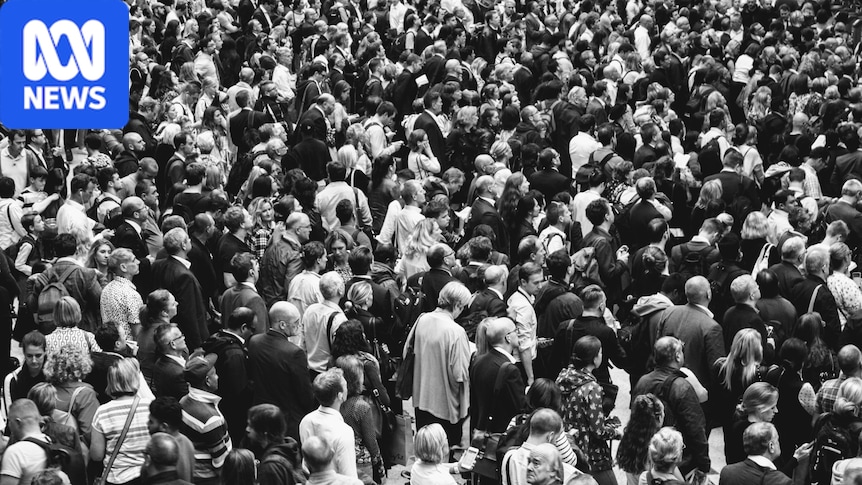
According to a prediction three scientists made in 1960, the world was due to end today.This "doomsday" was supposed to come not with a bang or a whimper, but from too many people.The scientists had calculated that on Friday, November 13, 2026, the world's population would grow so quickly as to be near infinite."Our great-great-grandchildren will not starve to death," they wrote in a paper published in the journal Science at the time."They will be squeezed to death."Luckily, this prophecy has not come to pass.Instead, in many countries, population decline is seen as a more serious concern than population growth.So why was this doomsday warning wrong, and why is it still so difficult to predict population change?How to calculate the end of the worldThe paper's authors created a mathematical formula based on fertility rates and death rates, and applied it to population estimates in the previous 2,000 years.Their formula was on a "hyperbolic curve": It showed a world population growing at increasingly fast rates. Less and less time was needed for the population to double or triple in size. Eventually, the formula predicted, the world's population would just shoot upwards, towards infinity, at a single moment in time.Javier Birchenall, an economist at the University of California Santa Barbara, said there was an element of humour to the study. The calculated end of the world happened to be the birthday of the paper's lead author, Heinz von Foerster, a researcher at the University of Illinois Urbana-Champaign's department of electrical engineering."I don't think they were completely serious. They were trying to make a point that this is exceptional," Dr Birchenall said.Dr Birchenall highlighted the mistaken prediction in a paper in the same journal last month.He initially did not want his paper to be published until November 13."My concern was, 'What if the world ends and these guys end up being right?'"Despite being heavily criticised by social scientists at the time, the predictions were correct to a point."The numbers they produced made sense up until the 1980s," Dr Birchenall said.But, in the past four decades, the world's population has grown much more gently than the formula predicted.In fact, the rate of world population growth reached its zenith just a few years after the doomsday prophecy, peaking at about 2.3 per cent in 1963.The problem with predicting populationDr Birchenall said the failed prediction demonstrates the risks of trying to treat a social pattern — population change — like a universal law."There's a difference between the way social systems respond and physical systems respond," he said.Peter McDonald, a demographer at the University of Melbourne, agreed."It is not possible to predict fertility with any degree of accuracy beyond about 10 years into the future," Professor McDonald said.In 1960, the world had about 3 billion people. (Supplied: City of Coffs Harbour)Past trends can be a good indicator of fertility rates in the short term but, in the longer term, they are going to respond to social forces that do not exist yet."The post-war baby boom which occurred in almost all advanced countries was not predicted by any of the leading demographers at the time," Professor McDonald said.Population growth and resource riskThe doomsday prediction came amid fears about overpopulation in the 20th century.Some countries responded to the threat with intense measures, such as China's One Child Policy.Professor McDonald said overpopulation remained a big concern in some poorer countries with high fertility rates, such as the Democratic Republic of the Congo. The African country's population is projected to double in the next 30 years, according to the United Nations, which could outpace its food resources."A failure of the harvest would have a devastating impact," Professor McDonald said.The UN's current forecast sees the world population reaching its peak at just over 10 billion in about 60 years, before slowly declining.While population growth is not accelerating on a global scale, resource use still is. A 2024 UN report cautioned that the world's resource extraction was rising dramatically, driven largely by wealthier countries.Reverse catastrophe unlikelyIn many places, Dr Birchenall said fears had "flipped", with fertility rates falling below the rate of replacement.This has also driven warnings of cataclysm, and sparked the pronatalist movement, whose advocates claim falling birth rates are an existential threat.Billionaire Elon Musk has said Australians were "disappearing", quoting a post on X that calls Australia's fertility rate a "catastrophe"."Catastrophe is certainly the wrong word to use in Australia," Professor McDonald said, adding that Australia's fertility rate was "misleading" because of the number of temporary residents and immigration rates.But he said there were some countries, particularly in East Asia, where low fertility rates and low migration were causing problems with aging populations."Massive increases in productivity would be required to offset this aging, but in the long term the population disappears," Professor McDonald said.Australia's immigration rate means it faces a lower risk from an aging population than some other countries. (Unsplash: Jay Wennington)Dr Birchenall said that, while shrinking populations were an "important concern", they were equally unlikely to cause a global doomsday."But it's funny that it's the opposite of what people had in mind back in the 60s," he said."We all think that the world is ending in my generation."
Despite a 1960 doomsday prediction, the world won't end today
Full Article
Original Source
Read the full article at Abc →KhanList aggregates and links to publicly available news content. We do not host full articles from third-party sources. Always verify important information with original sources.