
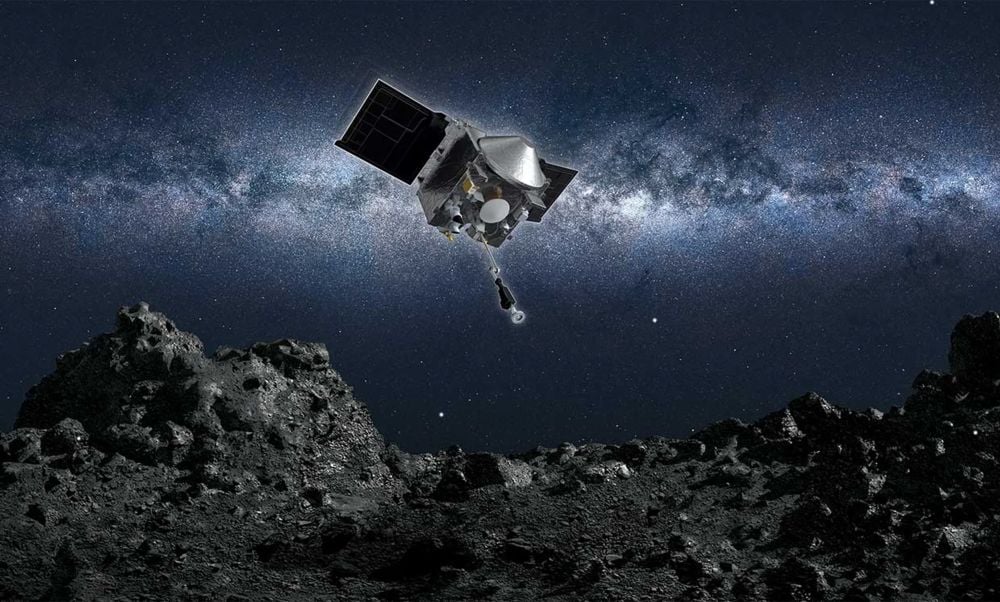
One of the most interesting discoveries in recent years is that some of the molecules necessary for life are found on asteroids and comets. Sample return missions from asteroids have shown that these rocky bodies are far more than just rock. They host some of the fundamental building blocks—amino acids—that are used to construct proteins. These discoveries are a collective a-ha! moment. It's becoming clear that some of the precursors for life could be widespread in the Solar System. And if they're widespread in ours, they could be widespread in others. The idea that life could appear elsewhere in the galaxy got a boost. NASA's OSIRIS-REx was a big part of this when it returned a sample from asteroid Bennu in 2023. Examination of those samples revealed the presence of 14 of the 20 amino acids that make up proteins in Earth life, along with four of the essential building blocks for DNA and RNA. Now, researchers have compared one of those molecules with the same molecule from another source, the Murchison meteorite, to see how they differ. The research is published in Nature Communications Earth and Environment, and is titled "Nitrogen and intramolecular carbon isotopic measurements of β-alanine in samples from asteroid Bennu and the Murchison meteorite." The lead author is Ophélie Mcintosh, a former postdoctoral researcher in Penn State’s Department of Geosciences. “I was genuinely gobsmacked by the enormous isotope difference between two neighboring atom positions within the same molecule. - Katherine Freeman, Professor of Geosciences at Penn State. "Amino acids are central to prebiotic chemistry, and their abundances and isotopic compositions provide critical constraints on the synthetic mechanisms and environments in which they formed," the authors write. "Samples delivered to Earth from the carbonaceous asteroid (101955) Bennu by NASA’s OSIRIS-REx mission offer an opportunity to investigate amino acids preserved in pristine material unaffected by terrestrial contamination." β-alanine (beta-alanine) isn't used by Earth organisms to build proteins, but it does play other roles in terrestrial life. Finding it in extraterrestrial rocks is interesting because that can provide some insight into pre-biotic chemistry and what conditions were like in the very early Solar System. This research is focused on the different compositions of β-alanine found in Bennu and the Murchison meteorite. Since the Bennu sample was collected and preserved in a sterile capsule before being opened in laboratory conditions, it's especially valuable scientifically. This sample of the Murchison meteorite sits in the National Museum of Natural History, Washington, D.C. Image Credit: By User:Basilicofresco - Derivative work from Image:Murchison meteorite.jpg, CC BY-SA 3.0, https://commons.wikimedia.org/w/index.php?curid=4301968 “Amino acids are the building blocks of proteins and peptides, but they are also found in carbon-rich meteorites and asteroid samples, so they can provide a direct link between space chemistry and the origins of life on Earth,” lead author Mcintosh said in a press release. “Most studies focus on the distribution and quantification of amino acids, so our question about how they’re formed is quite new. We used very unique isotope instruments, including one that exists only at Penn State, to help answer those questions.” A mission to collect an asteroid sample and return it to Earth is an extremely complicated endeavour. Scientists were hopeful that in the time that passed between planning and launching the mission and getting their hands on the sample, new laboratory techniques would be developed to investigate the sample as deeply and thoroughly as possible. That's what has happened in this case. The researchers were able to measure and compare the different isotopic compositions of β-alanine in the Bennu sample and in the Murchison meteorite sample. They not only compared bulk compositions. In this work, they were actually able to measure and compare isotopic carbon differences in carbon atoms in the same molecule. This level of detail is new. A device unique to Penn State allowed the measurement of isotopic averages in extremely small samples. It's called pico-CSIA, for Picomolar-scale compound-specific isotope analyses. A second device, a modified GC-Orbitrap (Gas Chromatography-Orbitrap Mass Spectrometer) measured specific compositions at specific locations in β-alanine molecules. “Isotope ratios provide a measurable tag that can link molecules to specific reservoirs or processes,” said paper co-author Christopher House, professor of geosciences at Penn State. “For our study, isotopes provided clues to an older history for specific atoms in a molecule.” Looking at isotopic composition is a way to look further back in time for the β-alanine's formation history. Typically, researchers are looking at processes inside the asteroid body itself for clues to how it formed. But examining isotopic composition from molecule to molecule is more fundamental, and carbon plays a critical role. It acts as scaffolding for organic molecules—Earth life is carbon-based after all—and records isotopic differences between molecules and within molecules. "Intramolecular isotopic measurements, which capture the position-specific carbon isotopic distribution within a molecule, offer a particularly powerful approach as they can reveal reaction mechanisms, constrain precursor reservoirs, and reflect environmental conditions. “This intramolecular information provides a much more detailed isotopic fingerprint,” lead author Mcintosh said. “Instead of simply asking whether a molecule is enriched or depleted in a particular isotope, we can investigate how that isotope is distributed within the molecule and use this pattern to distinguish between possible formation pathways.” This work takes isotopic composition to a whole other level. Especially when used on such a carefully handled sample as that from Bennu. “Being able to analyze the isotope values for each carbon and nitrogen within the beta-alanine molecule is a dream for geochemistry,” House said. “And here it is coupled to the ability to study a pristine asteroid sample returned to Earth by NASA.” The isotope values from atom to atom within the same molecule were wildly different, which came as a surprise to the researchers. They may have formed before Earth did. There was a lot of waiting and anticipation leading up to Bennu's successful sample collection maneuver. Once it was complete, there was more anticipation of the sample's arrival on Earth, and what we'd learn from it. That's partly what makes this research so interesting. Credit: NASA Goddard “I was genuinely gobsmacked by the enormous isotope difference between two neighboring atom positions within the same molecule,” said project principal investigator Katherine Freeman, Professor of Geosciences at Penn State. “The preservation of such startling differences is an indicator of the primordial nature of these molecules. We are working with molecules formed at the very dawn of the solar system, possibly even before the formation of Earth.” The intramolecular isotope differences show that, while their formation pathways were the same, they took place in much different environments, or in different batches. It shows that the same chemical can form in different environments in the protoplanetary disk, and that the disk is spatially heterogeneous. “One of the main things we discovered, for both glycine and beta-alanine, is that they might have formed in different environments or places in the solar system,” Mcintosh said. “This broadens our understanding of the type of environments where you can form those very important molecules for prebiotic chemistry.” The figure below shows elevated 13C in the Bennu sample, and it's particularly important. "The substantially greater 13C enrichment of the carboxyl carbon in Bennu is consistent with the incorporation of carbon from isotopically distinct precursor reservoirs, potentially reflecting differences in the local chemical environments in which β-alanine or its precursors formed," the authors write. This summary figure shows the carbon isotopic compositions across Solar System bodies, including Bennu (blue diamonds) and Murchison (grey squares). The figure presents bulk carbon values in different planetary bodies. Carbon is important because life is carbon-based, and it's like the structural scaffolding for organic molecules. Within a single molecule, carbon records isotopic differences in a way that other atoms like nitrogen and hydrogen don't. Notice the he greater 13C in carboxyl carbon (COOH) in Bennu, which is particularly important. Image Credit: Mcintosh, O.M., Baczynski, A.A., Rasmussen, C. et al. Nitrogen and intramolecular carbon isotopic measurements of β-alanine in samples from asteroid Bennu and the Murchison meteorite. Commun Earth Environ (2026). “When you compare the Bennu and Murchison samples, the carbon isotope average is so close that when you factor in margin of error, they’re basically the same,” Mcintosh said. “But when you look at intramolecular carbon, they’re completely different.” "The samples display similar intramolecular isotope distributions, consistent with a common synthetic route, but differ markedly in their position-specific carbon and nitrogen isotope compositions," the authors explain. That means the source materials were distinct isotopically. So they must have came from different locations and environments in the young Solar System. The authors say that the differences are hard to reconcile with any known processes taking place inside parent bodies. Instead, they reflect different chemical pathways in different parts of the protoplanetary disk. An illustration of a protoplanetary disk. This work shows that the same organic molecules can form in different parts of the disk, though with different isotopic compositions. This suggests that prebiotic chemistry can form in a wider variety of conditions. Image Credit: NASA/JPL-Caltech/T. Pyle (SSC) - February, 2005 “Beta-alanine is a prominent example of the amazingly diverse collection of amino acid-like molecules found in space samples,” Freeman said. “It can help us understand why there are so many different types of these compounds and where and how they were made. Ultimately, this helps us understand ways that space organics potentially shaped the unique chemistry in life.” These results could also be helpful as missions to detect and study potential biosignatures elsewhere in the Solar System are launched. Missions to Jupiter's icy moons could benefit from these results, for example. "Additionally, isotopic analyses of amino acids and other prebiotic molecules in Bennu samples and other pristine astromaterials provide a critical abiotic baseline for the search and identification of chemical biosignatures within our Solar System.
Asteroid Bennu's Sample Delivers Another Surprise
Full Article
Original Source
Read the full article at Universetoday →KhanList aggregates and links to publicly available news content. We do not host full articles from third-party sources. Always verify important information with original sources.