
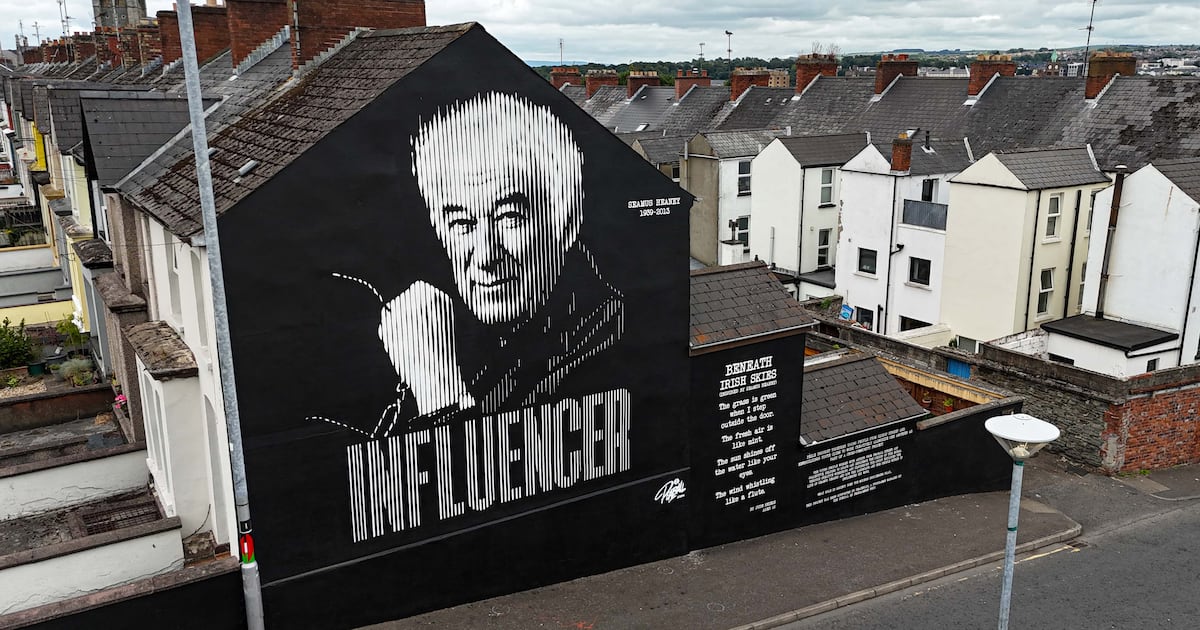
Message of murals transforming Derry is of a new, shared identity that goes beyond green, white and orange or red, white and blueDerry: The new Seamus Heaney mural in Westland Street. Photograph: Féile Media Seamus Heaney knew Derry’s walls. He would have looked out on them, often enough, as a boarder at St Columb’s College, over the rows of terraced houses that climb their way up the hill from the Bogside to Creggan, and as a poet he wrote about them. “The lonely scarp/ Of St Columb’s College, where I billeted/ For six years, overlooked your Bogside./ I gazed into new worlds: the inflamed throat of Brandywell, its floodlit dogtrack … the lights of houses in the Lecky Road/ were amber in the fog,” he recalled in The Ministry of Fear. Or, more sinister, in Casualty, set in the days after Bloody Sunday in January 1972: “‘PARAS THIRTEEN’, the walls said, ‘BOGSIDE NIL’.”Heaney understood the power of a mural on a gable end, and how their slogans spoke to the city and its people, just as the poet tries to sum up something of the human experience with pen and ink and page. READ MOREHe lived through Derry’s history and was inspired by it, just as it inspired the “People’s Gallery” of Bogside murals. He would have remembered when Free Derry Corner was just a slogan daubed on the side of the house, when people marched for civil rights, when British paratroopers shot people dead on those same streets. These days, the Bogside bustles with tourists keen to see the history of the Troubles that its murals depict. These days, Derry has other murals, and other stories to tell. Amelia Earhart gazes up to the sky, her red plane below her, on a building overlooking the riverfront. The Undertones perch on the city’s 17th century walls just as they once perched on the wall of a nearby park for an album cover. D:Ream frontman Peter Cunnah is surrounded by a dazzling display of multicoloured musical instruments on the side of a solicitor’s office. Bloody Sunday mural in Derry's Bogside. Photograph: Brian Lawless/PA They are throughout the city, and beyond, celebrating everything from the cultural heritage of the loyalist Fountain estate to to the women of Derry’s shirt factories. A recent addition, unveiled last month, is Heaney – a portrait of the poet overlooking an intersection on one of his familiar Bogside streets. Even here, the old and the new collide. Beside the mural a plaque remembers Billy McGreanery, “murdered by a British solider at this junction, 15th September 1971”, while opposite a placard cries: “Republican prisoners still exist!”[ Apathy and ignorance south of the Border remain significant blocks to Irish unityOpens in new window ]Here, Heaney has a role to play. He is, the mural proclaims in large, block capital letters, an “influencer”, and alongside is a poem by one of those he has influenced, 12-year-old Jude Shiels. His poem, Beneath Irish Skies, was inspired by Heaney. Written on this wall, besieged by the grey of pavement and tarmac, he evokes images of green grass, “fresh air … like mint”, the sun shining on the water and “the wind whistling like a flute”.The mural is the culmination of a year-long programme by street art collective Peaball in partnership with Derry community arts organisation Féile and funded through the EU’s Peaceplus programme, which brought together young people from different community backgrounds. Jude Shiels (12), whose poem Beneath Irish Skies sits alongside the new Seamus Heaney mural. Photograph: Féile Media “The word ‘influencer’ gave them a chance to look at the people they see online today and compare that with someone whose words have continued to influence people decades after they were written,” says Féile project co-ordinator Ruairi O’Connell. Such is the influence of these new murals. In transforming the city’s landscape, they are also reclaiming those walls. Their message is of a new, shared identity which goes beyond politics and conflict, and painted in colours that are not just green, white and orange or red, white and blue. The Apprentice Boys of Derry march past the city's much-vistite Derry Girls mural. Photograph: Charles McQuillan/Getty A mural of the late journalist and civil rights campaigner Nell McCafferty in the Bogside. Photograph: Joe Dunne for the Irish Times A spray can is so much more attractive than a peacebuilding project,” says Karl Porter from UV Arts, responsible for many of the city’s most eye-catching displays, including the landmark Derry Girls mural. “When you have a box of spray cans, the kids drop any inhibitions and just want to spray. “I let the kids go a bit mad for the first 10 minutes, get it out of their system, write whatever they want, and then paint it [over] straight away. “They say: ‘Right, what are we going to do, because it looks a mess now.’ Then they start to work together to develop it.” Out of chaos, comes order and “a more neutral, more safe space,” says Porter. “It’s away from the geopolitics of space.”Already the Heaney mural is changing how people use that space. [ ‘In Toronto, a call from Ireland surprised me. My mother had made a decision’Opens in new window ]Tourists and locals alike are seeking it out, snapping and sharing on social media. The Heaney family first saw it on Instagram and were surprised but delighted by it. They loved, too, the video of Shiels standing before the mural, reading his poem; above, Heaney looks out once again over the Bogside, not from a St Columb’s dormitory, but from a wall at the top of Westland Street. IN THIS SECTION
Derry dispatch: ‘Influencer’ Seamus Heaney plays a part in reclaiming city’s walls
Full Article
Original Source
Read the full article at Irishtimes →KhanList aggregates and links to publicly available news content. We do not host full articles from third-party sources. Always verify important information with original sources.