
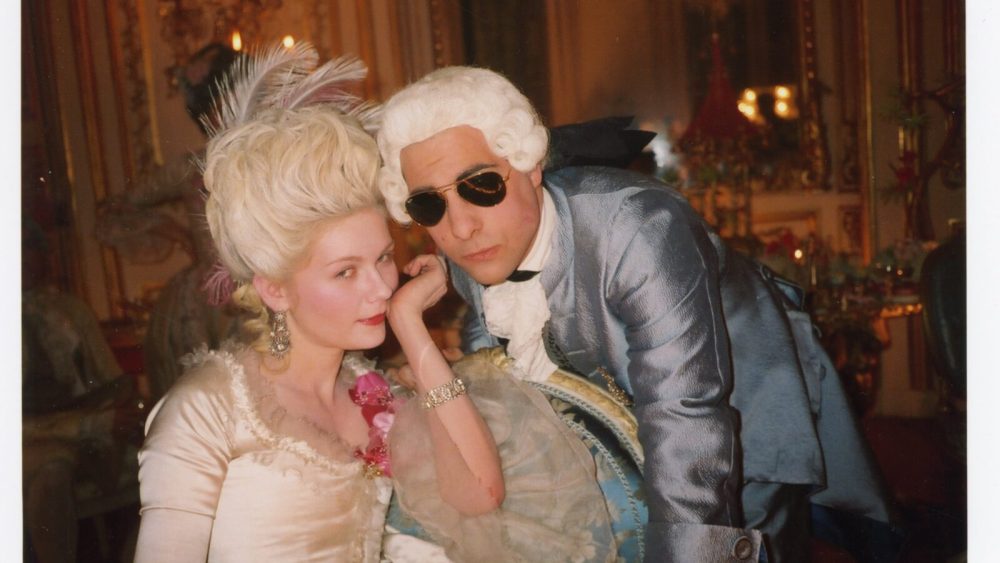
With its lush costumes, decadent food spreads and playfully anachronistic soundtrack, Sofia Coppola’s gorgeous 2006 film “Marie Antoinette” is a phenomenon of the aughts, a kaleidoscopic yet emotionally dark foray into youthful isolation and, like much of the filmmaker’s work, the bubble of privilege and celebrity. But while Coppola was making her third feature, what was gently shaping around her was hardly lonesome and gloomy. The pressure of a massive set with unprecedented access to Versailles and an intimidating production budget was alleviated by the presence and support of her family: her late mother Eleanor in particular, who was there to capture nearly 80 hours of behind-the-scenes footage to make something of it in the future. Now, 20 years after the film’s release, we are treated to mother Coppola’s gorgeously assembled archival documentary, a project she and her daughter started in earnest during the early days of the Covid lockdown, and that Sofia finished upon her mom’s passing in 2024. (She and Aaron Matthews share editing credits.) Full of love throughout its compact runtime — love for art, filmmaking, beauty and, most of all, that between a mother and daughter — “Making Marie Antoinette” feels like the ultimate making-of movie, a creative artifact and a near-term historical record that grasps what it feels like to be seen and admired through the eyes of a proud parent. There is something sweetly nostalgic about watching this affectionate documentary, and sensing that Sofia always knows when her mom is around, like a kid who glances back to make sure that her parent is watching before she goes on to put her talents on display. Popular on Variety Often accompanied by Eleanor’s diary entries — tenderly read by Diane Lane with maternal affection and self-introspection, like we’re being let in on a secret — “Making Marie Antoinette” not only portrays Sofia’s filmmaking panache, but it also opens a window into two generations of women raised by distinctive values. “Sofia’s generation is different,” Eleanor muses, acknowledging that her daughter’s age group values both family and career aspirations. She admits to having set her own interests aside when she was, at her daughter’s age, a mother of three, wondering why she didn’t have more creative endeavors of her own in addition to observing the achievements of her family. She feels, of course, immense pride as a direct result of those choices, like when her daughter won the Academy Award for “Lost in Translation” and thanked her mother for always encouraging her to make art. Still, you hear the inquisitive voice of someone who considers whether she should have stayed in the periphery as much. On the one hand, her perspective gave us other brilliant works like “Hearts of Darkness: A Filmmaker’s Apocalypse” (1991), the documentary, co-directed by Eleanor, that trailed the eventful production of her husband’s “Apocalypse Now.” But on the other, should it have taken her until 2016 to make her narrative debut, “Paris Can Wait,” a milestone she achieved at 80, primarily with Sofia’s encouragement? “My husband and daughter are directors. And I became the audience,” Lane reads. These internal thoughts flow elegantly throughout the film while Eleanor admires the outstanding work of costume designer Milena Canonero, which includes 72 unique gowns designed for lead actress Kirsten Dunst; she remains in awe of the craftsmanship and dedication of all departments, from the daily washing and powdering of countless wigs, to color-coded set design and actually edible food pairings often entombed in jiggly gelatin. A self-professed shy person who does her best to stay out of the way (“Making documentaries goes against my nature,” she explains), Eleanor understatedly captures every opulent detail around her, sometimes intimately and sometimes at a respectful distance, occasionally getting some on-camera remarks from both Sofia and the cast. In one scene, Dunst candidly considers her own coming-of-age as a young Hollywood star as it relates to the themes of the movie, remembering how it felt to know that everyone had opinions and judgments about her. “I see why Sofia relates to the story, too,” the then 24-year-old actress says. In other moments, we get to hang out with a witty Rose Byrne, listen in as Jason Schwartzman plays upbeat riffs on an old-fashioned organ, and witness an elongated rehearsal where leads and extras learn how to bow, 18th century-style. Every now and then, other Coppolas appear in the frame, like Sofia’s brother Roman who directs second unit and puts his sister at ease, while her father, Francis Ford Coppola, has advice at the ready: “Throw a Marie Antoinette party and invite everyone to it. Do it the way you want to do.” That party is vibrant and alive most of the time, except when Eleanor’s spirited camera catches main cast members taking little power naps, or yawning and stretching to get their second wind. Cozy and infinitely watchable, “Making Marie Antoinette” is a Coppola family affair end to end, with Eleanor’s unique motherly perspective being the film’s eyes and beating heart. In one scene, her diary entries reminisce about a very little Sofia, pretending to play director and yelling cut at her dad’s “Apocalypse Now” set, now making her own period piece and claiming her own spot in a still largely male-dominated industry. “My daughter is directing it with clarity, grace, and her own hip approach to history,” Eleanor muses in her diary, considering the time-bending nature of filmmaking that allows one to move forwards and backwards in linear history. Her documentary is caressed by that same mysterious quality, bottling fleeting moments in time with awe-inspiring care.
‘Making Marie Antoinette’ Review: The Late Eleanor Coppola’s Doc on Her Daughter’s Film is Full of Gorgeous Details and Maternal Affection
Full Article
Original Source
Read the full article at Variety →KhanList aggregates and links to publicly available news content. We do not host full articles from third-party sources. Always verify important information with original sources.