
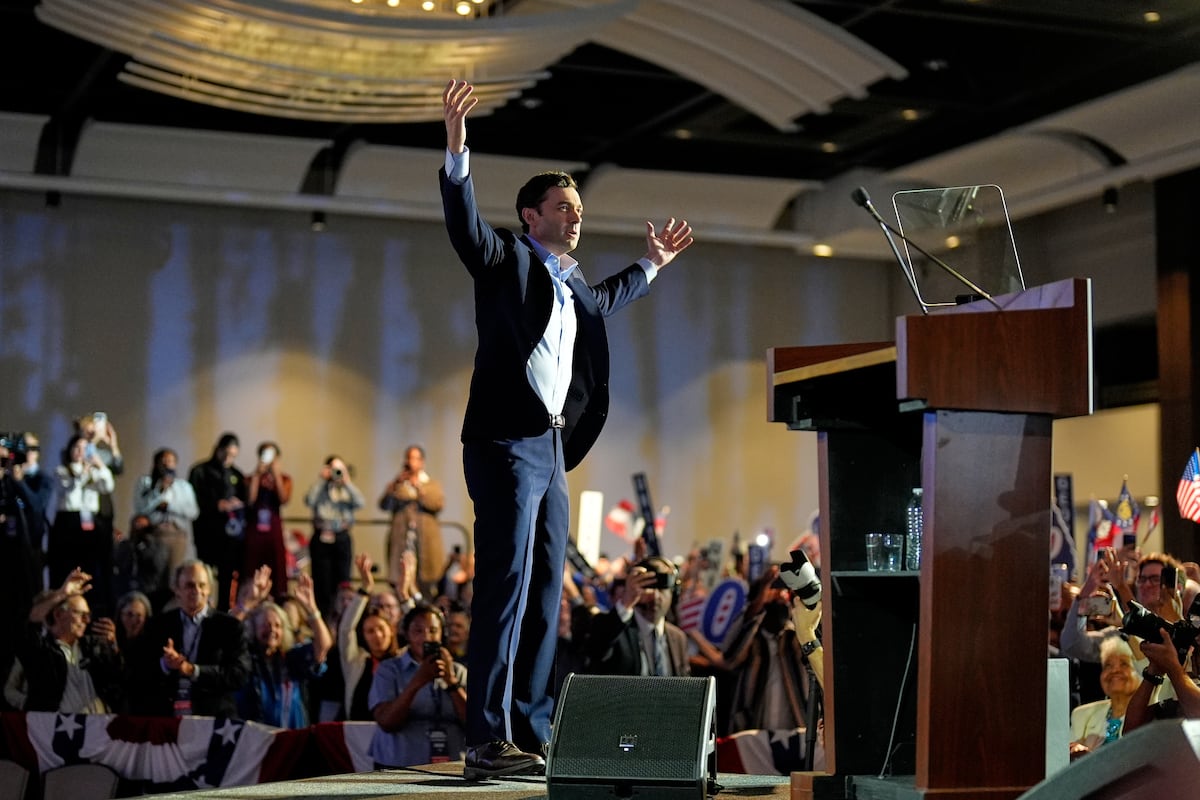
Two years after losing the White House and the Capitol to a Donald Trump reborn from the ashes, Democrats comfortably regained control of the House of Representatives and the Senate on Tuesday in the midterm elections. It was a slaughter for Republicans, a severe rebuke to the president of the United States, and an evening that can be described as historic despite the worn-out adjective: that dual legislative loss for the party in power had occurred on only six previous occasions.Fueled by voters’ weariness with a chaotic presidency full of broken promises, the opposition struck back at Trump with force, like a fighter getting up again after hitting the mat. Polls had predicted a blue wave, but to continue with one of those Washington analogies, a genuine tsunami ended up washing away Republican shores.The Democrats won almost everything that was up for grabs. In Texas, James Talarico — who was running for a Senate seat against Ken Paxton, a Trump-backed rival that a film critic would have described as a casting error — obtained a victory for his party for the first time in over 30 years. Meanwhile, his fellow Democrat Gina Hinojosa made history by becoming the first Latina to be governor of a deeply conservative state.As the night advanced, Republicans watched one state after another turn blue in the Senate: Iowa, Kansas, Ohio, both Carolinas and Maine, where voters ended Senator Susan Collins’ 30-year tenure. It was around 10.00 p.m. Eastern Time when it became clear that Democrats would surpass the 218 seats they needed for a majority in the lower chamber. As that unfolded, the vote count in the 35 states renewing Senate representation continued to deliver more bad news for Republicans, who lost one hard-fought seat after another.The red bleeding did not stop there: Trump’s party lost gubernatorial races in unlikely places such as Texas and Ohio, two states where Democrats also won Senate seats.Voting had not yet finished on the West Coast, and it was already clear there would be no need to wait for polls to close in Alaska to know that, for once, election night in the United States would remain what it is supposed to be: a single night and not, as recently, a process stretched over one or more weeks.The president of the United States had repeatedly urged his loyalists — and, by extension, his fellow citizens — to pretend his name was on the ballot even though this vote is only in theory a referendum on the president’s performance.When the debacle was already clear, Trump, true to his habit of denying reality and using emphatic capitalization, outdid his own cynicism on his social network, Truth: “I wasn’t on the Ballot and if I was, we would have won IN A LANDSLIDE!”. Shortly after, he spoke with The New York Times to announce he is willing to accept the election results, a statement that, in his case, qualified as breaking news. Later he spoke on the phone with Fox News to try to shift the blame of the phenomenal Republican defeat.Traditionally, voters tend to punish the occupant of the White House in the midterms, a presidential rite of passage that gives them a chance to tell the president they are unhappy with the state of affairs. This time, according to polls, anger over the economy’s performance, high fuel prices, the war with Iran, Trump’s egotistical fixations and government corruption motivated voters to tint the map blue in places Trump had won handily in 2024.Back then Americans gave him a return ticket to the White House because they believed his promise that he would fix inflation quickly. This Thursday will mark two years since that victory and they are still waiting. The candidate also repeated during that campaign that he would not involve the country in an overseas war, yet the operation alongside Israel against Iran has now been going on for about 10 months.Early signsThe first signs of the Republican catastrophe began early. They quickly became loud alarms with Jon Ossoff’s victory: he will be senator for a second time representing Georgia and gains ground as a possible 2028 presidential contender; Roy Cooper overwhelmed Michael Whatley in North Carolina, the candidate imposed by Trump; and the until-recently unthinkable prospect of a Democratic representative from South Carolina in Washington materialized. Starting in January, Annie Andrews will take the seat after defeating Darline Graham, another of the president’s picks, whom he had backed because she was the sister of Lindsey Graham, a vacancy both sought to fill after his death.Then Kansas and Iowa fell, with wins by pastor Adam Hamilton and centrist Josh Turek. Ken Paxton (another Trump-backed candidate) lost in Texas, a state that voted Democratic for the first time in more than 30 years. In addition to Paxton and Governor Greg Abbott (defeated by Gina Hinojosa), another big loser there was Elon Musk, who put in more than $400 million to help Republicans. This time, the world’s richest man’s money did not do the trick.The night also delivered other historic milestones. Two states of the old slaveholding South, Florida and Georgia, will have Black governors for the first time: Republican Byron Donalds and Democrat Keisha Lance Bottoms. And while Bottoms became the first African American to win that office in the state’s history, Deb Haaland became the first Native American to do so in New Mexico.Before the glass ceilings were broken, election day had proceeded with reasonable calm, aside from a few isolated incidents such as a bomb threat in Toledo, Ohio, flooding in Florida and a ballot-counting software failure in a New York county.The day began with the Justice Department sending a batch of threatening letters in the administration’s latest gambit to preemptively cast doubt on results in Alaska, where Democrats maneuvered to confuse voters with an independent candidate (Dan J. Sullivan) whose name was nearly identical to the Republican senator (Dan S. Sullivan). Afterwards, the worst fears did not come to pass: there were no armed federal agents at polling places, and the 1,000 observers sent by the government to the 50 states did not cause any incidents.Around midday, David Becker, executive director of the Center for Election Innovation & Research, a leading voice on voting rights in Washington, spoke with relief about the “calmest” day he could recall after a year in which Trump and his allies worked tirelessly to sow doubt about the electoral process. All signs indicate that election officials and workers, federal judges across the country and an army of civil-rights activists managed to resist the president’s push to “nationalize” the elections, even though the law establishes that organizing them is not a federal responsibility.In his interview with the NYT, Trump apparently disowned that history of election denialism. He also announced his willingness to work with Democrats in Congress, although little should be expected from that cooperation.He himself had said the previous day that he plans to face a hostile Congress turned into “Mr. Veto,” as the Constitution allows. On Tuesday he posted an image of one of his trademark red caps, except instead of Make America Great Again, it said “VETO”. It also seems unlikely that Democrats will pass up the chance to make his life difficult during the two years he has left in the White House, including investigations on leading members of the Trump administration and congressional hearings.When the new members of the House are sworn in on January 3, the lame-duck season will officially begin, another Washington metaphor. And Democrats will face a dilemma: how to hold Trump and his allies accountable for the chaos and brutality of the past two years without descending into mere vindictiveness. Everything seems to indicate that Americans have voted for them so their own lives will improve, rather than to have the Democrats settle their accounts with the U.S. president, whom voters have rebuked with a rarely seen severity.Sign up for our weekly newsletter to get more English-language news coverage from EL PAÍS USA Edition
Democrats sweep the midterms on a wave of rebuke to Trump’s presidency
Full Article
Original Source
Read the full article at English →KhanList aggregates and links to publicly available news content. We do not host full articles from third-party sources. Always verify important information with original sources.