
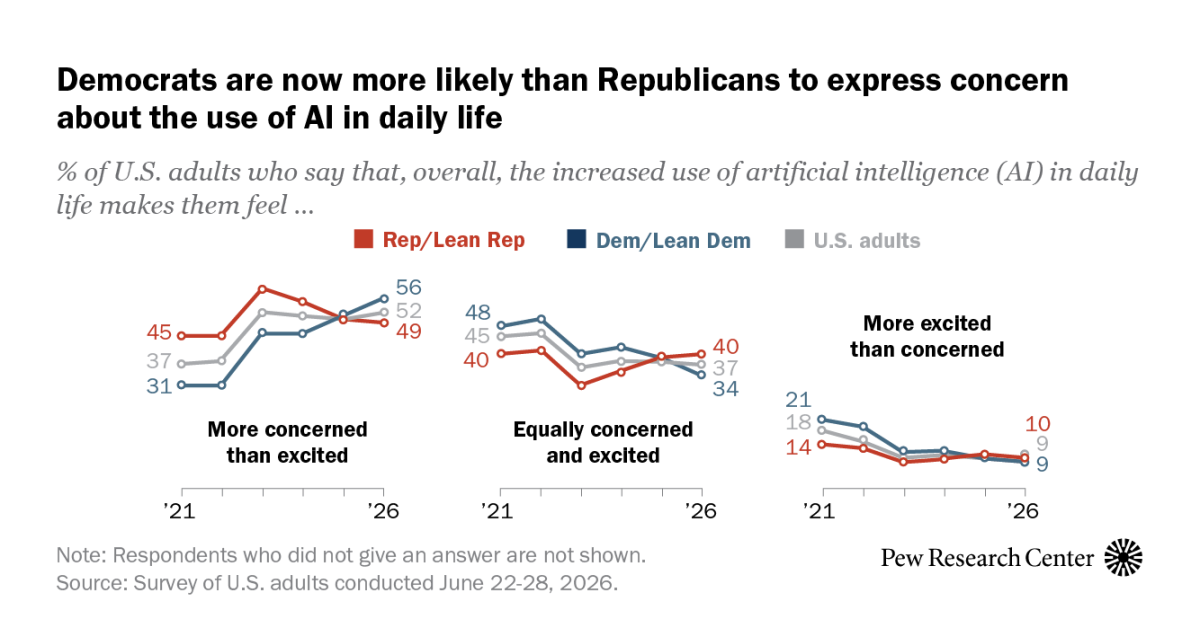
For the first time, Democrats are now more likely than Republicans to be concerned about the growing role of artificial intelligence in daily life and its potential to take jobs. Democrats are now more likely than Republicans to express concern about the use of AI in daily life % of U.S. adults who say that, overall, the increased use of artificial intelligence (AI) in daily life makes them feel … Note: Respondents who did not give an answer are not shown. Source: Survey of U.S. adults conducted June 22-28, 2026. PEW RESEARCH CENTER Democrats are now more likely than Republicans to express concern about the use of AI in daily life % of U.S. adults who say that, overall, the increased use of artificial intelligence (AI) in daily life makes them feel … GroupU.S. adultsRep/Lean RepDem/Lean Dem2021More concerned than excited3745312022More concerned than excited3845312023More concerned than excited5259462024More concerned than excited5155462025More concerned than excited5050512026More concerned than excited5249562021Equally concerned and excited4540482022Equally concerned and excited4641502023Equally concerned and excited3631402024Equally concerned and excited3835422025Equally concerned and excited3839392026Equally concerned and excited3740342021More excited than concerned1814212022More excited than concerned1513192023More excited than concerned109122024More excited than concerned1110122025More excited than concerned1011102026More excited than concerned9109 Note: Respondents who did not give an answer are not shown. Source: Survey of U.S. adults conducted June 22-28, 2026. PEW RESEARCH CENTER In a June Pew Research Center survey of U.S. adults, 56% of Democrats said they are more concerned than excited about AI’s increased use in daily life, compared with about half of Republicans. (Democrats and Republicans include independents who lean toward each party.) This reflects movement in both parties: Democrats have grown more wary of AI: Among Democrats, the share who say they are more concerned than excited about AI has risen from 46% in 2023 to 56% today. And their concern is up 25 percentage points since 2021. Fewer Republicans are concerned about AI: Since 2023, the share of Republicans who say this has fallen 10 percentage points to 49%. These changes are largely driven by those at the ends of the ideological spectrum. Among liberal Democrats, concern about the increased use of AI rose from 45% in 2023 to 63% today. During the same period, it dropped 14 percentage points among conservative Republicans. Views among moderate and conservative Democrats, as well as among moderate and liberal Republicans, have not changed significantly since 2023. These findings come as AI emerges as a midterm election issue. Candidates in both parties are debating the development of data centers, government regulation for AI and its impact on jobs. Americans overall have become more concerned than excited about AI’s growing presence in recent years. About half of U.S. adults now say this, up from 37% in 2021. Few adults are more excited than concerned, while just over a third say they’re equally concerned and excited. About this research This Pew Research Center analysis looks at how Americans feel about AI and its impact on jobs. Why did we do this? Pew Research Center does research to inform the public, journalists and decision-makers. This research builds on our past work on how people feel about AI, what they think it will do to jobs, and how views differ across partisan lines. Learn more about Pew Research Center. How did we do this? We surveyed 3,488 U.S. adults from June 22 to 28, 2026. Everyone who took part in this survey is a member of the Center’s American Trends Panel. The survey represents the views of the full U.S. adult population. Here are the questions used for this analysis, the topline and the survey methodology. How will AI affect jobs? In another shift, Democrats are now more likely than Republicans to predict that AI will lead to fewer jobs over the next 20 years (75% vs. 68%). More Democrats than Republicans expect AI to lead to fewer jobs, a shift from two years prior % of U.S. adults who say they think artificial intelligence (AI) will lead to __ in the U.S. over the next 20 years Note: Those who were not sure or did not give an answer are not shown. Source: Survey of U.S. adults conducted June 22-28, 2026. PEW RESEARCH CENTER More Democrats than Republicans expect AI to lead to fewer jobs, a shift from two years prior % of U.S. adults who say they think artificial intelligence (AI) will lead to __ in the U.S. over the next 20 years GroupFewer jobsWill not make much differenceMore jobs2024U.S. adults641452026U.S. adults711052024Rep/Lean Rep701342026Rep/Lean Rep681172024Dem/Lean Dem581672026Dem/Lean Dem7584 Note: Those who were not sure or did not give an answer are not shown. Source: Survey of U.S. adults conducted June 22-28, 2026. PEW RESEARCH CENTER This is a change from two years ago, when more Republicans than Democrats expected AI-related job losses. Since then, the share of Democrats who think AI will lead to fewer jobs has risen 17 percentage points, while Republicans’ views have changed little. Relatively few Americans in either party believe that AI will lead to more jobs or that it won’t make much of a difference. Note: Here are the questions used for this analysis, the topline and the survey methodology. Monica Anderson is a director of research at Pew Research Center. William Bishop is is a research associate focusing on internet and technology research at Pew Research Center.
Democrats are now more worried than Republicans about AI and its impact on jobs
Full Article
Original Source
Read the full article at Pewresearch →KhanList aggregates and links to publicly available news content. We do not host full articles from third-party sources. Always verify important information with original sources.