
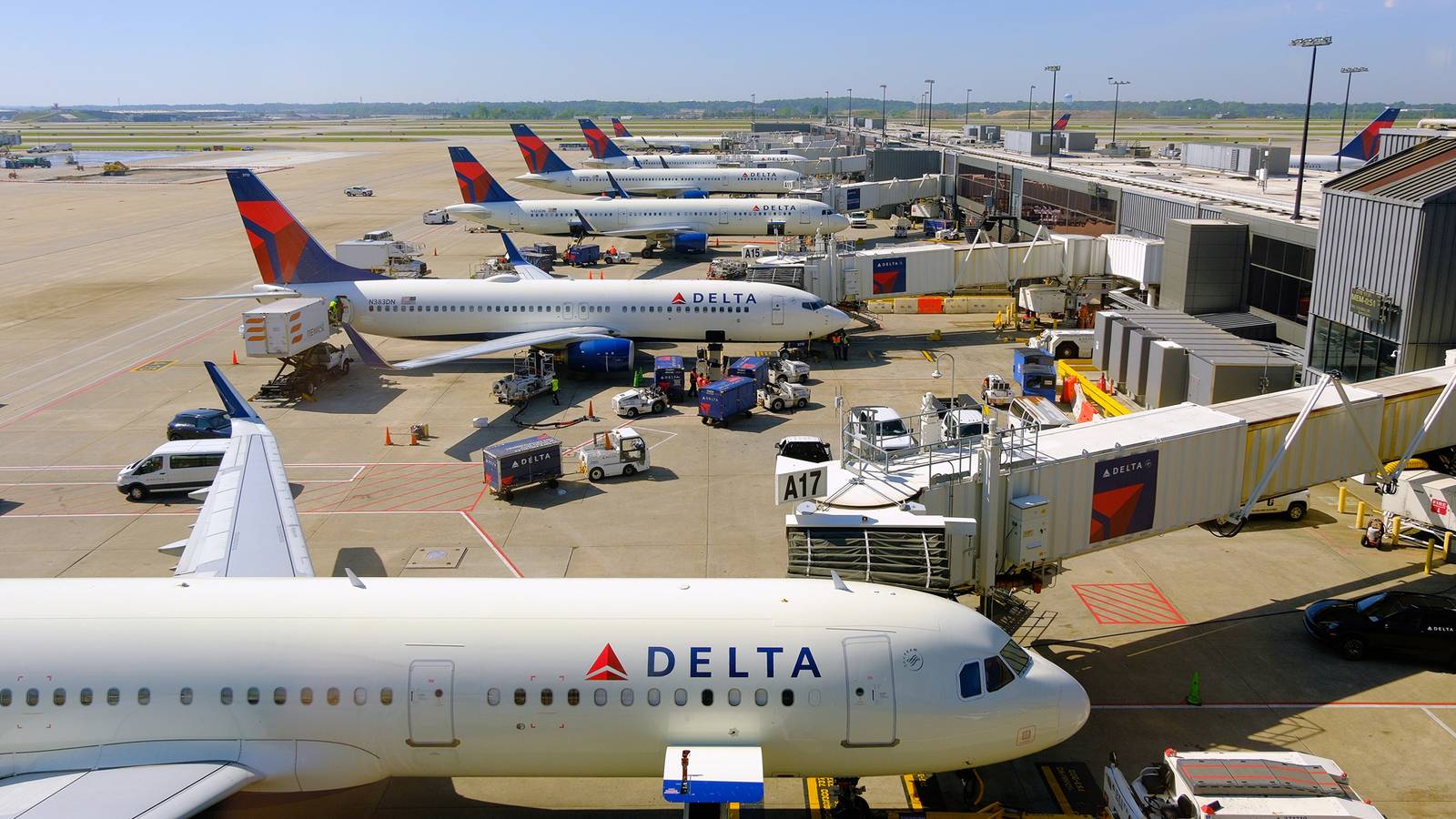
Published Nov 22, 2026, 10:31 AM EST Luke has over a decade of experience as a travel writer and aviation analyst. As a passionate traveler based across the Middle East and Asia, Luke offers strong insights into the industry. Based in South East Asia. Delta Air Lines flights bound for Hartsfield-Jackson Atlanta International Airport (ATL) were held at their departure airports on Sunday morning after an outage affected the carrier's weight-and-balance calculations. The issue led the Federal Aviation Administration (FAA) to issue a ground stop at Delta's request, affecting hundreds of flights and causing mounting delays. Delta said it was using "manual workarounds" while its teams worked to restore the automated system. While the ground stop was later downgraded to a ground delay program, the disruption came on the Sunday before Thanksgiving, with the holiday travel rush already underway. Delta System Outage Leads To Atlanta Ground Stop Credit: Vadim Rodnev | Shutterstock According to the FAA's National Airspace System (NAS) status page, the ground stop on Sunday morning was imposed on Delta flights bound for Atlanta. It was initially scheduled to remain in place until at least 9:00 AM ET, but was downgraded to a ground delay program shortly after 8:40 AM. The change allowed flights to resume operating under restrictions, although delays are expected to continue as the carrier worked through its backlog. FAA data showed inbound delays averaging 57 minutes, while flight tracking data shows that over 400 flights have been delayed at ATL, accounting for almost 20% of all inbound and outbound flights at the country's busiest airport. According to Atlanta News First, Delta passengers have also reported significant delays at airports including Newark, New York LaGuardia, Reagan National, Washington Dulles, Boston, Baltimore, Miami and Minneapolis. At the time of writing, Delta had not disclosed what caused Sunday's outage, or whether any flights had been canceled as a result. Simple Flying contacted the airline for comment and received the following statement: "Delta teams are using manual workarounds this morning to safely get flights departed while work continues to restore automation. We thank our customers for their patience and our people for their professionalism." How Delta's Weight-And-Balance Failure Disrupted Flights Credit: Markus Mainka | Shutterstock In its statement, Delta said its teams were working to restore automated weight-and-balance calculations for departing flights and that it was handling calculations manually. The airline added that it was working with air traffic control to "protect airport gates and tarmac areas from congestion" at ATL. Weight-and-balance calculations are a critical part of airline operations and are typically handled by automated systems. Every flight needs a final load sheet before departure to confirm total weight and center of gravity after passengers, bags, cargo and fuel have been loaded. These figures are then used to calculate takeoff performance, including the speeds pilots need and the engine thrust required for departure. When the automated system fails, airlines must complete the calculations manually, adding time to the process for every flight. At a hub as large as Atlanta, slower departures mean aircraft remain at their gates longer, leaving fewer spaces available for arriving flights. Holding inbound Delta flights at their departure airports helps prevent aircraft from arriving in Atlanta without an available gate. This can help limit congestion on the ground, but it also means delays can build up at airports where Delta aircraft are waiting to depart for Atlanta. Only last week, United Airlines suffered a similar weight-and-balance system outage that forced it to hold departures across its network. The disruption lasted more than 90 minutes and demonstrated how heavily airlines rely on automated systems to keep flights moving. Latest Outage Comes Ahead Of Thanksgiving Rush The disruption occurred during the opening weekend of the travel rush before Thanksgiving, which falls on Thursday, November 26. US carriers are projected to fly nearly 29 million passengers between November 20 and November 30, representing around 2.7 million per day. Airlines are also stepping up their Thanksgiving capacity year-on-year, offering 38,000 more daily seats than during the same period in 2025. Like all US carriers, Delta was significantly impacted by the recent nationwide ground stop on November 13 that lasted more than four hours. The stoppage followed a telecommunications failure within the FAA's system and affected flights nationwide. Delta struggled to recover its operations over the following days after aircraft and crews became displaced across its network, resulting in further delays and cancellations.
Delta Weight-And-Balance Outage Triggers Atlanta Ground Stop Days Before Thanksgiving
Full Article
Original Source
Read the full article at Simpleflying →KhanList aggregates and links to publicly available news content. We do not host full articles from third-party sources. Always verify important information with original sources.