
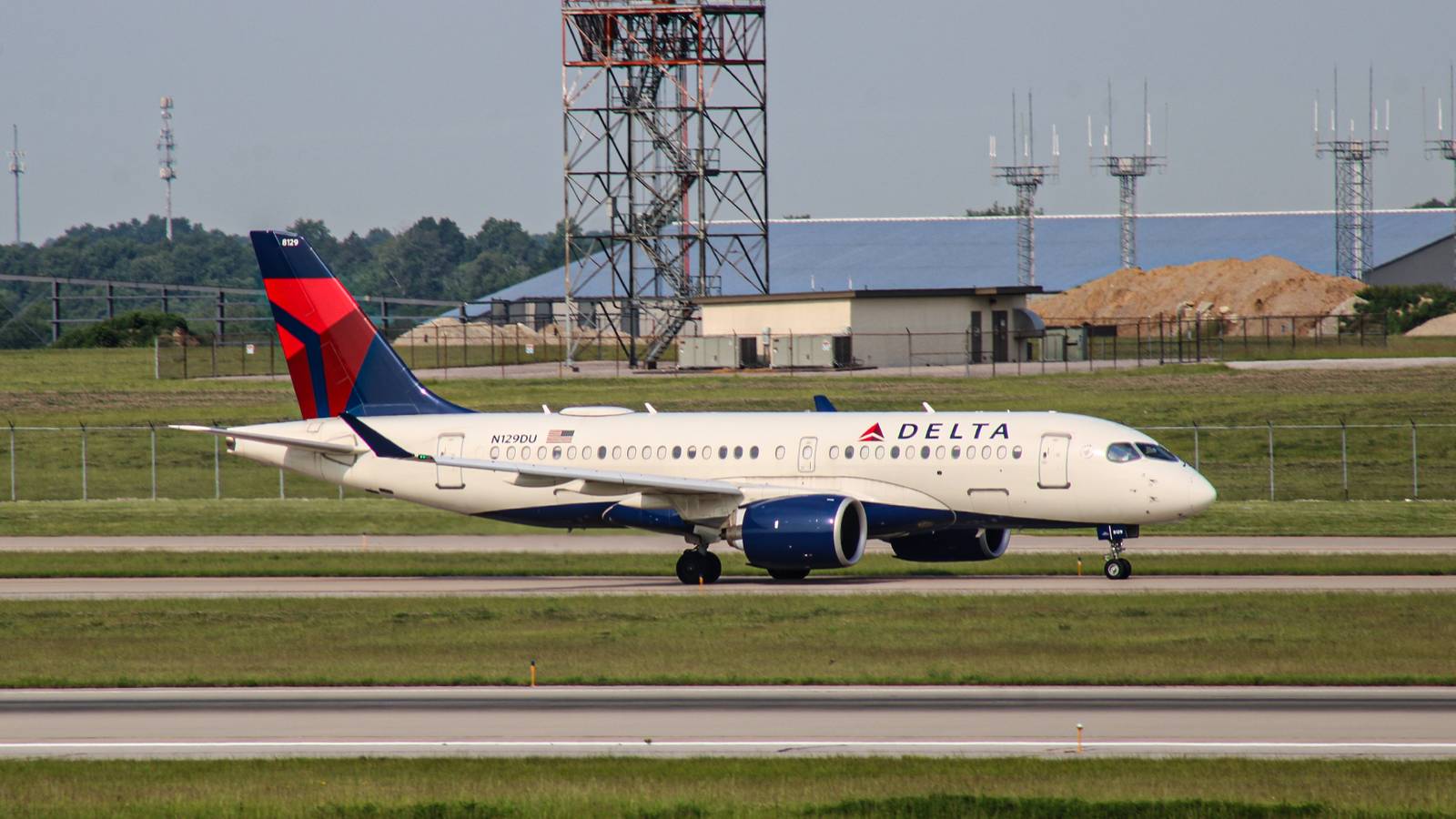
In the US, Delta Air Lines is doing something unique. American Airlines and United Airlines' smallest mainline planes are Airbus A319-100s seating 126-132 passengers, but these airlines are mainly focusing on larger narrowbodies, with the 160 to 172-seat Boeing 737 MAX 8 being their smallest new aircraft. Delta, on the other hand, is operating new Airbus A220s, including the 109-seat A220-100 (smaller than anything flown by American or United) as well as the 130-seat A220-300 (smaller than anything that its rivals have on order). There are several reasons why Delta ordered the A220, and one of them might be rather unexpected Meanwhile, flying these planes allows Delta to do some unique things with its network, since it has planes sized almost perfectly between the larger mainline planes and the Delta Connection fleet. These operations also work because, unlike the A319, 737-700, or their re-engined counterparts, the A220 is optimized for this size, which means that they're economical planes to operate. Delta's Airbus A220 Fleet & Operations Credit: Markus Mainka I Shutterstock Delta's order for the A220 is rather infamous for the circumstances surrounding the sale. After Bombardier (the original manufacturer) sold 75 examples of what was then called the CS100 to Delta for well below the sticker price, Boeing filed a dumping petition against Bombardier, which prompted the US Department of Commerce to place a 300% tariff on the CSeries. As a result, Bombardier partnered with Airbus, then sold off its remaining stake. The aircraft was renamed the A220, and Delta is now the largest customer for the type. Delta flies 45 A220-100s and 47 A220-300s, while it still has 53 A220-300s on order (30 of the 75 A220-100s originally ordered were converted to the larger A220-300, while the airline added another 70 orders). These planes are mainly based out of New York (at both LaGuardia and JFK), Seattle, Salt Lake City, and Minneapolis, primarily operating longer routes with lower frequency. This is an entirely separate role from the carrier's Boeing 717 fleet, which operates short routes with high frequencies. As is the case at the carrier's rivals, Delta's regional brand is capped at operating 76-seaters. Meanwhile, Delta's 717s seat 110 passengers, the A319-100s seat 132 passengers, the A320-200s seat 157 passengers, and the 737-800s seat 160 passengers. The A220, but particularly the A220-100, sits in a realm between the larger, more common mainline aircraft and the largest Delta Connection regional jets. This allows for some fairly unique route assignments and network decisions compared to the other two legacies. What The A220 Can Do For Delta Credit: Robin Guess I Shutterstock While capacity is often used to compare aircraft, the real crucial figures for airlines are operating costs against revenue potential. Compared to the 737-800, the A220 may burn over 20% less fuel per trip, while the type's lower capacity makes it ideal for destinations where Delta may struggle to fill a 737-800. This preserves fare integrity while lowering costs. The A220-300 burns just slightly more fuel than the A220-100 while seating 21 more passengers and still having transcontinental range, making it the more appealing of the two. Throughout the airline's network, the A220 is widely used for services like Seattle-Washington National, Seattle-Fairbanks, Salt Lake City-Pittsburgh, or JFK-Dallas/Fort Worth. These are relatively long routes either serving smaller spokes or serving destinations where Delta is a small player, and are only flown once or a handful of times per day. They stretch the economical limits of regional jets: a similarly-sized A319 burns significantly more fuel, while a 737 or A321neo would add significantly more capacity, diluting yields if the same frequency is maintained. The A220 also operates plenty of routes that don't fit this profile. Services like Salt Lake City-Orange County or LaGuardia-Chicago are short, high-demand, and operated with high frequencies. However, it is the longer, thinner services where the A220 truly shines, and the presence of this aircraft within Delta's fleet allows it to potentially operate these services more effectively than rivals. Of course, operating nonstop flights from Salt Lake City to Pittsburgh isn't the only reason why Delta ordered A220s. Small Narrowbodies & Regional Jets Credit: Wangkun Jia I Shutterstock Delta is a very opportunistic buyer, often willing to buy second-hand planes or unusual aircraft types if they're available for low prices. The A220, while an excellent aircraft, also had no commonality with anything else in Delta's fleet when it was first introduced. However, for the price that Bombardier originally sold the planes (allegedly around $20 million each), the planes went from being good to a screaming deal. The other benefit of the A220 is that it unlocked more 76-seater regional jets. Delta's pilot scope clauses place several restrictions on Delta Connection operations, since contracted regional flying can directly threaten mainline crew jobs. US carriers use 50-seater, 70-seater, and 76-seater aircraft, and the 76-seaters are the most lucrative of the three. Per Planespotters.net 109-110 Seats 130-132 Seats 157-160 Seats 180 Seats 193-199 Seats 234 Seats Delta's Narrowbody Fleet 45 A220-100s 74 717-200s 47 A220-300s 57 A319-100s 40 A320-200s 77 737-800s 163 737-900ERs 127 A321-200s 100 A321neos 48 757-200s 16 757-300s Total 119 aircraft 104 aircraft 117 aircraft 163 aircraft 275 aircraft 16 aircraft Because of this, Delta's pilot scope clauses place a cap on the number of 76-seaters that may fly under the Delta Connection brand, but this cap may be raised if the airline adds a new small mainline narrowbody type, as it did with the A220. The CSeries/A220 was sold to Delta for a more than reasonable price, and acquiring the type raised the carrier's 76-seater cap to 223 aircraft. Meanwhile, the aircraft itself is capable and exceptionally fuel-efficient, allowing Delta to more effectively serve long and thin domestic routes while performing well on shorter missions too. Of course, just because the A220 works well for Delta doesn't mean that it works for every US carrier, and it's the only one of the legacy carriers to operate the A220. Why American & United Don't Fly Small Narrowbodies Credit: George Wirt | Shutterstock The smallest mainline aircraft operated by either American Airlines or United Airlines is the Airbus A319-100, while United also flies the similarly-sized Boeing 737-700. They essentially have the same capacity as the A220-300, but the A319 and 737-700 are much older products that were ordered when the market was significantly different than today. What's more, neither airline operates an aircraft like the A220-100 or 717. Meanwhile, the smallest modern aircraft that either airline has ordered is the much larger 737 MAX 8. For American, one simple reason why the A220 isn't nearly as appealing is that its pilot scope clauses do not include a 'trigger mechanism' in which a new small narrowbody unlocks additional 76-seaters. Instead, the 76-seat fleet size is capped at 40% of American's total narrowbody fleet, enabling it to operate significantly more 76-seaters, as well as more regional jets overall. For American, the A220 would have to justify itself purely within the context of the airline's network and operations, as would any small narrowbody type. United's pilot contract does include a hard cap of 153 76-seaters. This can be raised by the addition of a new mainline small narrowbody. However, the carrier has explicitly been focusing on upgauging from regional jets and smaller narrowbodies to strengthen its domestic network, where it was previously weaker than the competition. Especially today, United is focusing on A321neos, 737 MAX 9s, and the 737 MAX 10 once it starts being delivered. For its current goals, the A220 is the wrong aircraft. The Challenges Of Flying Small Narrowbodies Credit: Austin Deppe I Shutterstock The A220 is extraordinarily cost-effective for its size, but the problem is that certain operating costs remain fixed or semi-fixed. No matter how fuel-efficient a 130-seat A220 is, it still requires pilots, flight attendants, and airport facilities just like a 160-seat 737. Meanwhile, the aircraft has 30 fewer seats to spread those costs, while Delta's A220-100s have 51 fewer seats. This makes the economics of operating the A220 and similar aircraft less compelling than their fuel efficiency would imply. Of course, one of the benefits that small planes offer is their capacity, which allows airlines to better match supply with demand, preserving fare integrity. However, US carriers have heavily employed price segmentation as a core part of their commercial strategies, using multiple fare brackets and basic economy tickets to help fill their planes. US Legacy Carriers Small Narrowbodies Ordered+Operated Medium-Sized Narrowbodies Ordered+Operated Large Narrowbodies Ordered+Operated American Airlines 103 737 MAX 8s 216 A321neos 115 737 MAX 10s Delta Air Lines 145 A220s 189 A321neos 100 737 MAX 10s United Airlines 123 737 MAX 8s 210 A321neos 224 737 MAX 9s 167 737 MAX 10s This improves the economics of flying more large aircraft and staying away from smaller types, which is why all three US carriers are gravitating to A321neos and 737 MAX 10s. The A220 is an excellent aircraft and the leading product in its market segment, but American and United are not currently interested in small narrowbodies. For Delta, the A220 was priced very attractively, the airline wasn't quite as focused on price segmentation and large narrowbodies as it is now, and it unlocked more large regional jets. As a result, Delta is flying these economical planes on routes where its advantages truly shine, while also using the Airbus A220 effectively throughout the rest of the domestic network.
Delta Air Lines' Airbus A220 Sits About 50 Seats Below A Boeing 737-800 & 30 Above A Regional Jet
Full Article
Original Source
Read the full article at Simpleflying →KhanList aggregates and links to publicly available news content. We do not host full articles from third-party sources. Always verify important information with original sources.