
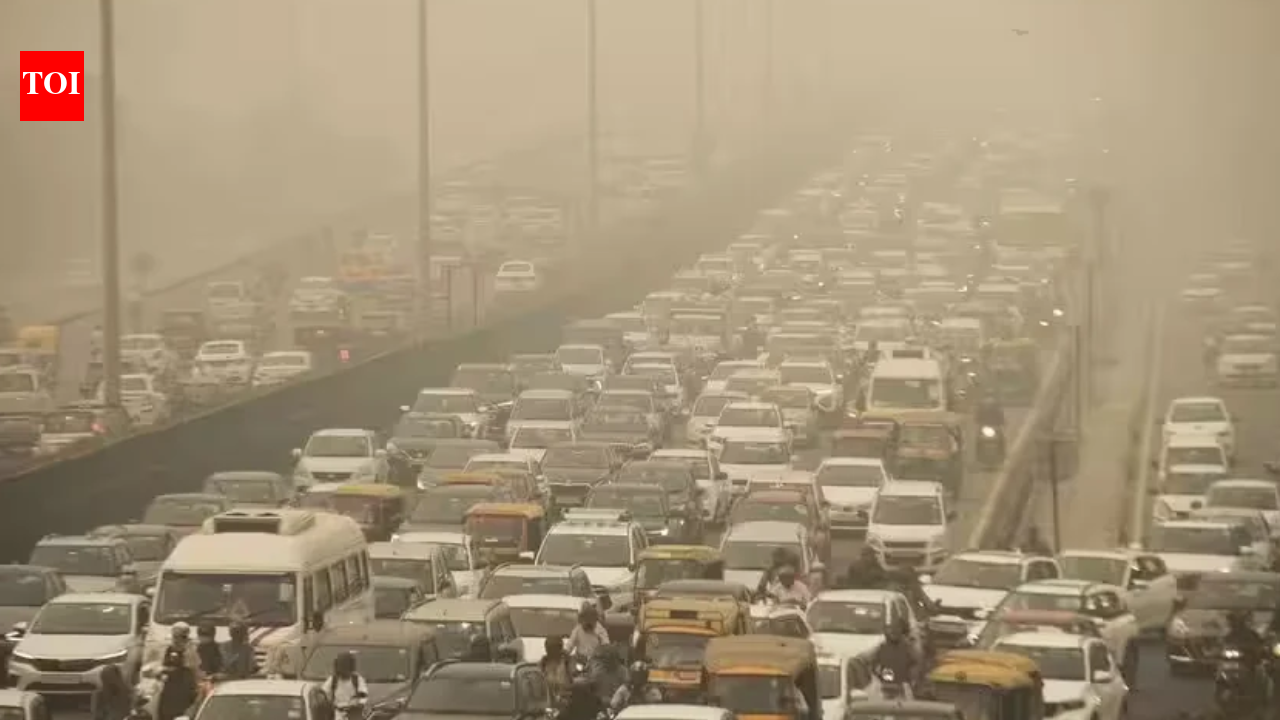
Delhi's air quality index has plunged into the severe category, prompting government officials to enforce work from home policiesNEW DELHI: With air pollution worsening across the national capital, Delhi Environment minister Manjinder Singh Sirsa has directed 50% of the workforce in his departments to work from home, while Transport minister Pankaj Singh has also issued similar instructions to departments under his charge, official sources said on Friday.The move follows the implementation of Stage III of the Graded Response Action Plan (GRAP), under which the Commission for Air Quality Management (CAQM) has asked the Delhi government and other National Capital Region (NCR) state governments to consider allowing public, municipal and private offices to function with 50% staff strength, with the remaining employees working from home.Stage III of GRAP is invoked when the Air Quality Index (AQI) enters the severe category, ranging from 401 to 450 under the specified action plan."Going by CAQM guidelines on air quality, heads of departments are free to take decisions regarding allowing work from home. Essential services will not be covered in this," a government official said.Pankaj Singh has directed departments including health and family welfare and information technology to adopt the work-from-home arrangement. Apart from the environment portfolio, Sirsa is also in charge of food and civil supplies, industries, and forest and wildlife.The Centre may also allow its employees to work from home, according to the revised GRAP schedule. AQI touches 494 amid thick smogOn Friday morning, Delhi witnessed a sharp deterioration in air quality with the real-time AQI touching 494 at 7.31 am, placing it in the severe category. Dense smog and pollution covered large parts of the city, reducing visibility and raising concerns over respiratory health.According to the Central Pollution Control Board (CPCB), IIT Delhi recorded an AQI of 488, followed by ITO at 455, Anand Vihar at 419, Rohini at 413 and Rajokri Border at 402. All these locations fell in the severe category.Several other areas recorded very poor air quality. R K Puram reported an AQI of 391, followed by Mandir Marg at 378, Dwarka Expressway at 369, Uttam Nagar at 363 and Lodhi Road at 341.The area around Dhaula Kuan recorded an AQI of 161, placing it in the moderate category, according to CPCB data.The city's air quality had entered the severe category for the first time this season earlier in the morning. The instantaneous AQI reached 403 at 6.05 am and remained at the same level at 8 am and 9 am, according to the CPCB's Sameer app.At 8 am, 33 of the 58 monitoring stations reporting data recorded severe air quality, while 24 were in the very poor category and one in the moderate category.IIT Delhi recorded the highest AQI at 488, followed by Chandni Chowk at 479 and North Campus of Delhi University at 478. Burari Crossing reported an AQI of 456, while ITO and Jawaharlal Nehru University recorded 451 each.By 4 pm, Delhi's overall AQI had settled at 373, placing it in the very poor category. Of the 59 monitoring stations that recorded data, 16 reported severe air quality, while all but one of the remaining stations were in the very poor category. Delhi Cantonment was the only station to record moderate air quality.IIT Delhi recorded the highest AQI at 452, followed by North Campus at 446. Narela and Pusa reported an AQI of 437 each, while Punjabi Bagh recorded 431.A thick layer of grey smog hung over the capital throughout the day, obscuring buildings and the skyline. The haze was particularly dense during the morning, when several areas experienced reduced visibility. The sun appeared faint behind the blanket of pollution.Unfavourable weather conditions and weak winds during the morning hours contributed to the accumulation of pollutants close to the ground. Several residents also took to social media to report breathing difficulties, throat irritation, persistent coughing, chest discomfort and breathlessness. Some said they were experiencing respiratory discomfort even indoors.Vehicles emerge as biggest source of pollutionTransport emerged as the largest contributor to Delhi's PM2.5 pollution, according to real-time source-apportionment data from the Air Quality Early Warning System and the Integrated Decision Support System (DSS).Vehicles accounted for 31.5% of PM2.5 emissions, followed by secondary organic aerosols at 24.7%.Domestic solid biofuel and dung-cake burning, along with biomass and stubble burning, together contributed 20.8%, while secondary inorganic aerosols accounted for 12.7%.Other sources included waste burning at 5.6%, firecrackers at 2.2%, industrial emissions at 1.8% and mineral dust and ash at 0.6%.Children particularly vulnerable to pollution exposureDoctors have warned that children are particularly susceptible to the effects of air pollution because their lungs, airways and immune systems are still developing.Dr Nikhil Rajvanshi, consultant paediatric pulmonologist, allergy and sleep specialist at Rainbow Children's Hospital, Delhi, said children breathe faster than adults and therefore inhale a greater quantity of pollutants relative to their body weight.Exposure to PM2.5, nitrogen dioxide and other harmful gases can irritate their respiratory tract and trigger coughing, wheezing and breathlessness, he said.Prolonged exposure to polluted air can affect lung development, reduce lung function, worsen asthma and increase the risk of respiratory infections. Emerging evidence also points to possible effects on cardiovascular health and cognitive development, Rajvanshi added.He advised parents to look out for symptoms such as persistent coughing, wheezing, unusual fatigue and breathlessness.Limiting outdoor activities during periods of high pollution, avoiding traffic-heavy areas, maintaining good indoor air quality and following prescribed asthma treatment plans can help reduce children's exposure, he said.Air quality likely to remain very poorWeather experts attributed the improvement in Delhi's air quality by Friday evening to changing meteorological conditions and an increase in wind speed during the afternoon.However, the Air Quality Early Warning System has forecast that the city's AQI is likely to remain in the very poor category from Saturday until November 16. The outlook for the following six days also indicates very poor air quality.The ventilation index is expected to remain below 6,000 square metres per second, while average wind speed is likely to stay below 10 kilometres per hour. These conditions are unfavourable for the dispersion of pollutants, according to the forecast.The CPCB classifies an AQI of zero to 50 as good, 51 to 100 as satisfactory, 101 to 200 as moderate, 201 to 300 as poor, 301 to 400 as very poor and 401 to 500 as severe.Temperatures remain above normalDespite the pollution and smog, Delhi recorded temperatures above the seasonal average on Friday.According to the India Meteorological Department (IMD), the maximum temperature settled at 31.4 degrees Celsius, 2.9 notches above normal, while the minimum was 16.2 degrees Celsius, 2.7 notches above normal.Palam recorded a maximum temperature of 28.5 degrees Celsius, 0.1 degrees above normal, and a minimum of 16.1 degrees Celsius, 1.9 degrees above normal.At Lodhi Road, the maximum temperature was 30.8 degrees Celsius, 2.8 notches above normal, while the minimum settled at 17.2 degrees Celsius, 5.2 notches above normal.The Ridge recorded a maximum of 30 degrees Celsius, 2.4 notches above normal, and a minimum of 17.2 degrees Celsius, 1.8 notches above normal.Ayanagar registered a maximum temperature of 31 degrees Celsius, 2.9 notches above normal, while the minimum temperature stood at 16.3 degrees Celsius, 1.8 notches above normal.
Delhi's air turns 'hazardous' as AQI hits 494; 16 stations in 'severe' zone
Full Article
Original Source
Read the full article at Timesofindia →KhanList aggregates and links to publicly available news content. We do not host full articles from third-party sources. Always verify important information with original sources.