
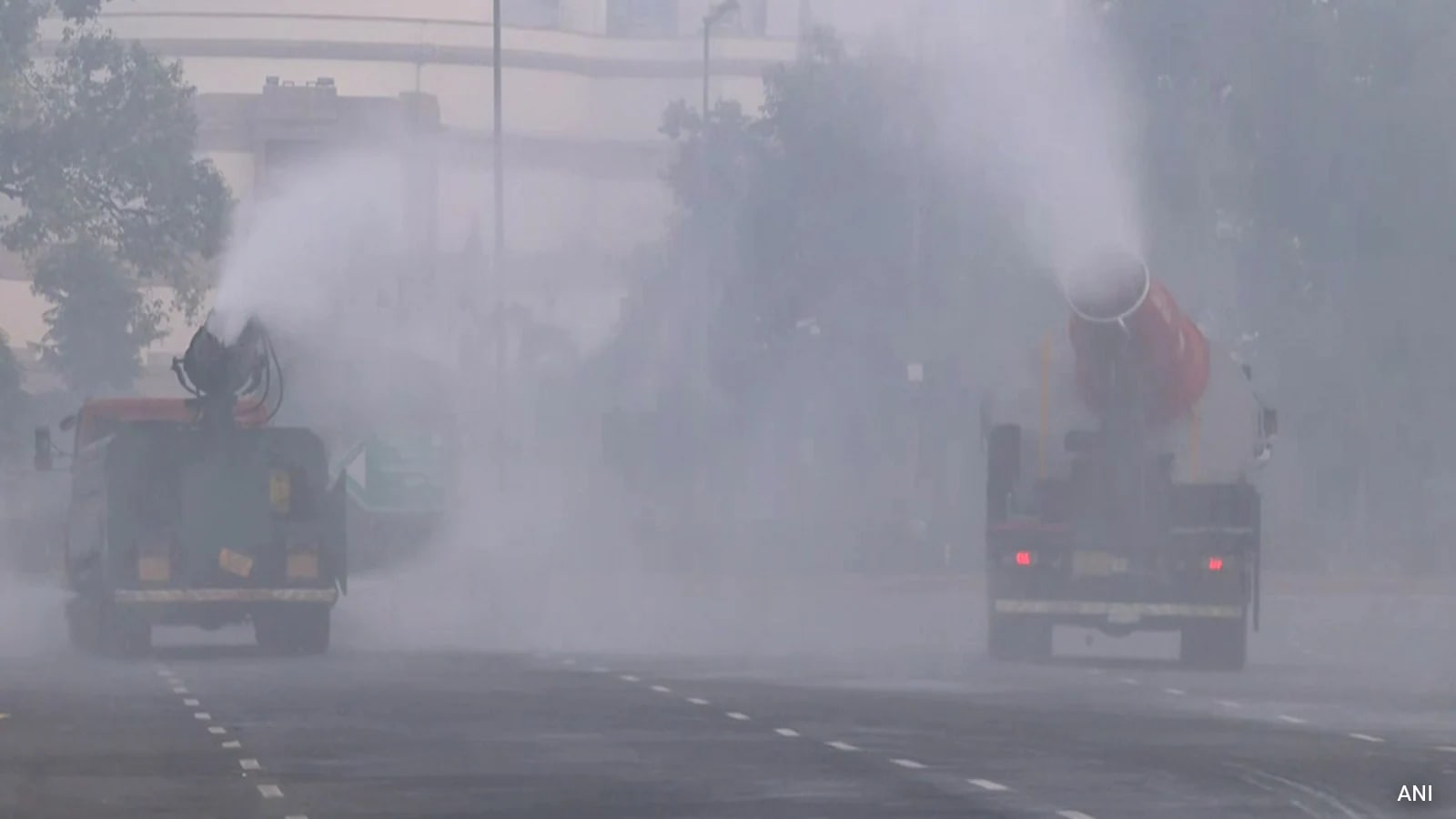
New Delhi: Delhi continued to grapple with hazardous air quality on Saturday morning, with the city's overall Air Quality Index (AQI) standing at 364 at 8 am, according to Central Pollution Control Board (CPCB) data.This places the capital in the 'very poor' category (301-400), though several stations recorded 'severe' levels (401-500).IIT Delhi logged 443, Punjabi Bagh recorded 433, and Narela stood at 409, all in the 'severe' band. Cantonment Area recorded 315, and Dhaula Kuan stood at 318, with Anand Vihar at 272 in the 'very poor' and 'poor' categories.According to the India Meteorological Department, misty conditions prevailed at New Delhi-Safdarjung, where the temperature was 17 degrees C at 5:30 am.This marks a slight improvement from Friday morning, when the citywide AQI stood at 389.READ | "Hope You're Enjoying Weather": Supreme Court's Quip On Delhi PollutionThe readings come a day after the Sub-Committee on the Graded Response Action Plan (GRAP) of the Commission for Air Quality Management (CAQM) invoked Stage 3 across Delhi-NCR, two days ahead of Diwali, to prevent further deterioration.According to the CPCB, an AQI between 301 and 400 falls under the 'very poor' category, while readings between 401 and 500 are classified as 'severe'.With Stage-III measures now in force, the existing curbs will continue alongside additional measures, including stricter pollution-control steps, increased enforcement and directions to concerned agencies to prevent further deterioration in air quality.The emergency action plan-which applies across Delhi and adjoining districts of Haryana, Uttar Pradesh, and Rajasthan-is invoked as a precautionary measure based on meteorological and pollution forecasts from the India Meteorological Department (IMD) and the Indian Institute of Tropical Meteorology (IITM), ensuring restrictions are placed before citywide Air Quality Index (AQI) levels breach the 'Severe' 401 mark.GRAP is a four-stage emergency framework managed by the Commission for Air Quality Management (CAQM) in coordination with the Central Pollution Control Board (CPCB) and regional state governments, with restrictions becoming progressively stricter as air quality worsens.Under Stage I, triggered when the AQI is between 201 and 300 and categorised as 'poor', the focus is on road dust control, enforcing pollution norms and banning open waste burning.Stage II kicks in when AQI is between 301 and 400, or 'very poor', bringing enhanced dust control, higher parking fees and staggered office timings.Stage III is invoked when AQI reaches 401 to 450, classified as 'severe', and entails strict vehicle bans, halting of construction and hybrid learning for primary schools.Stage IV, for AQI above 450 categorised as 'severe plus', involves a ban on heavy goods vehicles and emergency traffic and industrial restrictions.The activation of Stage III introduces high-impact measures targeted at curbing emissions and dust, operating concurrently with existing Stage I and Stage II mandates.Strict bans are enforced on BS-III petrol and BS-IV diesel four-wheelers across Delhi and designated NCR districts. The revised framework also tightens restrictions on older light/medium goods vehicles and non-Delhi-registered diesel commercial vehicles entering the capital.All non-essential, highly dust-generating construction, major excavations, earthwork, demolition, and road construction are suspended. Permitted essential projects must follow rigorous dust-mitigation protocols.Heavy dust-generating operations, including stone crushers and mining activities, face immediate shutdown or operational restrictions.School Operations: Guidelines allow education authorities to shift primary classes (up to Class 5) to a hybrid learning model, combining physical classroom and online instruction to reduce children's exposure to toxic air.Authorities are augmenting public transportation frequency-adding extra Metro trips and deploying additional buses-to absorb commuter demand and discourage private vehicle use.Stage III serves as a vital circuit-breaker designed to prevent air quality from escalating into the dangerous Stage 4 ('Severe+') territory. By targeting primary sources of particulate matter-specifically PM2.5, PM10, and nitrogen oxides-the restrictions reduce public health risks related to respiratory illnesses and cardiovascular stress, particularly among vulnerable populations like children and the elderly.While GRAP operates as an emergency intervention, CAQM officials emphasise that these 48 coordinated action items across all four stages underscore the long-term necessity of regional coordination, cleaner transport adoption, and sustainable urban waste management.(Except for the headline, this story has not been edited by NDTV staff and is published from a syndicated feed.)
Delhi Air 'Very Poor', 'Severe' In Several Areas Day Before Diwali
Full Article
Original Source
Read the full article at Ndtv →KhanList aggregates and links to publicly available news content. We do not host full articles from third-party sources. Always verify important information with original sources.