
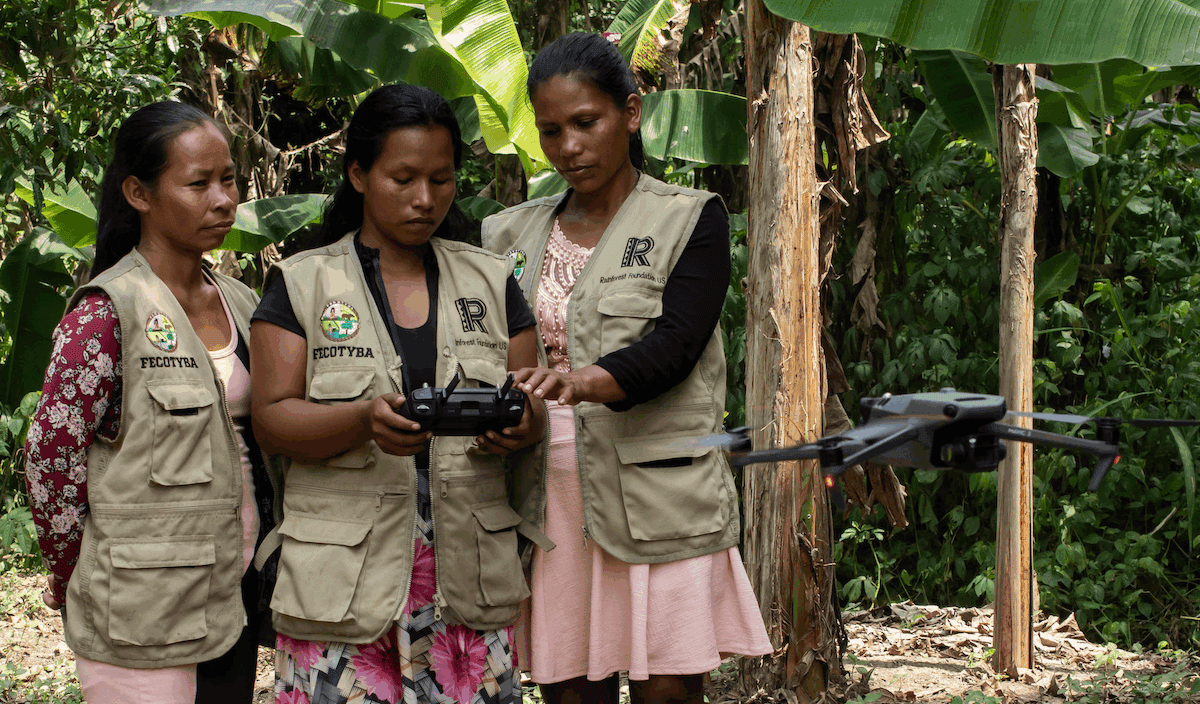
Delegates gathering for the U.N. Convention on Biological Diversity (CBD) conference of the parties (COP17) will debate how to protect biodiversity and finance its conservation, and they should start by listening to Global South women already doing this work, a new op-ed argues.Women-led solutions to crises like biodiversity loss and climate change provide ready examples for the delegates, if they are open to learning about them.“Working with the women behind these initiatives [has] shown me that documenting their solutions is only part of the task,” the author writes.This article is a commentary. The views expressed are those of the author, not necessarily of Mongabay. As global leaders convene in Armenia this week for the U.N. Convention on Biological Diversity (CBD) conference of the parties (COP17), it is difficult to ignore how women’s oppression is deeply intertwined with the exploitation of ecosystems. After almost two decades of pledges, biodiversity action remains underfunded, forest loss continues to be a growing threat, socio-ecological transitions are a low priority, and ecosystems are spiraling toward collapse. The impacts of resulting climate disasters and biodiversity destruction are not felt equally, yet gender justice issues also remain unresolved within these international talks. In Yerevan, Armenia, countries will consider the first global review of the Kunming-Montreal Global Biodiversity Framework (KMGBF), which was the first formal assessment to measure progress since its adoption in 2022. COP17 is also poised to advance efforts on biodiversity finance under the umbrella of common but differentiated responsibilities. But progress cannot be measured only in targets, financial commitments and international mechanisms. We should also ask a more basic question: What can we learn from the people who are already protecting biodiversity in their territories? Women leading agroecology and community conservation initiatives in Zambia. Image courtesy of Kapyanga Women Association & Zamsof. While hundreds of policymakers spend long hours negotiating decisions to promote false solutions and powerful corporate actors lobby to continue profiting from biodiversity destruction and obstruct environmental regulations, women from the Global South continue working without big cameras or fancy social media presences to protect what is left of their territories. They are ensuring the continuation of life on Earth for you, me, and future generations. The reality in the negotiation corridors will be very different from the violence, extortion, and environmental destruction in the mining areas surrounding El Callao, in Bolívar state, Venezuela, for example, which is one of the epicenters of the gold rush promoted after the U.S. military invasion of the country earlier this year. Being born and raised in Bolívar, it will be difficult for me to agree in Yerevan that governments are “taking action for nature.” And after hearing over the last several months from friends and colleagues from the Global South about human rights violations and ecosystem destruction they confront, it is important to remind everyone of an incontrovertible fact: As long as governments fail to address the systemic drivers of biodiversity destruction — especially in the Global South — and continue using domestic policies to expand extractivist sectors while broadening status quo dependency, these failures will persist. One of the most contentious topics is biodiversity finance. Biodiversity offsets and credits, debt-for-nature swaps, and nature-based solutions are just some of the flawed market-based instruments presented to mobilize finance toward Global South countries. Despite all the widely known controversies, poor performance and human rights abuses, they are increasingly dominating attention while urgent priorities — including allocation of direct resources for community-led conservation actions and giving communities full decision-making power in finance institutional structures — remain unaddressed. Market-based schemes should be ruled out. They instrumentalize greenwashing and allow brokers, developers, intermediaries and large NGOs to extract funding that should be benefiting communities. Indigenous women of the Ticuna community of San Francisco de Yahuma in Loreto, Peru, are breaking gender barriers and taking on leadership roles on conservation in their communities. Image courtesy of Joseph Zegarra/Rainforest Foundation US. Women and youth making a difference Over the last few months, I have been working with friends and colleagues from Africa, Latin America and the Caribbean, and Southeast Asia to understand what real solutions to the climate and biodiversity crises look like. We all have in common a deep reverence for life, respect for traditional wisdom, a great deal of technical forest knowledge, advocacy experience, and a strong commitment to defending territories. And, of course, a tireless stubbornness to fight for systemic changes to the current model of development. Real solutions might look like an agroecological farming system rooted in traditional knowledge, or a community defending its territory from extractivist industries. They might be women organizing to protect forests, strengthen food sovereignty, or build more equitable forms of community autonomy. I’ve also seen women from Brazil, Colombia, Chile, the Democratic Republic of Congo, and Nepal plus researchers from Morocco and Zambia, a peasant from Uruguay, an Indigenous leader from Panama and legal activists from Bangladesh all showing resilience and concrete community-led conservation actions. All of them remind us that the value of ancestral knowledge, community autonomy, and access to decision-making power cannot be replaced by money or “innovative schemes.” Their real community-led solutions cannot be separated from the political dimensions of life and stay only on the technical side, focusing on reformist approaches to delay urgent systemic changes. They cannot be “scaled up” like the top-down generic schemes presented in international talks. Women’s group in Thailand’s northern Chiang Rai province leads a community forest restoration project. Image courtesy of RECOFTC. Real women-led solutions are unique, as every complex ecosystem is, and demand putting power in the hands of environmental defenders. The ancestral ‘nainu’ agroforestry system in the Gunayala autonomous territory of Panama is a hopeful example capable of teaching us what biodiversity action actually looks like, as the Gunadule people create a shield of resistance with a concrete community-led solution centered on traditional knowledge and women’s leadership. The strong understanding of these Global South women about the interconnections between oppression and the exploitation of ecosystems is just as inspiring as the sophisticated strategies they have built to confront mining, agribusiness, colonial legal frameworks, and patriarchal policies. Working with the women behind these initiatives has also shown me that documenting their solutions is only part of the task. The point is not to turn these communities into inspirational examples for an international audience, nor is it to extract their knowledge and package it into another global model. It is to recognize that these communities have their own knowledge, priorities and political agency, and that biodiversity policy needs to create the conditions for those solutions to flourish. That means secure rights to land and territory. It also means direct, public and accessible finance. And, it means protecting communities from destructive extractive projects, recognizing traditional knowledge and women’s leadership, and giving communities meaningful power over the decisions and financial structures that affect them. Working with this group of women and men on a Gender-Just Real Solutions Map for Territories and Communities is a learning path to find answers to a complex crisis. One thing is clear: We must support localized actions which are genuinely community-led solutions that uphold rights, autonomy, socio-ecological transitions and create conditions to fight social inequalities. The question for COP17 is not whether these solutions exist. They do. The question is whether governments are prepared to recognize them, resource them, and most importantly, listen to the people who are already putting them into practice. Valentina Figuera Martínez is a feminist researcher and campaign coordinator at the Global Forest Coalition, where she works with communities and civil society organizations to advance gender justice, biodiversity protection and the rights of women and Indigenous and local communities. Banner image: Women from the Ticuna community of San Francisco de Yahuma, in Loreto, Peru, use drones to monitor and protect their forests. Image courtesy of Joseph Zegarra/Rainforest Foundation US. Citations: Carmo, F. F., … Kamino, L. H. (2022). Controversies and hidden risks in biodiversity offsets in critically threatened Canga (ironstone) ecosystems in Brazil. Oryx, 57(1), 63-71. doi:10.1017/s0030605322000333 Shmelev, S. E. (2025). Biodiversity offset schemes for Indonesia: Pro et contra. Sustainability, 17(14), 6283. doi:10.3390/su17146283 Morales, L. A., Castillo, G., … Madi Dias, D. (2025). El sistema nainu de agricultura familiar: Semillas de la memoria social Y de la autonomía alimentaria en Gunayala (Panama). Tipití: Journal of the Society for the Anthropology of Lowland South America, 21(2), 233-248. doi:10.70845/2572-3626.1438 Cite this articleValentina Figuera Martínez (2026). Delegates at biodiversity COP17 should follow the lead of Global South women (commentary). Mongabay Conservation news. DOI: https://doi.org/10.66709/news-333386 Credits Topics
Delegates at biodiversity COP17 should follow the lead of Global South women (commentary)
Full Article
Original Source
Read the full article at News →KhanList aggregates and links to publicly available news content. We do not host full articles from third-party sources. Always verify important information with original sources.