
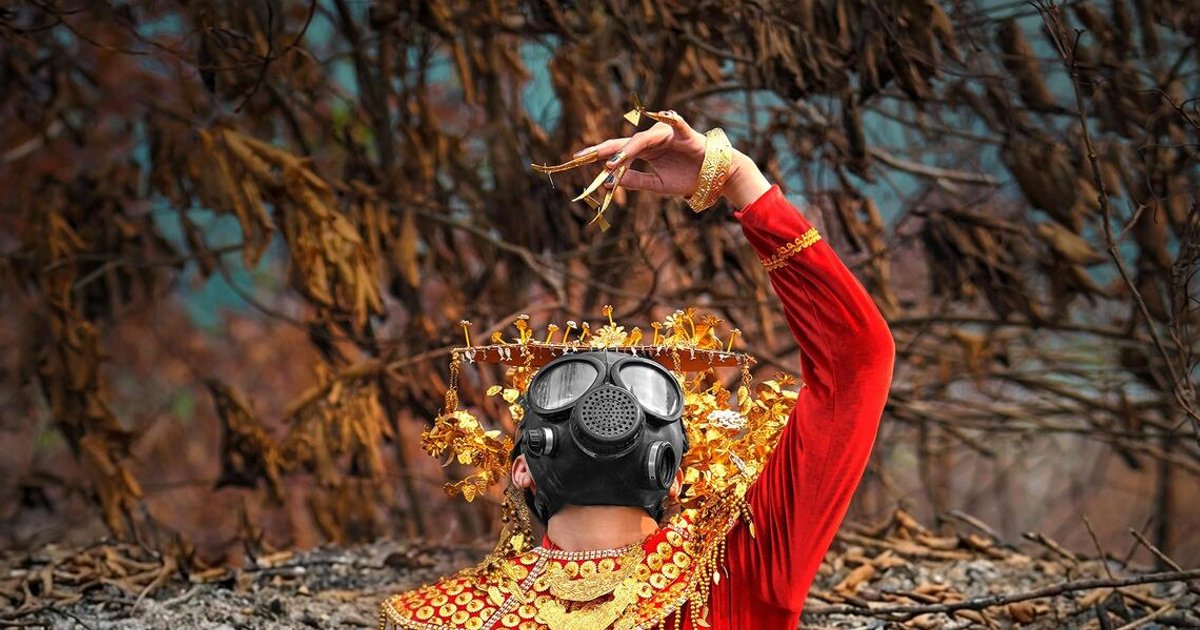
JAKARTA – In a forested area outside Palembang, a dancer dressed in Aesan Paksangko, the intricate ceremonial attire of South Sumatra, performs the tari tanggai, a traditional welcome dance. The scene changes abruptly: now, she stands amidst charred trees. She reaches for a full-face gas mask and continues her dance.This scene is part of a performance art project titled Tarian Kehancuran Budaya (The Dance of Cultural Destruction) by Palembang-based art collective Jaga Api that has gone viral in Indonesian social media.“In South Sumatra, it feels like the fires keep happening every year. So the idea that I had was: is the haze our culture now?” Pebri Yansyah, 33, a visual artist and member of Jaga Api, told The Straits Times.As smoke from fires in Sumatra and Kalimantan once more spreads across South-east Asia, driving up respiratory illnesses, causing school closures, and disrupting flights, individuals are responding with more than just complaints.From creating memes and works of art to implementing more practical measures like providing masks and health care, people from both within and outside Indonesia are coming up with various ways to express their concerns and show solidarity with one another.Laughing, and dancing, through the smokeFor many, the initial response has been humour. In Singapore and Malaysia, content creators and netizens have taken aim at the Indonesian government’s handling of the haze crisis in various ways.Singaporean content creator Calvin Chua, for example, posted a video repeatedly asking “Who do we fine?” for the smoke that has enveloped many parts of the island.Malaysian account @isawkwardguy, who routinely makes videos poking fun at the friendly rivalry between South-east Asian countries, made a video mocking Indonesian government spokesperson Syahganda Nainggolan’s claim that the country also sends oxygen to Malaysia. “Thank you for the oxygen,” he says sarcastically.Many Indonesians joined in instead of taking offence. “Fine our government, you have the people’s blessing,” one reply to Calvin Chua’s post read.For Jaga Api, social media turned out to be an unexpected amplifier. The group drew inspiration from Tarian Kehancuran Budaya, a 2024 painting by Mr Pebri which was part of a series of works featuring masks. They adapted it into a performance, video and photo series, which was shot on Sept 7. The group premiered the video at a public forum in Palembang in October, where civil society groups encouraged them to post the work online.The response surprised them. “We used local symbols from South Sumatra, so we thought only people from South Sumatra would relate,” Pebri said. Instead, it spread across Indonesia, garnering tens of thousands of likes and drawing the attention of popular Indonesian social media aggregators like USS Feed and Cretivox.“Art may not be the solution, but it can be an inspiration for the solution,” Pebri said.The work has inspired at least one other group: in Ketapang, West Kalimantan, Zwageri Generation, the youth division of non-profit conservation organisation YIARI, has choreographed and performed its own dance.Photographs posted by the group on Oct 17 show young dancers, mostly in their late teens, in traditional Dayak clothing, gas masks and rubber boots dancing on burnt peatland.Members of Zwageri Generation performing a traditional Dayak dance while wearing gas masks and rubber boots on burnt out peatland in Ketapang, West Kalimantan. PHOTO: JAGA API“The ground was actually still warm when we got there,” Dieka Pertiwi, education and awareness manager at YIARI, told ST.Dieka said that Zwageri Generation had been inspired by Jaga Api’s posts and wanted to do something similar. “Sadly, it was so easy to find a place to do the shoot. The location was just a kilometre away from the YIARI office, and there was burnt peatland everywhere you look,” she said.The dancers were performing Ma’alap Senggayung, a ritual practiced by the Dayak Pesaguan people to seek blessings from their ancestors for a fruitful harvest during the tree-flowering season.“What are we going to pray for, when the trees are already gone?” Dieka said. “This is our way of raising this issue in a way that resonates more with others, instead of directly criticising those in power.”Breathing roomFurther east in Palangkaraya, Central Kalimantan, the Ranu Welum foundation – an indigenous youth movement – is taking a more practical approach by setting up shelters for local residents to find temporary refuge from the haze.“Most people in Kalimantan live in wooden houses, which makes it hard to keep out the smoke. That’s where the idea of haze shelters came from,” Ranu Welum managing director Sarasi Sylvester Sanurat told ST.The foundation, whose name means “water of life” in Dayak, began in 2014 as a group of university students making short videos on current affairs.During the 2015 haze crisis, members of the group came met with Singapore-based media company Big Red Button, who had come to Palangkaraya to hand out N95 masks.Singaporean Wally Tham, who runs Big Red Button, said that he had watched years of heated online comments achieve little and wanted to see the problem up close.“If we weren’t so angry, what would we actually learn and see?” Tham said.The partnership grew into haze-safe shelters: permanent buildings equipped with air filtration, health workers, oxygen tanks and medicine. The first three opened in Palangkaraya in 2019. Today, 26 operate across Central, West and South Kalimantan, run with partner organisations that provide their facilities and staff.The shelters are free and open to anyone during the day, and has served over 3,000 people this fire season.Residents in Palangkaraya, Central Kalimantan, at a haze shelter run by the Ranu Welum foundation. PHOTO: RANU WELUM“Most people who come to a shelter complain of coughing or shortness of breath,” Sarasi said. “Many come because they can’t afford to go to a conventional health facility. They might have a BPJS (national health insurance) account, but it hasn’t been activated yet, or they haven’t updated it to their current address.”The foundation also provides financial support for patients who need treatment, as it did for a toddler in Palangkaraya a few weeks ago. “We helped get her admitted to the hospital, she hadn’t been able to sleep for three days because of the smoke,” he said.Besides the haze shelters, Tham is also working with Ranu Welum to provide better equipment to volunteer firefighters, who form most of Central Kalimantan’s firefighting force and often have to put out fires with makeshift tools.The shelters also allow those firefighters to concentrate on work, he added. “Knowing that the wives and children are safe allows the firefighters to focus.”For those located far from the fires, the groups suggest several ways to help. Sarasi said that Ranu Welum welcomes donations of masks, vitamins, air purifiers as well as volunteers with medical training.Wally, meanwhile, urged Singaporeans to look up Indonesian activists on social media and find out more about what is happening in areas hardest hit by the fires. “The degree of suffering there is much higher than what Singaporeans experience,” he said.Pebri from Jaga Api shared a similar sentiment. “We all have a role to play,” he said. “Our hope is for the general public to gain greater awareness about these issues and continue to help voice them, so that we can push those in power to act.”
From dance to clean-air shelters: How South-east Asians are turning haze anger into action
Full Article
Original Source
Read the full article at Straitstimes →KhanList aggregates and links to publicly available news content. We do not host full articles from third-party sources. Always verify important information with original sources.