
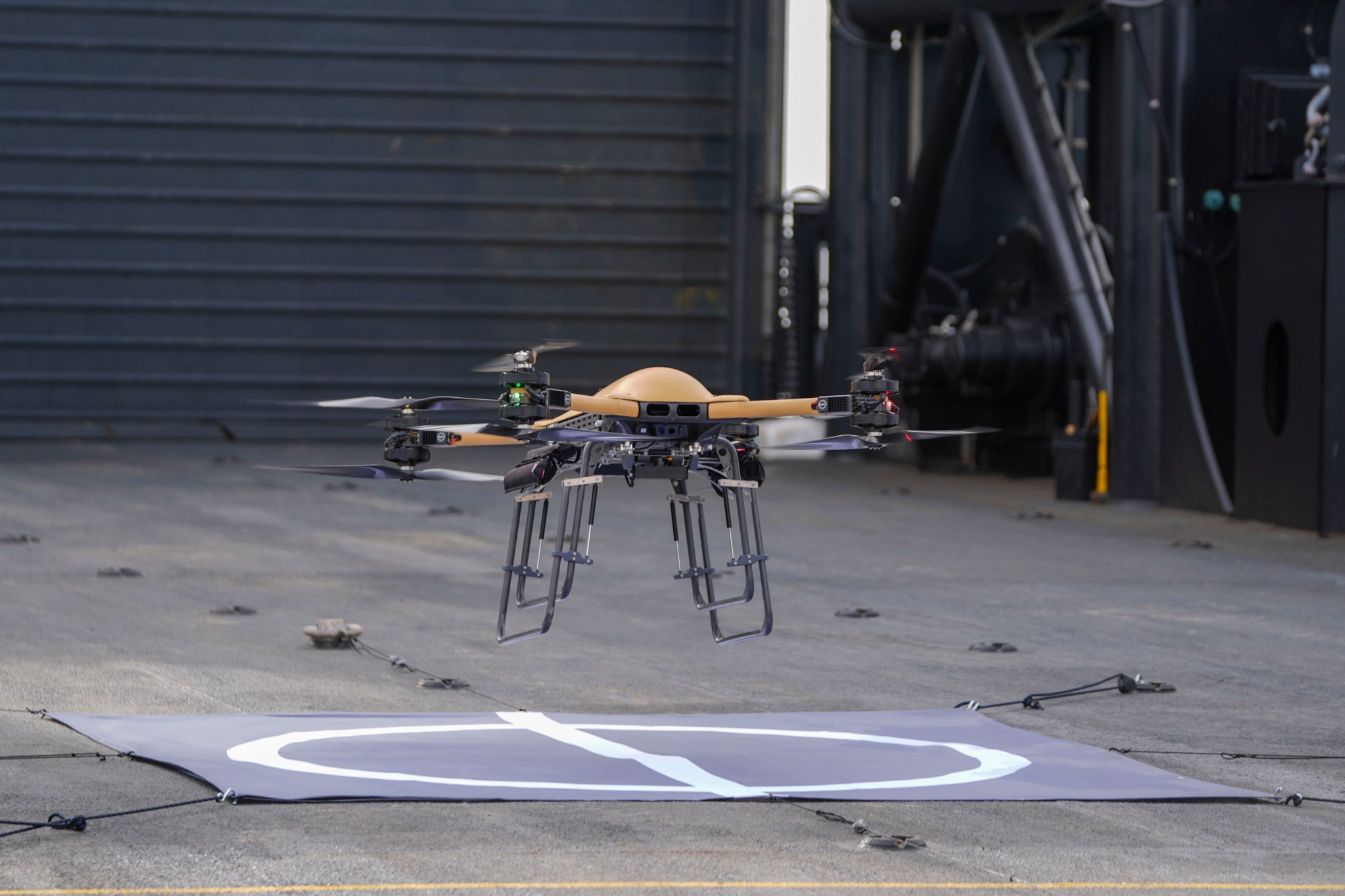
The U.S. Marine Corps and Navy will be conducting a technology demonstration for a Marine battlefield cargo drone early next year. The event, from Jan. 25 to Feb. 5, 2027, in Huntsville, Alabama, will allow contractors to display their drones for the Increment II the Marine Corps’ Tactical Resupply Unmanned Aircraft System, or TRUAS, program. TRUAS Increment II aims to “provide an organic aerial distribution capability for small-unit logistics support across the last tactical mile in expeditionary advanced base operations and distributed operations,” according to the Monday announcement by the Navy’s Air Warfare Program Management Office, which is sponsoring the demonstration. Contractors will perform up to five flights, as well as demonstrate ground setup and flight preparation. The first flight calls for a drone to transport a 100-pound payload up to 40 nautical miles under no-wind conditions, drop off the cargo either automatically or under manual control, and then return to the launch site without refueling. The second flight involves carrying and depositing a payload of 150 pounds or more out to 10 nautical miles. The UAV must have a speed of at least 50 knots per hour and fly no higher than 1,000 feet during the flights. The UAS must be capable of launch and recovery without mechanical equipment such as a catapult, arresting net or cable. “Following the two required flights, participants may be given the opportunity to perform up to three additional flights to demonstrate unique features and/or capabilities,” the Navy said. The announcement lists a variety of technical specifications. They include flying at an altitude of up to 4,500 feet and, eventually, 8,000 feet. Speed should be a minimum of 50 knots per hour, with an eventual goal of 150 knots per hour, in crosswinds of 20 to 30 knots. The Marine Corps is looking for an unmanned aircraft that can function autonomously, such as assessing the landing zone “before and during landing, day and night, and detect and avoid personnel, equipment, structures, excessive slope, and other terrain hazards.” With skies becoming saturated by drones, TRUAS craft should have safeguards against collisions, including an “organic airborne sense-and-avoid capability for manned and unmanned aircraft at cruise speed, with performance comparable to a human pilot operating under Visual Flight Rules and sufficient reaction time for collision avoidance.” The service also anticipates that its cargo drones will be forced to land under enemy fire. “TRUAS shall minimize the time required to descend from cruise altitude to the LZ [landing zone] to enhance survivability by reducing the window for hostile detection,” the announcement noted. The announcement did not specify what kind of cargo TRUAS will carry. Last month, Ukraine claimed to have performed the world’s first drone medevac of a casualty from a frontline position. Ukraine’s 92nd Separate Assault Brigade posted a dramatic video of a wounded soldier being hoisted on a sling attached to the underside of a large hexacopter. “Heavy Russian drone activity and mined terrain made evacuation by an unmanned ground vehicle impossible,” said Ukrainian media. “Working with the manufacturer, the troops developed a technical solution that allowed the heavy drone to carry the wounded soldier while remaining stable in flight, preventing it from tipping over or swaying excessively.”
Defense contractors to demo cargo drones for US Marine Corps
Full Article
Original Source
Read the full article at Militarytimes →KhanList aggregates and links to publicly available news content. We do not host full articles from third-party sources. Always verify important information with original sources.