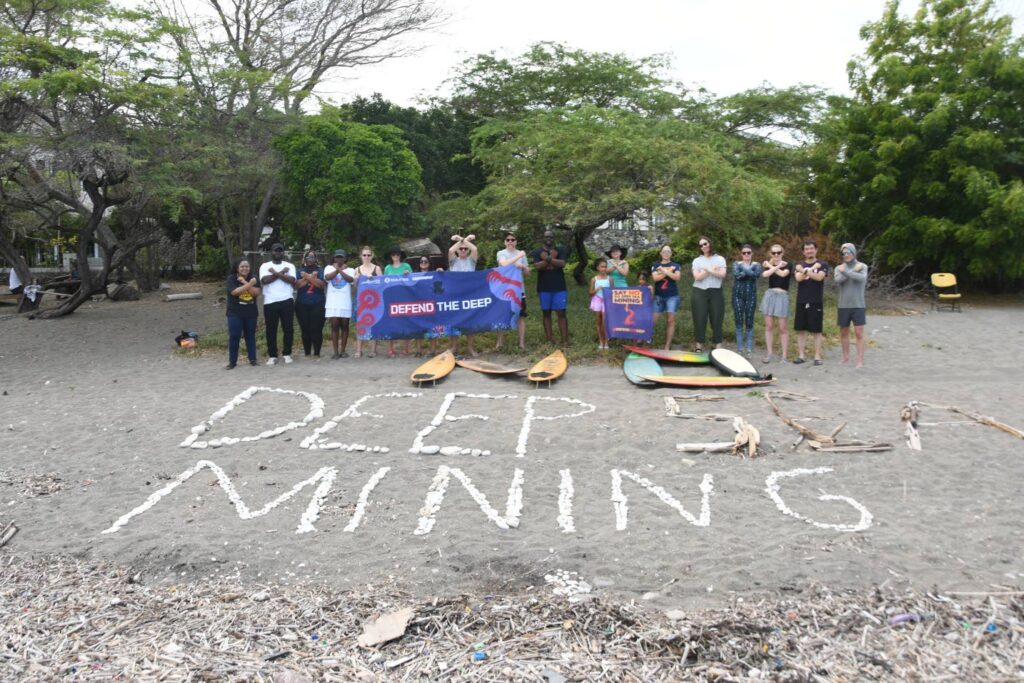
Environment activists at Jamnesia Surf Camp in Bull Bay, St Andrew, on Sunday for a symbolic paddle-out as part of a global day of action against deep-sea mining.Karl Mclarty AS global discussions on the future of deep-sea mining continue in Kingston, environmental stakeholders have renewed calls for Jamaica to support a moratorium on the emerging industry, warning that the world could be exploiting one of its least understood ecosystems before fully grasping the consequences. Scores of people took to the waters at Jamnesia Surf Camp in Bull Bay, St Andrew, on Sunday for a symbolic paddle-out as part of a global day of action held while delegates at the 31st Session of the International Seabed Authority (ISA) continued deliberations on regulations governing deep-sea mining. The demonstration celebrated Jamaica’s connection to the ocean while urging the Government to join 43 countries which have called for a moratorium, precautionary pause, or ban on deep-sea mining. Supporters of deep-sea mining argue that it would extract valuable minerals — including manganese, nickel, cobalt and rare earth elements — from the ocean floor, typically at depths of 400 to 6,500 metres. People opposed to deep-sea mining gather at Jamnesia Surf Camp in Bull Bay, St Andrew, on Sunday for a symbolic paddle-out as part of a global day of action. (Photo: Karl Mclarty) While companies view it as a means of securing critical minerals needed for the global transition to clean energy, conservationists warn it could inflict irreversible damage on fragile marine ecosystems. Against that backdrop, Jamaica Environment Trust (JET) Chief Executive Officer Dr Theresa Rodriguez-Moodie argued that governments should adopt a precautionary approach rather than rushing to regulate an industry whose environmental impacts remain largely unknown. “We know more about outer space than we know about the deep sea, which is significant,” Rodriguez-Moodie told the Jamaica Observer on Sunday. She said too little was known about the deep sea to justify commercial mining, arguing that the ocean floor should remain untouched until more scientific research is conducted to better understand the ecosystems that could be permanently affected. Jamaica Environment Trust Chief Executive Officer Dr Theresa Rodriguez-Moodie arguing that governments should adopt a precautionary approach rather than rushing to regulate an industry whose environmental impacts remain largely unknown, during an interview with the Jamaica Observer on Sunday. (Photo: Karl Mclarty) “Let’s learn more about the deep sea before we start to exploit it, before we start to plunder it. In fact, we’d like that we don’t plunder and destroy it but, at the very least, pause — pause a little bit and learn because we have a lot of lessons to learn from other extractive industries and we need to properly understand this environment before we start deciding how to destroy it,” the environmentalist said. According to the National Oceanic and Atmospheric Administration (NOAA), only about 28.7 per cent of the global sea floor has been mapped using modern high-resolution sonar. Direct exploration has been even more limited, with less than five per cent of the ocean visually surveyed and only about 0.001 per cent of the deep sea floor analysed. Rodriguez-Moodie argued that while discussions at the ISA have centred on developing regulations for deep-sea mining, creating an effective regulatory framework is difficult without first establishing a scientific baseline of the deep ocean. “The reality is that until we know more, we should take a precautionary approach, which is to protect it rather than still dive ahead,” said Rodriguez-Moodie. Co-founder of the Deep Sea Conservation Coalition Matthew Gianni argued Sunday that there were several risks that could come from mining the ocean’s floors without pragmatic scientific research and structured global policy. (Photo: Karl Mclarty) She added that Jamaica, as host of the ISA and a signatory to several international ocean agreements, has a responsibility to champion the protection of the world’s oceans. Another ocean advocate and critic of the ISA is co-founder of the Deep Sea Conservation Coalition Matthew Gianni, who argued on Sunday that there were several risks that could come from mining the ocean’s floors without pragmatic scientific research and structured global policy. “We know that we’re degrading the environment. We know that we’re losing biodiversity, species and ecosystems and so the question is: Are the nations of the world gathered here in Jamaica going to agree to continue to do so? Or, will they shift to a ‘let’s agree to protect the deep sea ocean’, at least until we can be sure that we’re not going to do it harm and let’s not continue the sort of destructive industrial resource action that we’ve been engaging in since for the last 300 years of the industrial revolution,” said Gianni. He also raised concerns over the moves of some countries to pursue seabed mining outside of the ISA framework, positing that allowing contractors to bypass the multilateral process would undermine both international law and the authority’s ability to regulate the industry effectively. Co-coordinator of the Stronger Caribbean Together Network Davia Hylton sharing her criticisms of deep-sea mining. (Photo: Karl Mclarty) “If any mining is allowed by the ISA, it has to be done for the benefit of humankind as a whole, and not just for individual companies or countries that want to make a profit or otherwise supply their domestic economies with critical raw materials…It’s important that the ISA maintains the integrity of its founding principles, and also put up a united opposition to so-called unilateral mining, or mining outside the framework of international law,” Gianni told the Observer. Co-coordinator of the Stronger Caribbean Together Network Davia Hylton, also shared her criticisms, arguing that policy makers did not yet know the implications of deep-sea mining. She challenged the ISA to think not only of what nations could earn from extractions, but also to consider the Earth as an interconnected ecosystem where humanity thrives only when nature does. “Relying on science is very important, but so is understanding that there are limits to that science. Because the deep sea is so far down, and it’s so unreachable and pristine and untouched, we won’t know, even with the best of today’s science, what those effects will be, and that doesn’t mean go ahead. “Not knowing means an abundance of caution, and caution means care. It can’t just be caution for the sake of fear, or just for the sake of caution’s sake. It’s care for the people on the planet, and those to come, and the animals and the flora and the fauna, and everything that exists,” said Hylton.
Deep-sea caution
Full Article
Original Source
Read the full article at Jamaicaobserver →KhanList aggregates and links to publicly available news content. We do not host full articles from third-party sources. Always verify important information with original sources.