
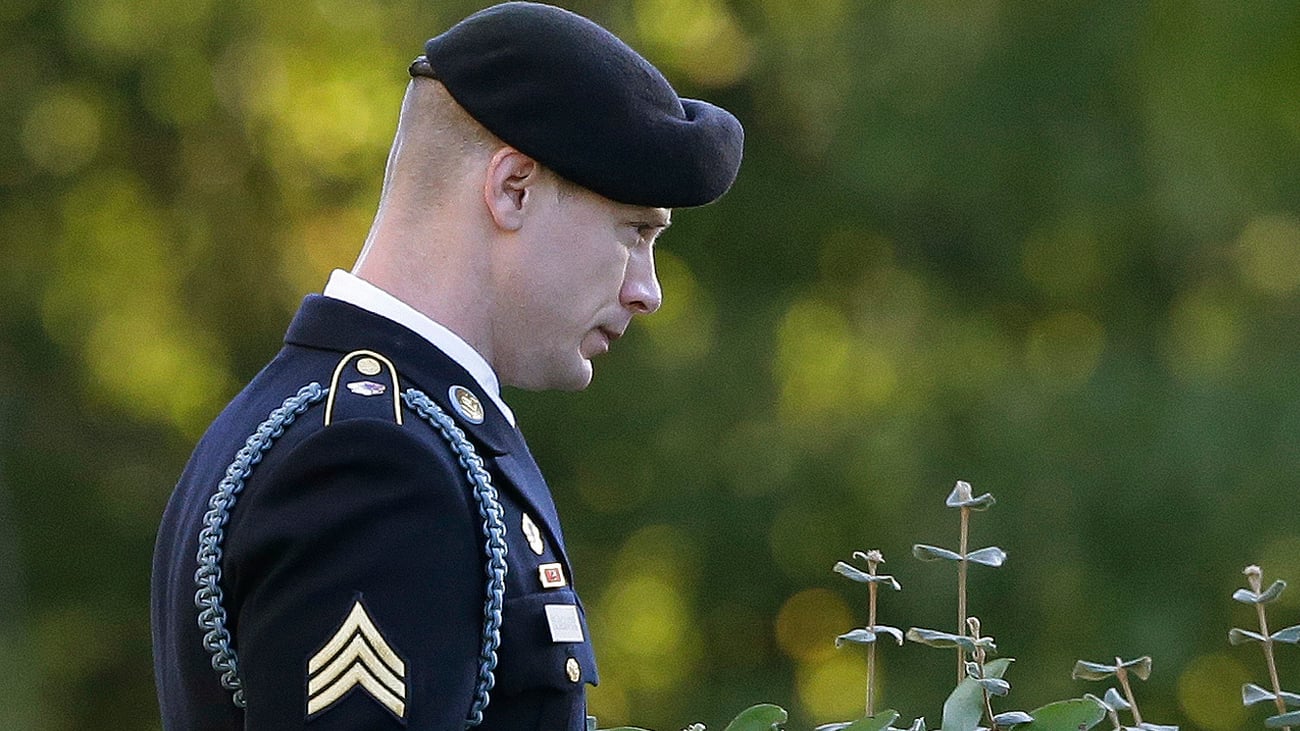
Robert Bergdahl was dishonorably discharged after leaving his unit in Afghanistan in 2009, but was immediately captured and held hostage by the Taliban for five years before a 2014 prisoner swap.WASHINGTON (CN) — A D.C. Circuit panel on Tuesday ruled a federal judge had overstepped their authority by voiding the court martial of U.S. Army soldier Robert Bergdahl, who was dishonorably discharged for deserting his unit in Afghanistan in 2009.Bergdahl, who left his post without permission to report poor conditions and leadership deficiencies within his unit to headquarters, was captured by the Taliban-allied Haqqani network and held hostage for five years. President Barack Obama approved a prisoner swap in 2014 for five Taliban members detained at Guantanamo Bay, Cuba.The three-judge panel determined that Senior U.S. District Judge Reggie Walton could not grant Bergdahl his request to vacate the court-martial judgment because federal courts lack jurisdiction on collateral review under Article III of the Constitution.U.S. Circuit Judge Robert Wilkins explained in the court’s opinion that the authority to review a court-martial judgment belongs exclusively to military tribunals who have been empowered with direct appellate review. The case is remanded back to Walton, a George W. Bush appointee, to dismiss Bergdahl’s case.Wilkins, a Barack Obama appointee, pointed to four service-specific Court of Criminal Appeals for the Army, the Navy and Marine Corps, the Air Force and the Coast Guard, where cases are heard by panels of at least three judges who are either military or civilians.Any further appeals go to the Court of Appeals for the Armed Forces, a “court of record” made up of five civilian judges appointed to 15-year terms.“‘The [Court of Appeals for the Armed Forces] must review certain weighty cases (including those in which capital punishment was imposed,) and may grant petitions for review in any others,’” Wilkins wrote, quoting from the 2018 case Ortiz v. United States.“And since 1983, the Supreme Court has been the only Article III court with statutory authority to directly review specified [Court of Appeals for the Armed Forces] decisions by writ of certiorari.”Before 1983, Congress had not specifically granted any court jurisdiction to review court-martial decisions, instead writing in the 1950 Uniform Code of Military Justice that final orders from completed court-martial proceedings are final and binding upon the courts.The 1983 Supreme Court decision in *Chappell v. Wallace*opened the door for judicial review over court-martial decisions, but only allows the court to provide relief from particular consequences — such as habeas petitions from military prisoners, Tucker Act claims for backpay due to a court-martial or military correction board decisions regarding military records — “none confers authority to vacate the military judgment itself.”Wilkins was joined by Chief U.S. Circuit Judge Sri Srinivasan and U.S. Circuit Judge Gregory Katsas, an Obama appointee and a Donald Trump appointee, respectively.On March 25, 2015, military authorities brought court martial charges against Bergdahl for desertion with intent to shirk hazardous duty and misbehavior before the enemy in violation of the Uniform Code of Military Justice. Between 2015 and 2017, the Army prosecuted Bergdahl’s case before the general court-martial at Fort Bragg, North Carolina.Bergdahl filed three motions to dismiss the case on claims of unlawful command influence, based on statements made by then-Senator and Chairman of the Armed Services Committee John McCain of Arizona and Trump as a presidential candidate.Trump had frequently criticized Bergdahl as a private citizen, presidential candidate and again as president when a military judge declined to impose a prison sentence. Trump slammed Obama for the prisoner swap that returned Bergdahl from Taliban custody.The president’s public comments and concerns regarding the military judge’s impartiality led Bergdahl to challenge his conviction in federal court, specifically seeking “collateral review of an unconstitutional conviction” and asserting his due process rights were violated.In his first motion on Aug. 1, 2016, Bergdahl highlighted McCain’s comments that if he ultimately faced no punishment, the Senate Armed Services Committee would hold their own hearing based on the fact several soldiers were injured during the search for Bergdahl.On Sept. 28, 2016, presiding military judge Colonel Jefferey Nance denied the dismissal motion on the grounds that “no member of Congress, not even the Chairman of the [Senate Armed Services Committee], holds command authority over the military.”Bergdahl’s second challenge, filed on Jan. 20, 2017, was based on Trump’s comments that included calling him a traitor and a call for him to face the death penalty. The military court denied the motion again, noting that while Trump’s comments were “disturbing and disappointing,” they were made as a private citizen running for office and thus insufficient to count as unlawful command influence.On Oct. 16, 2017, Bergdahl pled guilty to one-day desertion and misbehavior without a pretrial agreement or waiver of his dismissal claims. The same day, Trump declined to comment on the plea deal, pointing to his prior statements, and Nance applied for a position as an immigration judge and submitted his order denying Bergdahl’s dismissal motion based on Trump’s comments as a writing sample.Bergdahl renewed his dismissal motion, where Nance allowed defense counsel to examine him regarding his impartiality and any impact by Trump’s comments, before again denying Bergdah’s third dismissal motion.On Nov. 3, 2017, Bergdahl was sentenced to a dishonorable discharge, reduction to the lowest enlisted pay grade and forfeiture of $10,000 in pay and allowances. Bergdahl appealed to the U.S. Army Court of Criminal Appeals, who affirmed his conviction 2-1, after which the Court of Appeals for the Armed Services affirmed the prior rulings 3-2.Bergdahl then brought his suit in federal court on Feb. 17, 2021.Subscribe to our free newslettersOur weekly newsletter Closing Arguments offers the latest about ongoing trials, major litigation and rulings in courthouses around the U.S. and the world, while the monthly Under the Lights dishes the legal dirt from Hollywood, sports, Big Tech and the arts.Additional Reads
DC Circuit rules soldier’s desertion court martial was wrongfully revoked
Full Article
Original Source
Read the full article at Courthousenews →KhanList aggregates and links to publicly available news content. We do not host full articles from third-party sources. Always verify important information with original sources.