
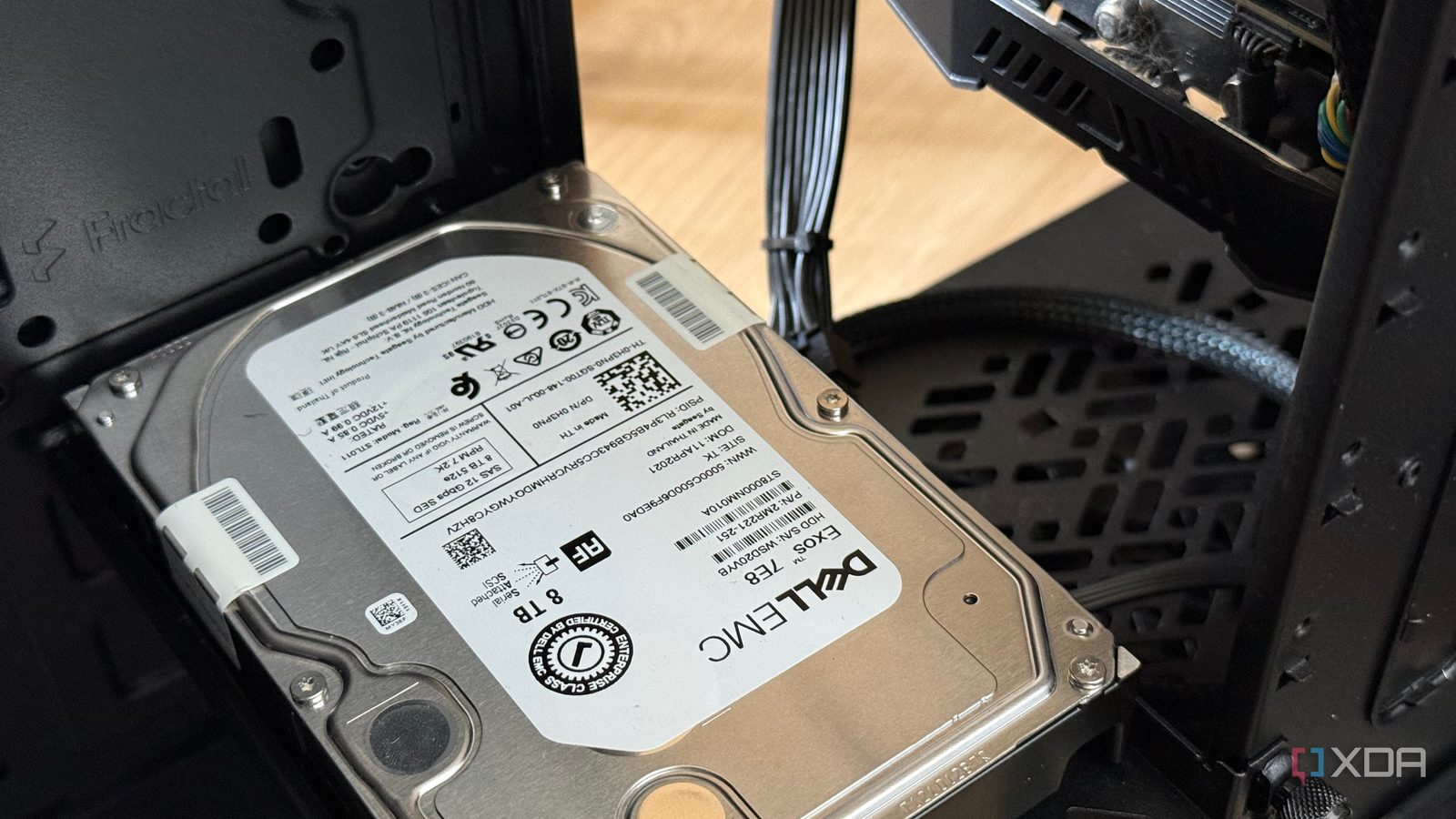
Published Sep 22, 2026, 8:00 AM EDT His love of PCs and their components was born out of trying to squeeze every ounce of performance out of the family computer. Tinkering with his own build at age 10 turned into building PCs for friends and family, fostering a passion that would ultimately take shape as a career path. Besides being the first call for tech support for those close to him, Ty is a computer science student, with his focus being cloud computing and networking. He also competed in semi-pro Counter-Strike for 8 years, making him intimately familiar with everything to do with peripherals. Every time I've gone to buy storage, price has been the leading factor in my purchase, but another thought sits concurrent to that, and it's the old addage of "don't buy too big." It's an old piece of forum wisdom that was repeated by people I respected in PC hardware circles, and even though it gets repeated ad nauseam, the data doesn't actually support it, at least not in the direction we normally think about it. Backblaze's Q1 2026 Drive Stats report, which covers 341,263 hard drives, suggests it's the wrong thing to worry about entirely. High capacity doesn't predict that a drive will fail sooner than its smaller counterpart, and in reality, model and age have far more to do with it than the TB number on the drive. Bakcblaze's biggest drives are its most reliable ones right now The data are clear on this There is a ton of interesting data to be pulled from Backblaze's reports, but one of the headline numbers from the Q1 2026 report suggests that a crucial piece of conventional wisdom about data storage is incorrect. Backblaze is one of the biggest cloud storage and backup companies in the world, and they're responsible for the storage of mind-numbing amounts of data. They also record and release detailed reports on hard drives and their failure rates, which is fascinating and useful to us enthusiasts. Backblaze now runs more than 86,000 drives at 20TB or larger, and that group posted an annualized failure rate of 0.85%, well under the fleet-wide 1.24%. Some individual models did even better: Toshiba's 24TB drive came in at 0.22% and Western Digital's 22TB at 0.38%. Annualized failure rate is the more accurate lens to view this under because it's built from drive-days rather than raw failure counts. A model deployed for only a few months gets its failures scaled to a full year of service, so drives with very different deployment histories can be compared on the same footing. This also isn't a fluke, judging by the previous year's data. Backblaze's 20TB-and-up drives had a combined AFR of 0.72%, which is also below the fleet average. Age is still the primary factor, not capacity The older a drive is, the more likely it is to fail Backblaze doesn't mix and match capacities at random, and a drive's capacity can actually be a decent indicator of when it was purchased. This is because Backblaze buys whatever capacity makes the most economic sense at the time, so generally speaking, the 24TB drives are the newest in the fleet, while the 4TB and 8TB drives have been active for much longer. The reason why that's notable is that hard drive failures closely follow a bathtub curve. There are a lot of early failures at the start of the curve, and then a long, flat stretch where there aren't many failures, up until the drives reach the end of their useable lifespan. Backblaze's biggest drives are sitting in the flat part of that curve right now, and its smaller drives are slowly starting to climb up the end of it. During its Q1 2026 webinar, the company cautioned against reading too much into the 20TB+ numbers because younger drives simply fail less. Reliability is quite spread across the different sizes of drives, too. Backblaze's standout performers for the quarter include an 8TB HGST model with zero failures across 1,026 drives and a 12TB Seagate with one failure across 1,087, alongside 14TB and 16TB models with similarly clean records. Its original 4TB HGST drives stayed in service for nearly nine years before dropping below the reporting threshold. The real risk for the home NAS user is a different one High capacity comes with more than just a bigger price tag Even if a 24TB drive was less likely to fail than an 8TB drive, there are other factors that the home user must contend with that are a bit more trivial to a company like Backblaze. When a drive in a redundant array dies, the array runs degraded until the replacement is rebuilt. During that window, the surviving drives are under sustained load, and they're often the same age and batch as the one that just died. A second failure or an unreadable sector at the wrong moment can take all of your data with it. Backblaze has redundancies on top of redundancies, and you, a home user, probably have one or maybe two layers of redundancy. Bigger drives mean longer windows of rebuilding, and therein lies the risk. Finding the balance is key for your home NAS The answer isn't to buy four-dozen 1TB drives and run them in some sort of massive array, but to find the balance. Storing all of your data on one massive drive has no redundancy, but doing so across a bunch of identical drives increases your potential for cascading failures. A reasonably-sized array of drives from different brands and models, combined with a solid filesystem like ZFS, all configured with some parity, is the way to go.
Data from 341,000 hard drives prove the 'don't buy big' rule is completely backwards
Full Article
Original Source
Read the full article at Xda-developers →KhanList aggregates and links to publicly available news content. We do not host full articles from third-party sources. Always verify important information with original sources.