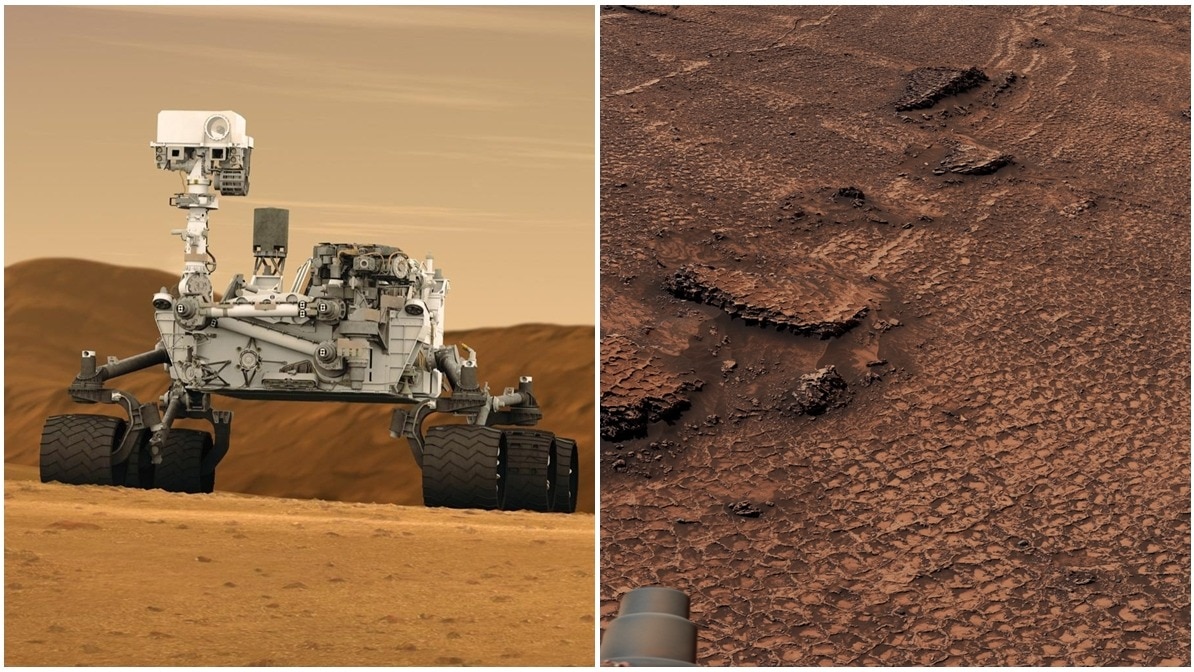
Nasa's Curiosity rover has spotted an unusual field of polygon-shaped rock patterns on the surface of Mars, a discovery that could help scientists better understand the planet's ancient environment and the geological processes that shaped it billions of years ago.The newly released images show hundreds of interconnected polygonal ridges spread across a light-toned region inside Gale Crater, where Curiosity has been exploring since 2012.While polygonal formations have been seen on Mars before, Nasa has said that the sheer extent of this "honeycomb-like" landscape surprised the mission team, prompting a closer investigation. A panaromic view of the field captured by Curiosity. (Photo: Nasa) WHAT ARE THE POLYGONS DISCOVERED ON MARS?The rover encountered the formations while travelling through an area informally known as Valle Grande. Scientists are now examining both the raised ridges and the material inside the polygons using Curiosity's suite of scientific instruments to determine how they formed.Researchers have not yet reached a conclusion. Similar polygonal patterns on Earth can develop when mud dries and cracks, when underground ice expands and contracts, or through the movement of mineral-rich groundwater. Mars, however, has experienced a very different geological history, making it too early to link the newly discovered structures to any one process. An image of rock with polygon shapes captured by Curiosity. (Photo: Nasa) The region also contains several dark-toned pebbles and cobbles scattered across the surface. Scientists are investigating whether these rocks originated elsewhere on Mars, were thrown into Gale Crater by ancient impacts, or are meteorites that landed on the Red Planet.A ROVER UNDERSTANDING MARSCuriosity was launched aboard an Atlas V rocket on November 26, 2011, and landed inside Gale Crater on August 6, 2012.Its primary mission is to determine whether Mars ever had conditions capable of supporting microbial life by studying the planet's rocks, soil and atmosphere. A field with polygon shapes captured by Curiosity. (Photo: Nasa) Over nearly 14 years on Mars, the rover has transformed scientists' understanding of the planet.It confirmed that ancient Mars once hosted lakes and rivers, detected complex organic molecules preserved in sedimentary rocks, measured seasonal changes in atmospheric methane, and, more recently, helped uncover evidence of an ancient Martian sandstorm and the first pure sulfur crystals ever found on the planet.The newly discovered polygon field adds another intriguing chapter to Curiosity's long-running mission.By analysing the rocks' chemistry and structure, scientists hope to determine whether the formations record ancient water activity, climate changes or entirely different geological processes, bringing researchers one step closer to understanding whether Mars was once a habitable world.- EndsPublished On: Jul 30, 2026 15:29 IST
Curiosity rover finds mysterious honeycomb-like polygons on Mars. See pics
Full Article
Original Source
Read the full article at Indiatoday →KhanList aggregates and links to publicly available news content. We do not host full articles from third-party sources. Always verify important information with original sources.