
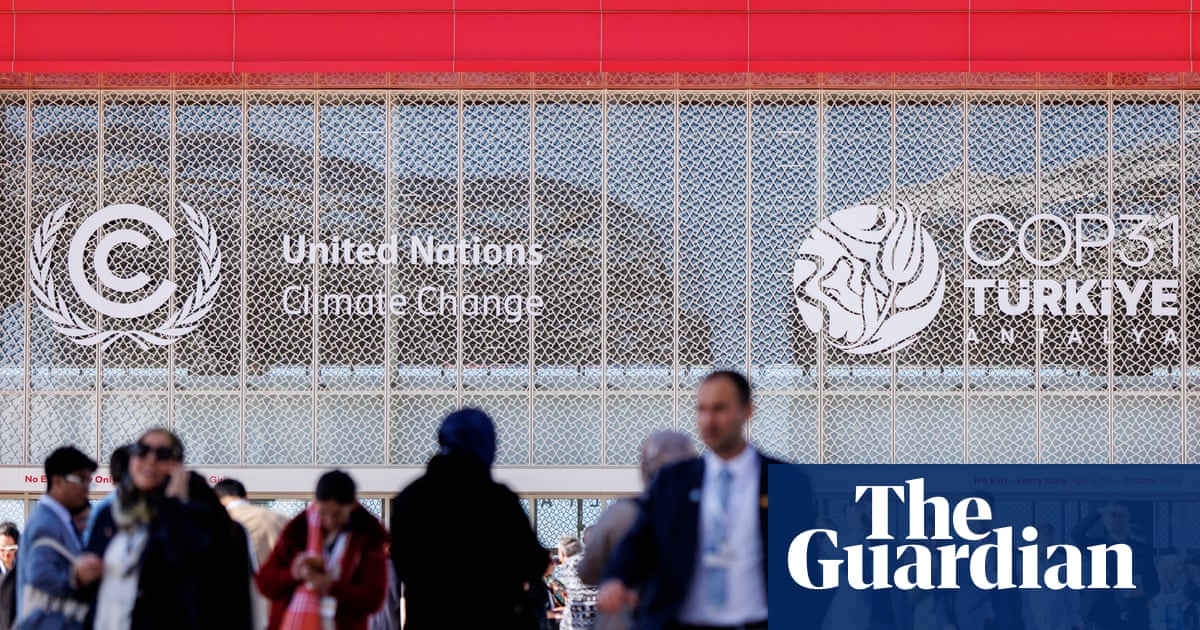
A draft text of a possible final outcome from the Cop31 UN climate summit is an attempt to “draw out parties” on their areas of agreement and disagreement, Australia’s president of the talks has said.Many countries were surprised to see a first draft of a potential “cover decision” from the fortnight-long talks early on Monday afternoon, with more than four days of negotiation still to go. The text includes several proposals regarded as highly contentious by some countries, including a call to “immediately transition away from fossil fuels”.Chris Bowen, Australia’s climate and energy minister, said: “It’s a genuine attempt to draw out parties on what they can support and what they can’t. There’ll be things in there that don’t have agreement, but if we only concentrated on the things that do have broad agreement, it would be a very thin document.”The 18-page draft, which is likely to undergo several more iterations before the scheduled end of the talks on Friday evening, includes among its 144 separate items a call to “immediately transition away from fossil fuels”, and to limit the “overshoot” of the 1.5C temperature limit targeted in the Paris climate agreement.The document in its current form lays out the competing positions of governments from tiny island states to oil behemoths and emerging economies. It needs ultimate approval by the nearly 200 nations at the UN climate summit.The Cop31 negotiations president, Chris Bowen, speaking at a press conference after the launch of the draft text. Photograph: Dogukan Keskinkilic/Anadolu/Getty Images“We’ve got to start with a broad document, concentrate on getting agreement with some difficult issues, then refine it down over the coming days,” Bowen told the Guardian in an interview.Alden Mayer, a senior associate at the E3G thinktank, said putting out the draft text at this stage was a gamble. “But it would also be a gamble to wait until later in the week. They have decided to take the ‘full monty’ approach, knowing that many of the 144 paragraphs will not survive the week,” he said. “The question is where does the presidency think the sweet spot is on the various contested issues.”The wording on fossil fuels echoes a pledge made by all countries at Cop28 in Dubai to “transition away from fossil fuels”, which had no timetable or work programme attached, but is likely to be attacked by oil-producing countries that have hardened their positions since then.There are also provisions to address the “overshoot” of the 1.5C temperature limit targeted in the Paris agreement and a target to derive 35% of global final energy from electricity by 2035, a key priority for the host nation, Turkey.Mohamed Adow, the director of the Power Shift Africa thinktank, called the text “an overgrown garden. There are lots of encouraging green shoots but there are also a lot of weeds that need to be pulled out.”He welcomed the fleshing out in the draft of a previous promise to triple finance to poor countries to help them adapt to the impacts of extreme weather. “If that language remains in the final version, it would suggest countries are starting to listen to the needs of the vulnerable,” he said.skip past newsletter promotionafter newsletter promotionThe “cover decision” is one part of the expected outcome of this Cop, and some countries – chiefly Russia, Saudi Arabia and the Arab group and some allies – have objected to having one. Cover decisions have been used in most of the 30 previous Cops, taking in resolutions that were difficult to fit into the other formal negotiating strands.Within the other strands at Cop31, there are still major disagreements among developed and developing countries. Poor nations are unhappy that no new finance is likely to be forthcoming at this Cop.“Climate action roadmaps without climate finance lead nowhere,” said Siphesihle Mvundla of groundWork, an environmental justice nonprofit in South Africa. “The global south is spending 225 times more repaying debt than they receive in climate finance from the very countries who owe them a climate debt.”Participants at Cop31. Photograph: Beyza Comert/Anadolu/Getty ImagesThe text contains items likely to be subject to trade-offs among parties. For instance, language calling for “carbon dioxide removal” was attacked by campaigners who see it as a “false solution”, but it is unlikely that some fossil fuel-producing countries would agree any text without such a reference.Bowen also said fossil fuel-producing countries did not bear more responsibility than consumer countries in tackling the climate crisis. “There are two types of countries in the world, fossil fuel exporters and fossil fuel importers, and we’re all in it together. The idea that everything [is for] fossil fuel exporters is not one I support,” he said. “We’re all part of this process, and just dealing with one and not the other is not realistic.”He refused to commit Australia, which is one of the world’s biggest producers of coal, to a phaseout of fossil fuel exports, as campaigners and some countries are calling for, but said Australia had a plan to reach net zero greenhouse gas emissions and was adjusting for a world in which all countries did the same.“I accept the logic that all countries will need to reduce emissions, and that means they’re reducing their use of fossil fuels, and that will impact on Australia’s exports, absolutely,” he said. “That’s why we’re preparing our economy for that change.”
Cop31 draft text is attempt to ‘draw out parties’ to find agreement, president of talks says
Full Article
Original Source
Read the full article at Theguardian →KhanList aggregates and links to publicly available news content. We do not host full articles from third-party sources. Always verify important information with original sources.