
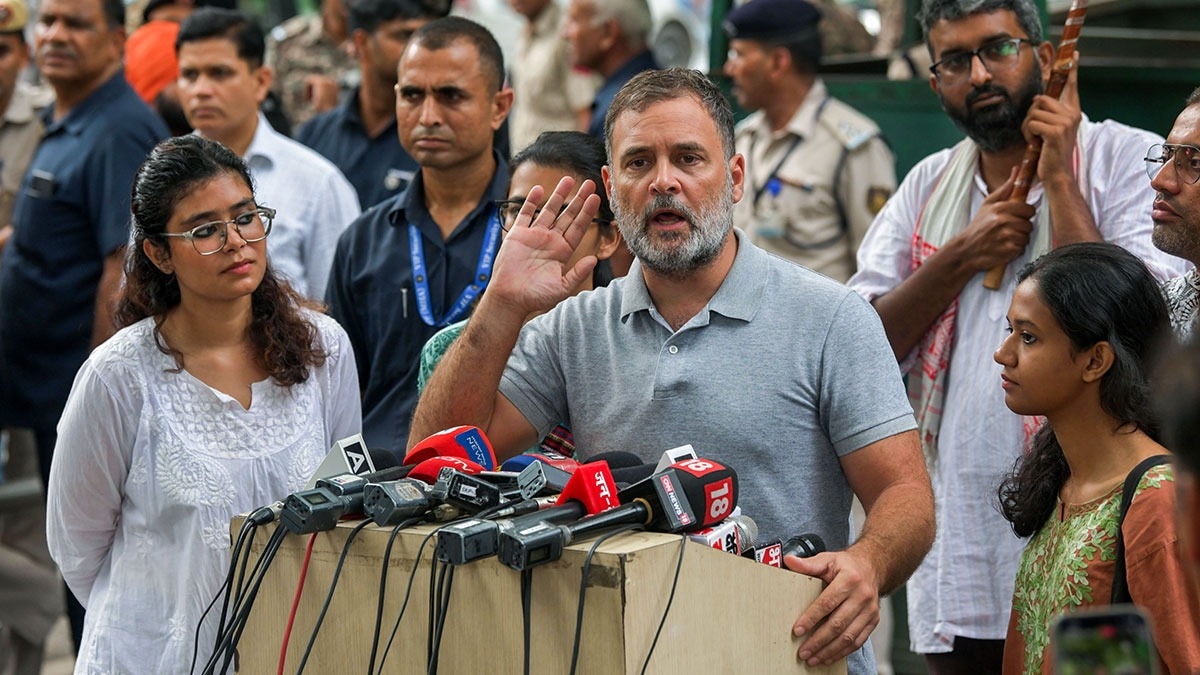
On August 22, Congress leader Rahul Gandhi took ‘Chhatron Ki Goonj’ to Pune for an event exclusively for young women. On the surface, it was a small scheduling decision, yet it reflected the outcome of a two-month debate within the Congress.The format was significant too. Students spoke about violence, restricted mobility, unequal household responsibilities, lack of economic independence, and social controls imposed in the name of safety. Rahul linked these grievances to the Jantar Mantar protests, attacking Prime Minister Narendra Modi for expressing “cultural shock” specifically at young women using abusive language while saying nothing similar about male protesters.Invoking the Gen Z idiom of “smash patriarchy”, he sought to position the Congress alongside young women challenging what he described as the BJP-RSS view that they should remain confined and controlled.Read together with the Instagram ‘Ask Me Anything’ that Rahul held for students on August 6, the Pune event reveals what the Congress has concluded about the Cockroach Janata Party (CJP): it cannot beat the CJP at its own game, will not join it, and has instead decided to borrow from the communication strategy that made the fledgling organisation an instant success. Chhatron Ki Goonj is being shaped less like a conventional political rally and more like an interactive platform where Rahul listens, uses presentations and data, lets young participants narrate their experiences and adapts his language to the audience. The Congress is also beginning to segment Gen Z, building conversations around specific constituencies, such as young women, rather than treating the youth as one political bloc.There is no war-room plan to destroy or discredit the CJP. The Congress strategy is more subtle and took shape in stages between June and August—support the grievances the CJP raises, claim a share of the political victory, maintain organisational distance, build a parallel Rahul-led youth platform, and gradually move the Congress’s language closer to the everyday concerns that made the CJP successful.The Congress also insists that this strategy did not begin as a response to the CJP. Rahul launched Chhatron Ki Goonj in Kota on June 17, three days before CJP founder Abhijeet Dipke began his sustained mobilisation at New Delhi’s Jantar Mantar. Congress leader Shashi Tharoor has made this point publicly, and it has become the party’s central defence: the Congress did not discover student politics after watching the CJP trend. Rahul was already talking about examination paper leaks and a broken examination system.Yet, for the first month of the CJP movement, the Congress deliberately stayed away from Jantar Mantar. Two anxieties shaped that decision. The first, openly expressed by party functionaries at the time, was that the CJP might be a BJP-sponsored distraction intended to weaken the Congress’s own campaigns on paper leaks and allegations surrounding donations made to the Ayodhya Ram temple.The second anxiety was older and much deeper: the memory of 2011. The India Against Corruption agitation had attacked the Congress-led central government, turned anti-establishment anger into a political constituency, created the Aam Aadmi Party (AAP) and, in 2015, given AAP 67 of Delhi’s 70 assembly seats while the Congress won none. Dipke, Congress leaders noted internally, and he has since acknowledged, worked with AAP’s social media team in 2020.That experience left the Congress with an important institutional lesson. A new anti-establishment movement does not necessarily have to defeat the ruling party first. It can instead destroy the Opposition party that appears least capable of representing change. That is why the fact that the CJP attacks Prime Minister Narendra Modi has never been automatically reassuring inside 10 Janpath.Then came the confrontation in July, which provided the clearest evidence of this discomfort. Rahul could have walked into Jantar Mantar, sat beside Dipke and placed the full institutional weight of the Congress behind the movement. He chose not to. Instead, in an unannounced demonstration that caught even some Congress leaders by surprise, he protested near the prime minister’s residence, demanding Dharmendra Pradhan’s resignation as Union education minister and action over the police treatment of protesting students.K.C. Venugopal, Lok Sabha member and AICC general secretary (organisation), credits the July outcome to both Parliament and the parallel street protest. The Opposition’s interventions in the House put the government on the back foot, he says. “Rahul Gandhi’s intervention, his direct engagement with the students and the protest outside the prime minister’s residence helped create the pressure necessary to address their concerns,” Venugopal said.Pawan Khera, Rajya Sabha member, chairman of the AICC media and publicity department and a member of the Congress Working Committee, describes the two separate stages—Congress near Modi’s home and CJP at Jantar Mantar—as a division of labour. “The CJP was where it was supposed to be, at Jantar Mantar. And Rahul ji was where he was supposed to be, outside of the prime minister’s house. And across the country, the Congress continues with its Chhatron Ki Goonj,” he said. “There is space for varied actors in a democracy.”That is the textbook formulation of the Congress’s current position. Do not attack the CJP and risk alienating the same Gen Z audience the Congress wants to attract. Do not merge with it and give it legitimacy, cadre and the status of a national Opposition force. Instead, validate the cause while insisting that the Congress has its own platform for reaching the same constituency.By August, that strategy was becoming more personalised and interventionist. On August 21, Rahul accompanied 19-year-old Sahil Lochab, who suffered serious pellet injuries during the July 20 Jantar Mantar protest and says he lost vision in one eye, to the police after Lochab complained that repeated attempts to register an FIR had failed. Rahul then sat outside the office of a Delhi deputy commissioner of police for nearly seven hours, refusing to leave until a case was registered. The police eventually filed an FIR against unknown persons while disputing allegations over the use of pellet guns; the Supreme Court had separately constituted an expert committee to examine the police action.Politically, the episode showed how Rahul is trying to attach himself directly to individual grievances emerging from the student movement rather than surrender their political ownership to the CJP. Like his July protest, the sit-in was unannounced. It allowed him to turn one student’s complaint into a broader argument about access to justice and to project persistence rather than episodic engagement. Instead of joining Dipke at Jantar Mantar, Rahul is trying to become an advocate for individual young people who personify the larger grievances over examinations, policing and institutional accountability.Khera makes both the solidarity claim and the ownership claim in the same breath. The Congress stands firmly with student movements everywhere, he said, including in Jharkhand, where it is a stakeholder in the government. The National Students’ Union of India (NSUI) and the Indian Youth Congress led protests nationwide, sparking a wider conversation about a collapsing education system, rampant unemployment, widespread corruption, sweeping censorship and the future of the youth. “We welcome that these issues we’ve long raised are resonating with people,” he said. “The veil of fear is breaking, and people are coming onto the streets for the right reasons.”But Tharoor has put the problem more candidly than almost anyone else in the party. The Congress had raised the same issues but simply failed to make them resonate. The party, he said, needed to examine whether it had failed to read the pulse of Gen Z. That is the real strategic question for the Congress: not whether it chose the right issue, but why the CJP made the issue feel as if it belonged to students while the Congress made it look like another political campaign.A Congress Rajya Sabha member, who asked not to be named, believes the problem lies with the messenger. He is not surprised that the young achieved more than his party did. When the issue reached Parliament, the Congress’s first speaker was the 84-year-old Mallikarjun Kharge, who turned to Manusmriti.“What did Manusmriti have to do with it? Instead of addressing concerns of the youth, we had an elderly leader talking about a text written thousands of years ago and arguing over it in Parliament. No wonder young people do not listen to us,” the Rajya Sabha MP said. “Young people want to look towards the future while we remain preoccupied with the past.”The numbers explain why the Congress is concerned. The CJP has 26.1 million followers on Instagram compared with Rahul’s 15.2 million. Dipke says nearly 70 per cent of his followers are under 28. Many do not identify with any political party. And it’s more worrying for the Congress when he says that they are unhappy not only with the government but also with Opposition parties for failing to hold it accountable.This is precisely the constituency Rahul has spent years trying to reach. The Bharat Jodo Yatra and the Bharat Jodo Nyay Yatra transformed a distant dynast into a politician willing to listen. The Congress went from 52 Lok Sabha seats in 2019 to 99 in 2024, perhaps gaining 41 seats along the yatra routes. Alliances, candidates and state-level anti-incumbency contributed their share, but the yatras remain the Congress’s one genuinely successful political innovation after 2014. The uncomfortable part for the party is that Rahul’s own political opening—porous, decentralised and friendly towards movements—is also what helped legitimise the style of politics now competing with him.His recent interventions suggest an attempt to take that model further. With the 18-29 age group likely to constitute a substantial part of the electorate in 2029, the Congress is experimenting with a mix of youth-specific conversations, individual advocacy and disruptive street action to build a constituency around Rahul distinct from both the BJP and the CJP.For Congress strategists, more worrying than Dipke’s social media reach is what he has begun doing on the ground. On August 15, he launched ‘School Thik Karo’, a campaign in which citizens audit rural government schools. Dipke’s message is simple and politically powerful: if government schools are good enough for ordinary people, why do ministers, education officials and even government-school teachers send their own children to private schools?That distinction matters. A paper leak creates anger. A broken school creates an opportunity to organise people. Every school is a fixed location, every parent a possible participant, every missing toilet or absent teacher a story to tell, and every repair a visible success. This gives the CJP an advantage over the Congress’s main national campaign since August 2025—‘vote chori’. Electoral integrity is an important issue, but to an ordinary voter it can appear distant and complicated. A leaking classroom roof is immediate, visible and easy to understand.The Congress has decided to expand Chhatron Ki Goonj to nearly 800 cities, with Rahul attending some of them personally. The party is also trying to move from agitation to governance. Rahul and Congress president Kharge have asked the chief ministers of party-ruled states to prepare concrete plans for restructuring their education and examination systems, in consultation with education experts, student organisations and other stakeholders, and to submit them within a month. This is one part of the response that rests on something the CJP does not have: state governments and organisations.It is here that the Congress believes it still has an advantage. Praveen Chakravarty, Rajya Sabha member and chairman of the AICC technology and data cell, calls speculation about a CJP threat meaningless. The CJP may choose to form a political party, he says, but its electoral impact in 2029 will be extremely limited, and the Congress does not need to worry about it as a political competitor.Chakravarty rates this much more highly as a youth movement. Jantar Mantar and Pradhan’s resignation that followed showed that young people can come together and bring about material change, and that has created a new confidence among the youth that could have a significant impact on Indian politics.Chakravarty also disputes the claim that the CJP achieved in a month what the Congress could not achieve in years or that the CJP alone is now performing the role of the Opposition. The movement came after 10 to 12 years of growing disenchantment with the Modi government, arose around a specific student issue, and was amplified considerably by Rahul and the Congress.“Had Rahul Gandhi and the rest of us not protested outside the prime minister's residence, continuously raised the issue in Parliament and amplified the students’ demands, would the CJP protest have had the same effect or produced the same outcome?” asked Chakravarty. In his reading, the July outcome came from the youth movement and the amplification it received from the principal Opposition party, not from one succeeding at the expense of the other.Manickam Tagore, Lok Sabha member and president of the Tamil Nadu Congress, makes much the same argument in geographical terms. The CJP’s leadership and principal base are in Maharashtra, where several established parties and their leaderships have weakened or become disorganised while the BJP remains organisationally strong, and the CJP may therefore find political space there. Beyond that, Tagore does not see the same reach. “The issues it raises may have national resonance, but the political impact of its leadership, organisation and style is likely to remain confined to a few states,” said Tagore.Tagore’s precedent, once again, is 2011. The BJP had already been raising corruption before AAP emerged, he says, but Anna Hazare's agitation and AAP’s entry gave the issue enormous momentum. Corruption became a national issue while AAP’s electoral gains remained largely confined to Delhi. Elsewhere, it was the better-organised BJP that captured the space and converted anti-Congress sentiment into votes in 2014.The Congress has similarly been raising the current concerns since 2019, and the CJP gained traction within 20 or 30 days because its arrival gave those issues fresh momentum. “But generating momentum around an issue and converting it into sustained electoral support are two different things,” Tagore said. “Ultimately, the party with the organisation and the ability to articulate that sentiment across the country will benefit from it.”The analogy, however, has a second half, and it is the part the Congress cannot ignore. In Delhi, the one state where AAP did manage to turn momentum into seats, the party it replaced was the Congress.It would also be wrong to suggest that what happened in July 2026 has no precedent. Modi allowed the land acquisition ordinance to lapse in 2015 after strong opposition and protests. In November 2021, his government repealed the three farm laws after farmers had protested for almost a year. What was different this time was the symbolism. This was a movement that began on social media, was led by a very young communicator, moved from memes and online campaigns to Jantar Mantar, and eventually forced the resignation of a Union cabinet minister.For the Congress, therefore, the CJP is both an opportunity and a warning. Its agitation has weakened the government on issues the Congress has itself been raising and has shown that Gen Z can be mobilised against the political establishment. But it has also exposed the Congress’s own weakness in communicating with the same generation.The party’s answer is not to confront the CJP nor to embrace it, but to learn from it while relying on what a movement still lacks: organisation, elected governments and a national political network. Rahul’s increasingly targeted youth events, unannounced street interventions and willingness to attach himself to individual student grievances are part of that adjustment.Whether it will be enough depends on two things that remain unresolved—whether the CJP can turn digital energy and street mobilisation into durable political organisation, and whether the Congress can change its language, messengers and methods quickly enough to stop a new political force from occupying the space it believes should naturally be its own.Subscribe to India Today Magazine- EndsPublished By: Shyam BalasubramanianPublished On: Aug 24, 2026 18:49 IST
Congress's CJP strategy: Keep distance, learn lessons, own the youth agenda
Full Article
Original Source
Read the full article at Indiatoday →KhanList aggregates and links to publicly available news content. We do not host full articles from third-party sources. Always verify important information with original sources.