
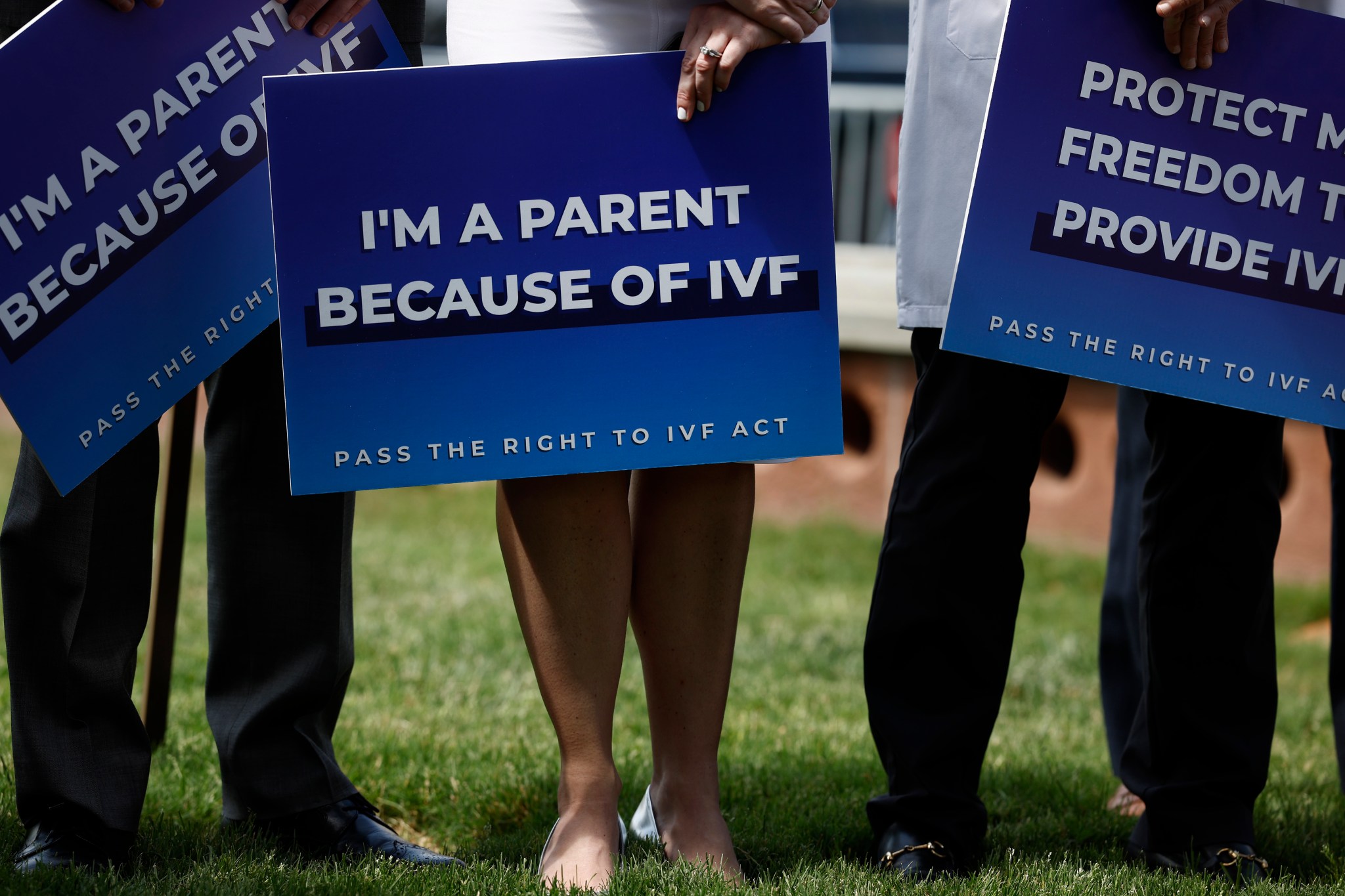
Editor’s note: The views expressed in this op-ed are solely the author’s and do not reflect the official positions or policies of the U.S. government or the Department of Defense. The United States asks military families like mine to accept a lot: deployments, repeated moves, long separations and lives built around the needs of the service. It should not deny us the medical care we need to have children. TRICARE, the health insurance program for our nation’s service members and their families, refuses to cover in vitro fertilization in most cases, denying service members the tools they need to start a family. Congress has not yet fixed this failure, but it can now. As lawmakers consider this year’s defense bill, they have another opportunity to expand IVF coverage. They have come close before: Last year, both chambers included IVF coverage in their versions of the bill, only to drop it from the final legislation. For my family, those decisions have real consequences. My wife and I want children. But every conversation we have about parenthood runs into the same hard fact: I inherited the BRCA1 mutation, which is linked to prostate and pancreatic cancer in men and substantially higher risks of breast and ovarian cancer in women. Any child we conceive would have a 50% chance of inheriting it, and with it, their own significant cancer risk. This is an all too familiar story in my family. My mother carries the same mutation. She survived breast cancer in her forties, underwent a mastectomy and continues to live with significant complications from her treatment. My sister carries it, too. At just 30, she is currently undergoing chemotherapy for breast cancer and will need a mastectomy, along with the removal of her uterus, fallopian tubes and ovaries. That is an inheritance my wife and I hope never to pass on, but we are struggling to find a path forward. Without military insurance covering IVF and genetic testing, the cost of these treatments creates an enormous barrier. A single cycle of IVF costs between $12,500 and $25,000, and most patients require multiple cycles. I am an Army officer, and my wife is a nurse. If we saved for several years, we might be able to afford the treatment ourselves. But a junior enlisted soldier making roughly $32,000 a year in basic pay may have no realistic way to absorb tens of thousands of dollars in fertility care. Infertility affects thousands of service members. Among active-duty women surveyed by the Department of Defense, 15% reported having tried unsuccessfully to conceive for at least a year; among married active-duty women, that figure rose to over one in five. Nearly one in three women receiving fertility services reported paying that cost out of pocket due to lack of coverage. Much of this gap in coverage stems from the military insurance’s exceedingly narrow eligibility standards, which only cover IVF when infertility was caused by a qualifying service-related illness or injury. That requirement creates two problems and a massive obstacle to care. First, many barriers to having healthy children have nothing to do with military service. Many, like mine, are inherited genetic conditions. Second, even when infertility is related to military service, proving that connection can be extraordinarily difficult. Infertility often has multiple possible causes, and in roughly 30% of cases, doctors cannot identify a cause. Congress can remove these barriers in this year’s defense bill, but neither chamber has yet produced a complete solution. The House-passed version of this year’s National Defense Authorization Act included IVF coverage but specifically excluded genetic screening. The Senate completely rejected IVF coverage in committee. But the bill is not finalized, and Congress still has the opportunity to do right by military families. First, the Senate could adopt a bipartisan amendment adding IVF coverage back before its final vote. Second, if it does not, House and Senate negotiators could include coverage for both IVF and genetic testing when they reconcile the two bills. This should not be controversial. IVF coverage is already available through federal employee health plans and offered by half of large private employers. Even members of Congress have access to plans that cover IVF. Military families should not be asked to accept less. For now, my wife and I discuss more than just baby names, nurseries and strollers. We talk about oncologists and chemotherapy. We worry about whether one day our future daughter might confront the same diagnosis and hardships as my mother and sister. If I had left the military for a civilian career, we could have had access to an employer health plan that covered the treatment we needed. Choosing to serve my country should not make it harder to have children. Congress can still change that this year. It is time to finally provide military couples with comprehensive IVF coverage, including the genetic testing that families like mine desperately need. Capt. Parker Bolstad is a second-year student at Yale Law School and an active-duty Army officer.
Congress has access to IVF. Military families like mine do not.
Full Article
Original Source
Read the full article at Militarytimes →KhanList aggregates and links to publicly available news content. We do not host full articles from third-party sources. Always verify important information with original sources.