
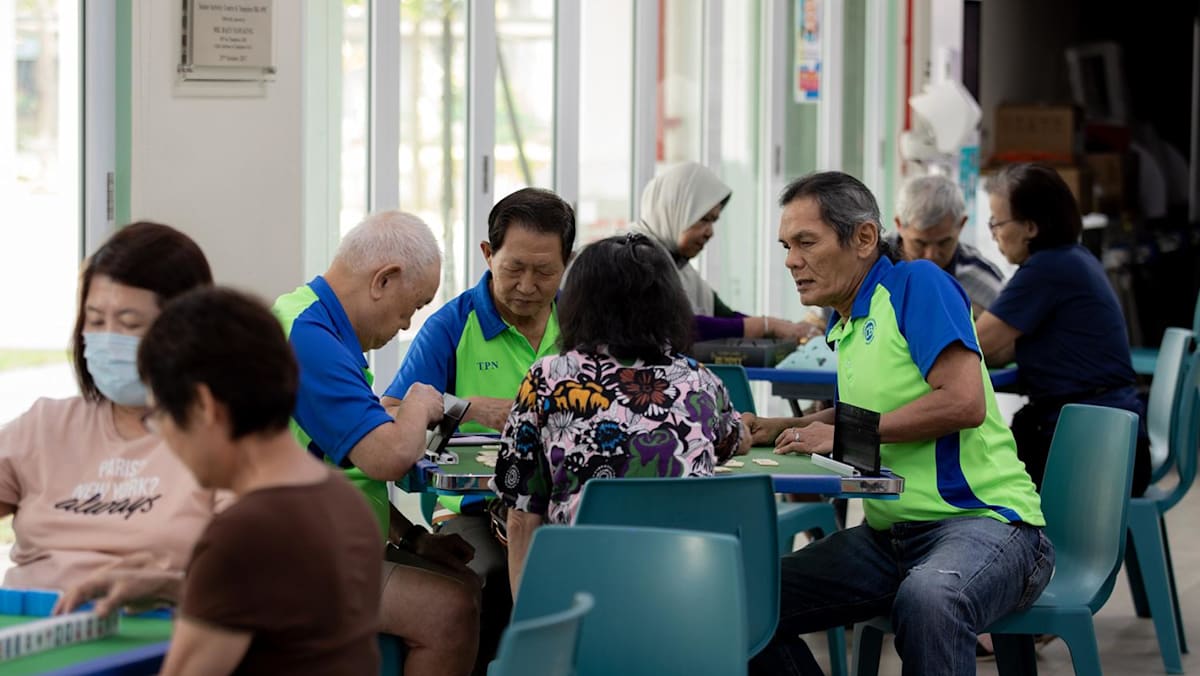
Commentary Helping seniors age well takes more than hospital care, says Agency for Integrated Care Manpower and Talent Chief Derek Tan on Community Care Day (Nov 1). Seniors participating in activities at Lions Befrienders Active Ageing Centre at Block 499C Tampines Avenue 9, on Sept 7, 2023. New: You can now listen to articles. This audio is generated by an AI tool. SINGAPORE: When we think about healthcare, hospitals typically come to mind - doctors, nurses and other medical professionals who diagnose illness, provide treatment, and help patients recover.Less visible are the many people working to support seniors in their daily lives. Community therapists at Senior Care Centres help seniors rebuild strength and confidence after a fall. Programme executives at Active Ageing Centres coordinate activities to keep seniors socially engaged. Care staff at nursing homes lead exercises to keep residents more active.They are part of the diverse community care workforce that enables seniors to continue living well beyond the walls of a hospital. Their work will only get more important now that Singapore is officially a super-aged society with more than one in five aged 65 and above. By 2035, this is expected to reach more than one in four. Expectations around ageing are changing. Each successive generation of seniors will be more informed, more digitally connected and more confident in making their own healthcare decisions. Many want to remain active, socially connected, and independent for as long as possible. Meeting the needs of future seniors must go beyond treating illnesses. It will take different forms of support across different stages of ageing to help them age well in the community. WHAT COMMUNITY CARE MAKES POSSIBLEThe relationships community care professionals build may not be easily measured, but they often determine whether a senior is able to age well in the community.Take the example of a programme executive at an Active Ageing Centre who noticed that a regular senior had stopped attending activities. After checking in, she learned that the senior had become anxious about leaving home after a fall and gradually withdrew from social activities.Working with volunteers, family members and colleagues, she gradually helped the senior regain confidence and return to community activities with friends. What began as missed activity sessions turned out to be a sign that someone was at risk of becoming socially isolated. Identifying that risk and intervening early is often as important as providing healthcare.And it is precisely this breadth and depth of community care that is largely invisible to most of us. Unlike acute healthcare settings where interactions are often brief and episodic, community care professionals journey alongside seniors over time. They become familiar and trusted faces, and those sustained relationships become a source of reassurance for families and seniors.MORE THAN “BASIC” TASKSAs Singapore ages, shrinking family sizes and an increasing number of seniors living alone will add to the demand for community-based support.But the challenge is not simply about numbers.Community care can often be seen as helping with “basic” caregiving tasks. But the work can be physically demanding when transferring seniors from a wheelchair to a bed or toilet, or emotionally taxing when seniors lash out in frustration at needing help with small things. It can also be highly complex, requiring difficult conversations about worsening conditions and changing needs.Technical competencies matter. So do resilience, empathy and adaptability.So strengthening the sector is not simply about filling vacancies. It is about equipping people with the right skills and creating opportunities to build meaningful careers in community care.Efforts are under way to strengthen training, skills development and career progression within the sector. The Agency for Integrated Care has partnerships with the Institutes of Technical Education and polytechnics to strengthen entry pathways.Sector-wide job redesign initiatives also help to uplift the value and attractiveness of care roles. The Community Care Career Track, for example, provides clearer progression pathways and opportunities for skills development for both newcomers and existing staff.For many community care professionals, one of the most rewarding aspects of the job is seeing seniors regain confidence, reconnect with others, and rediscover a sense of purpose and identity. Seniors participating in an acting activity at a Lions Befrienders active ageing centre. (Photo: Lions Befrienders) RECOGNITION MATTERS WHEN CARERS ARE OFTEN INVISIBLEBut recognition matters too. Community care often remains invisible until we ourselves, or someone we love, need its support.Community Care Day on Nov 1 is an occasion to acknowledge the people whose work often goes unnoticed, but whose contributions make ageing in place possible every day.If Singapore is to age well, we need to broaden our understanding of what care looks like, and who makes it possible.Supporting seniors is not the responsibility of a few professions working behind institutional walls. It takes a network of people across homes, neighbourhoods and care settings working together.Ageing well does not happen by chance. Derek Tan is Chief of Manpower and Talent at Agency for Integrated Care.
Commentary: The invisible workforce helping Singapore age well
Full Article
Original Source
Read the full article at Channelnewsasia →KhanList aggregates and links to publicly available news content. We do not host full articles from third-party sources. Always verify important information with original sources.