
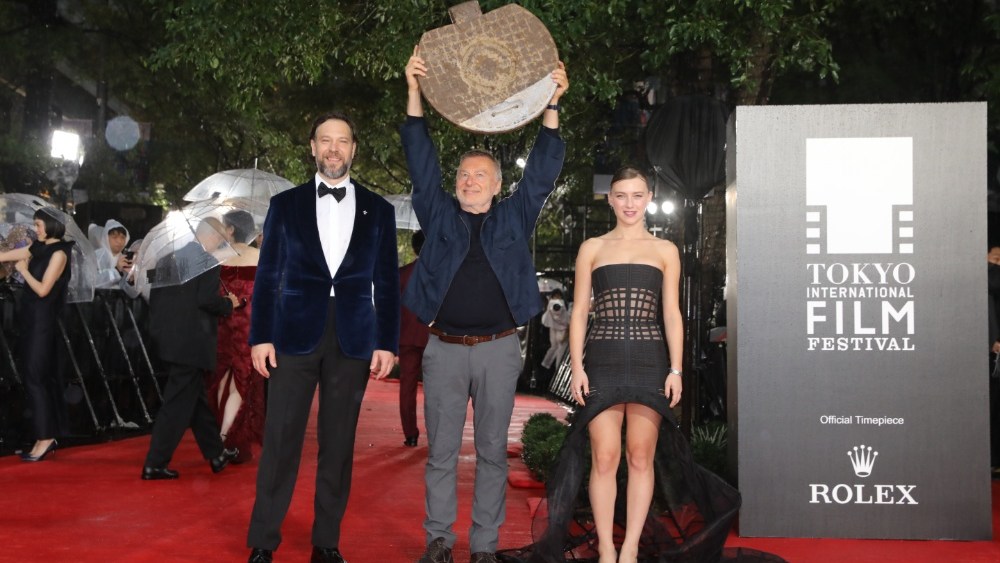
Milcho Manchevski, the North Macedonian director whose 1994 debut “Before the Rain” won Venice’s Golden Lion and earned an Oscar nomination, is back in competition at the Tokyo International Film Festival with “Sister Brother Manhole Cover,” a project stalled for years after he accused his country’s film agency of corruption. The dark comedy centers on Malina and Viktor, a sister and brother getting by on the fringes of post-Communist Macedonia by pilfering busts of national heroes cast in bronze, along with manhole covers, and selling off the metal. When a job goes wrong and Viktor is seriously hurt, Malina cuts a deal with a crooked doctor. The siblings end up on the run, and eventually take shelter with the doctor’s wealthy mother, Todora, who is blind. “I wanted to tell a story about a kind of love that is rarely at the center of films, yet it is so beautiful: the love between a brother and a sister,” Manchevski tells Variety. “It can be fierce, complicated, sometimes painful, but also unconditional like no other type of love.” The director also took inspiration from traditional Macedonian songs about sisterly love, which he calls poignant and at times shocking. Of Malina and Viktor, he says: “They are far from ideal people. But they are deserving of understanding and affection. I am interested in people as they are, with their contradictions, not as examples of how people should behave. Idealized characters make for bad movies.” The siblings break the law and sometimes make terrible mistakes, but Manchevski says he had no wish to turn them into objects of pity. He sees the pair’s refusal to think of themselves as victims as a way of reclaiming their own story. “Poverty is not picturesque. It is painful and dehumanizing,” he says. “We should be careful not to romanticize it, or to pretend that people can simply overcome it through courage and good intentions. The circumstances that shape these lives are real, and they are political.” For Manchevski, the busts stand for the values a society claims to honor while it abandons people like Malina and Viktor. “They would rather eat than venerate the past and the ideals,” he says. The manhole covers are a plainer matter: everyday infrastructure that turns into a hazard the moment it disappears. Still, he adds, the covers “keep a lid on the ugliness of society, on its septic underground” until someone pries them loose. Manchevski says he follows the characters and story rather than picking a genre in advance. “People can be in terrible circumstances and still be funny. They can be cruel and generous, ridiculous and moving,” he says. “Life does not keep these things separate, so I don’t see why a film should.” Having grown up under Communism, he is wary of films that advertise their moral correctness and offer little beyond it. “Art should not talk down to its audience,” he says. “It should open up a world, not close the discussion.” He also mourns what he calls “the death of beauty in cinema today,” though he hopes the tide will turn. The film unfolds in two movements. The first trails the siblings through a rough and unpredictable world; the second tightens its focus on their inner lives. “Sticking to genre rules is a bit like painting by numbers – it makes the film easier to make and easier to digest, but it seldom results in profound work,” Manchevski says. This marks Manchevski’s fourth time at the Tokyo festival; his previous feature, “Kaymak,” played in competition in 2022. “I love Tokyo,” he says. His other credits include “Dust,” which opened Venice in 2001, “Shadows,” “Mothers” and “Willow,” as well as an episode of HBO’s “The Wire.” “‘Sister Brother Manhole Cover’ was blocked for years after it was financed. After I reported corruption at the Film Agency that goes all the way up to the Prime Minister, I faced political harassment, a media smear campaign and criminal proceedings,” Manchevski says. Manchevski reported the alleged corruption in 2020 and 2022, and the project had first been approved in 2023. He says he won two court cases against the agency and that institutions including the State Commission for Prevention of Corruption and the State Audit Office confirmed his account. The Venice Film Festival, Whistleblowing International and Transparency International lent him their support. “I would not reduce the situation of all Macedonian filmmakers to my own experience,” he says. “But when a filmmaker can be prevented from working for political reasons, that points to a dysfunctional society.” Once the blockade lifted, Manchevski shot the feature alongside “Good People,” a documentary about those affected by the Kočani nightclub fire. The film comes from a specific place, but Manchevski says the problems it explores are not confined to North Macedonia. “It is not only a third world problem. We are all the third world today,” he says. “In that sense, wealth inequality is the new global warming.” The film is a co-production spanning North Macedonia, Bulgaria, Serbia, Albania, Italy and the U.K. Manchevski values the exchange of perspectives such partnerships bring, provided there is trust and a shared commitment to the work. “Many festivals and (European) film funds have abdicated their role in promoting and boosting brave films,” he says. “This ecosystem is complicit in the death of beauty in contemporary cinema.” The cast includes Sara Klimoska, Filip Trajkovikj, Sonja Mihajlova, Dejan Lilich and Petar Mirchevski. Stefano Falivene served as cinematographer and David Munns as production designer. Jane Kortoshev produced the film, with Banana Film as the lead production company. Gala Film (Bulgaria), Sense Production (Serbia), Tirana Film Institute (Albania), Berkeley Media Group (U.K.) and Amarcord Production co-produced, in association with Italy’s Augustus Color. Galina Toneva, Milan Stojanovic, Agron Domi, Yu-Fai Suen, Ludovico Cantisani d’Auria and Augusto Pelliccia are co-producers, while Manchevski, Kiril Kirilov, Svetlana Levicheva and Tatiana Forese serve as executive producers. Steven Barnes is the U.K. associate producer. Coccinelle Film handles world sales. Next up for Manchevski is “Homecoming,” which he describes as a simple story about regret and forgiveness. “I am elated that I finally cracked it open by reducing it to its emotional and narrative essence,” he says.
‘Before the Rain’ Director Milcho Manchevski on Tokyo Competition Title ‘Sister Brother Manhole Cover,’ Whistleblowing and the ‘Death of Beauty’ in Cinema
Full Article
Original Source
Read the full article at Variety →KhanList aggregates and links to publicly available news content. We do not host full articles from third-party sources. Always verify important information with original sources.