
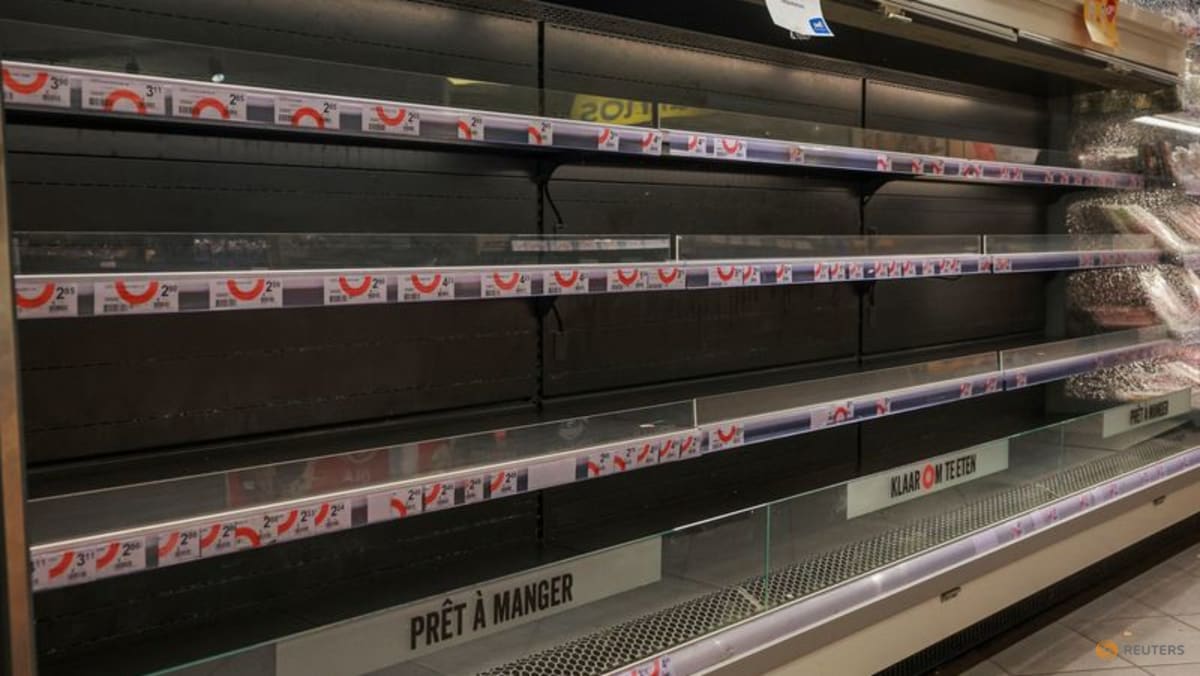
Commentary Recent cyberattacks involving public LED screens and supermarket refrigerators have exposed security weaknesses in many electronic devices connected to the internet, says RSIS’ Benjamin Ang. Empty refrigerated shelves are seen inside a store in Brussels, Belgium after an overnight IT incident affected cooling and freezer systems on November 2, 2026. (Photo: Reuters/Stephanie Lecocq) New: You can now listen to articles. This audio is generated by an AI tool. SINGAPORE: A string of apparently unrelated cybersecurity incidents around the world has revealed risks that any country, including Singapore, could be vulnerable to.Last month, hackers hijacked public LED screens in Kluang, Malaysia, and broadcast obscene content at several locations. Around the same time and halfway across the world, other hackers sabotaged internet-connected commercial refrigerators across Europe, manipulating temperature settings to rise as high as 50°C and causing widespread food spoilage, operational disruptions and even store fires.There were also reports of freezer malfunctions in US military bases earlier in August, which the Pentagon is reportedly considering to be a suspected hack following the fridge outages in Europe.VULNERABILITIES REVEALEDThe incidents have exposed security weaknesses in the growing number of electronic devices connected to the internet over the past decades. One common reaction online has been to question why public LED screens and supermarket refrigerators need to be connected to the internet.The reality is that connecting these devices can be very cost-effective for businesses in terms of remote monitoring, control, troubleshooting and energy saving. The same convenience has made smart devices increasingly attractive to home owners too. Yet many of these connected devices are designed for low cost and efficiency, rather than for security or resistance to cyberattacks. The problem is compounded when such devices are beyond updating, embedded in organisations that lack the expertise to manage them, or when business operations and facilities become too reliant on internet-enabled monitoring to remove vulnerable devices completely.This gives a determined attacker many targets to choose from, whether the motive is profit, espionage, politics, ideology, notoriety, thrill-seeking, personal grudges or mental health issues.In the case of the LED screen cyberattack in Malaysia, the hacker group that claimed responsibility said its aim was to expose security vulnerabilities rather than extort money.France on Nov 9 accused Iran of being behind the string of hacks into the country’s supermarket fridges and freezers in October. Iran has denied responsibility. THE WIDER RISKSThe latest events have also revealed the risk of cyberattacks going beyond stolen passwords and leaked information to now carry the wider risk of disrupting everyday life and essential services, such as food supply and healthcare. In France, refrigerators at three regional blood banks were hit in early November.The proliferation of hacking tools was already a growing threat in November 2023 when I wrote about how two bank outages in Singapore had implications on national security. Today, the growth of AI-enabled hacking and AI-enabled information campaigns means that these capabilities are now available to wider range of potential attackers, as can be seen from the recent spate of cyber incidents involving healthcare entities and other organisations in Singapore.There is an even bigger risk of a hybrid attack, defined as one that combines two or more tactics, such as cyberattacks and information campaigns. This can be seen recently when unknown attackers hacked Ukraine's emergency alert app to broadcast fake nuclear strike and chemical threat warnings directly to Ukrainian citizens.For example, if attackers had hacked supermarket refrigerators to spoil the food, while simultaneously spreading rumours on social media and public LED screens, they could have caused widespread panic. If the rumours had targeted ethnic or religious or immigrant communities, they could have triggered social unrest. Savvy attackers may not even need to launch a cyberattack, if they take advantage of high-profile incidents like the recent Microsoft outage or the mass grounding of aircraft to spread fear. WHAT CAN BE DONEEven as we expect device manufacturers to build devices more securely, we as corporate and individual customers should do our part by ensuring security patches are updated and passwords are secured. Some basic cyber hygiene practices can prevent many avoidable attacks.It will also be essential to brace for the scenario of a hybrid attack. The key to surviving is building resilience, or the ability to recover after an attack.This can be seen in how organisations build technology and cyber resilience by putting in place back-ups, buffers, redundant systems, and multi-sourcing. For example, when global check-in systems failed in 2024, the airlines who switched to manual processes were able to carry on business, albeit at a slower pace. Similarly, local supermarkets with employees checking on refrigerators regularly throughout the day will be able to spot discrepancies before food spoilage can occur.Having accurate and transparent updates from the authorities during a crisis is also just as important as restoring affected systems, as this helps dispels rumours and prevents panic. Our research into conspiracy theories reveals that misinformation thrives where information is lacking, so authorities can fill that void with facts. For instance during the COVID-19 pandemic, the government revealed the major warehouse holding Singapore's multi-month food stockpiles to counter rumours and panic buying. But the responsibility does not just rest with governments and businesses.Individuals can help stop false or misleading information from spreading by checking a message against official and trustworthy sources before sharing or by reporting a falsehood. These small steps keep rumours away from the people who are most vulnerable to them.We can also make basic preparations for when essential services like power or banking fail. The Singapore Civil Defence Force provides guidance for preparing an Emergency Ready Bag, which should include a torchlight and batteries, first aid kit, cash, water and dry foodstuff and N95 masks.No country can stop every cyberattack. Attackers will keep looking for vulnerable devices, whether it is a billboard or a refrigerator. A cyber incident paired with false rumours can do even more harm, but we can all help build resilience. The aim is not only to prevent as many attacks as possible, but also to recover quickly from the ones that happen.Benjamin Ang is Senior Fellow at the S Rajaratnam School of International Studies (RSIS), Nanyang Technological University. This piece was written with contributions from Mak Kah Jun, member of ISACA.
Commentary: Cyberattacks on billboards, supermarket fridges reveal a new test of resilience
Full Article
Original Source
Read the full article at Channelnewsasia →KhanList aggregates and links to publicly available news content. We do not host full articles from third-party sources. Always verify important information with original sources.