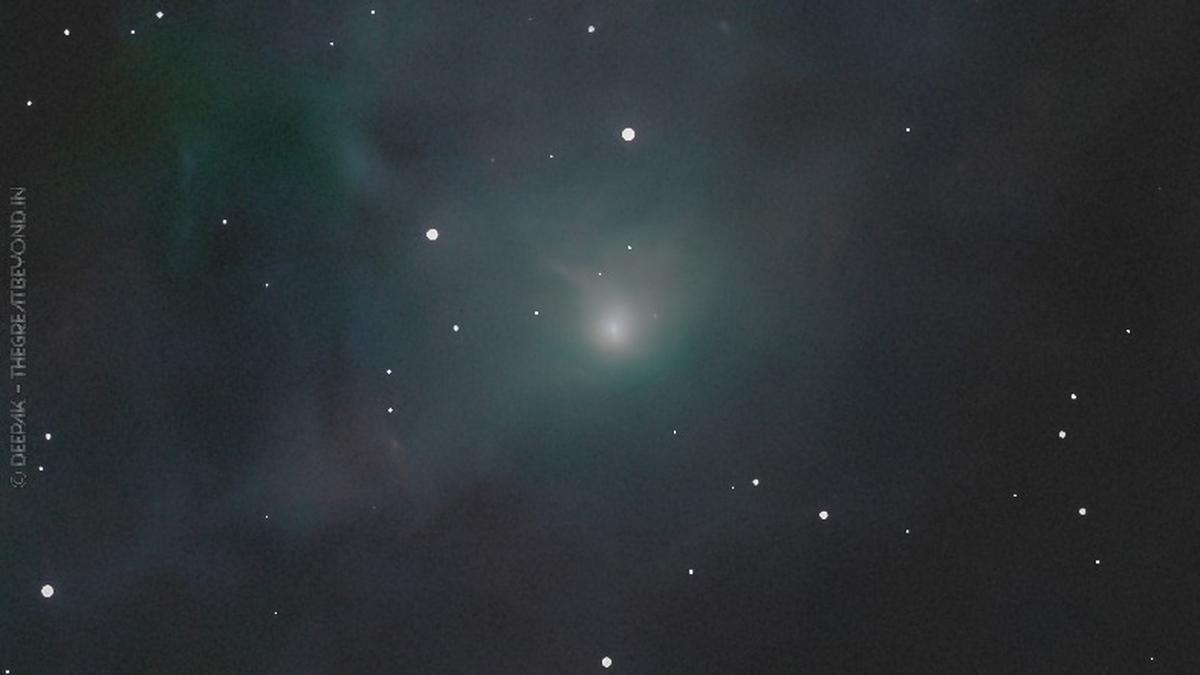
Image of Comet 10PTempel 2 captured using a Seestar S50 smart telescope by astronomy enthusiast Deepak Choudhary. Comet 10P/Tempel 2, which was last visible from Earth five-and-a-half years ago, can now once again be spotted by observers in Bengaluru in the wee hours till early August.Comet 10P/Tempel 2, which was discovered in the year 1873, completes one orbit around the Sun every 5.5 years. Its last sighting was in 2021.“The comet has already been brightening during June and July. It will continue to be observable through late July, and the first half of August, with peak visibility occurring around August 2 and 3. After that, it will gradually fade as it moves away from both the Sun and Earth,” said Deepak Choudhary, a Bengaluru-based astronomy enthusiast.Mr. Choudhary had captured the image of the Comet 10P/Tempel 2 in the wee hours of July 26 using a Seestar S50 smart telescope.Periodic coment“Comet 10P/Tempel 2 is a periodic comet. Although it returns every 5.5 years, it is not always easily visible from Earth. Its visibility depends on how close it comes to Earth during that return, and its position relative to the Sun in our sky. Depending on how bright it becomes during that apparition, some returns are excellent, while others are much less favourable,” Mr. Choudhary said.He added that the period between late July through early August offers the best opportunity to observe the comet as it is expected to brighten to around magnitude 8–9, making it accessible to binoculars under dark skies.Not to naked eye“It is unlikely to be visible to the naked eye, as the comet is expected to remain too faint for most people without optical aid. It is also visible in binoculars and small telescopes with an aperture of 80–150 mm, ” he added.Mr. Choudhary said that it is best to observe the comet from a dark location away from city lights on a clear, moonless night.Closest to sun“On August 2, the comet is closest to the Sun. The Sun’s heat causes more ice to vaporise. This creates the comet’s coma (the fuzzy cloud around the nucleus) and tail, making it brighter and easier to observe. On August 3, it will be closest to the Earth,” he said. Published - July 27, 2026 01:52 pm IST
Comet which makes appearance once in 5.5 years now visible in Bengaluru sky
Full Article
Original Source
Read the full article at Thehindu →KhanList aggregates and links to publicly available news content. We do not host full articles from third-party sources. Always verify important information with original sources.