
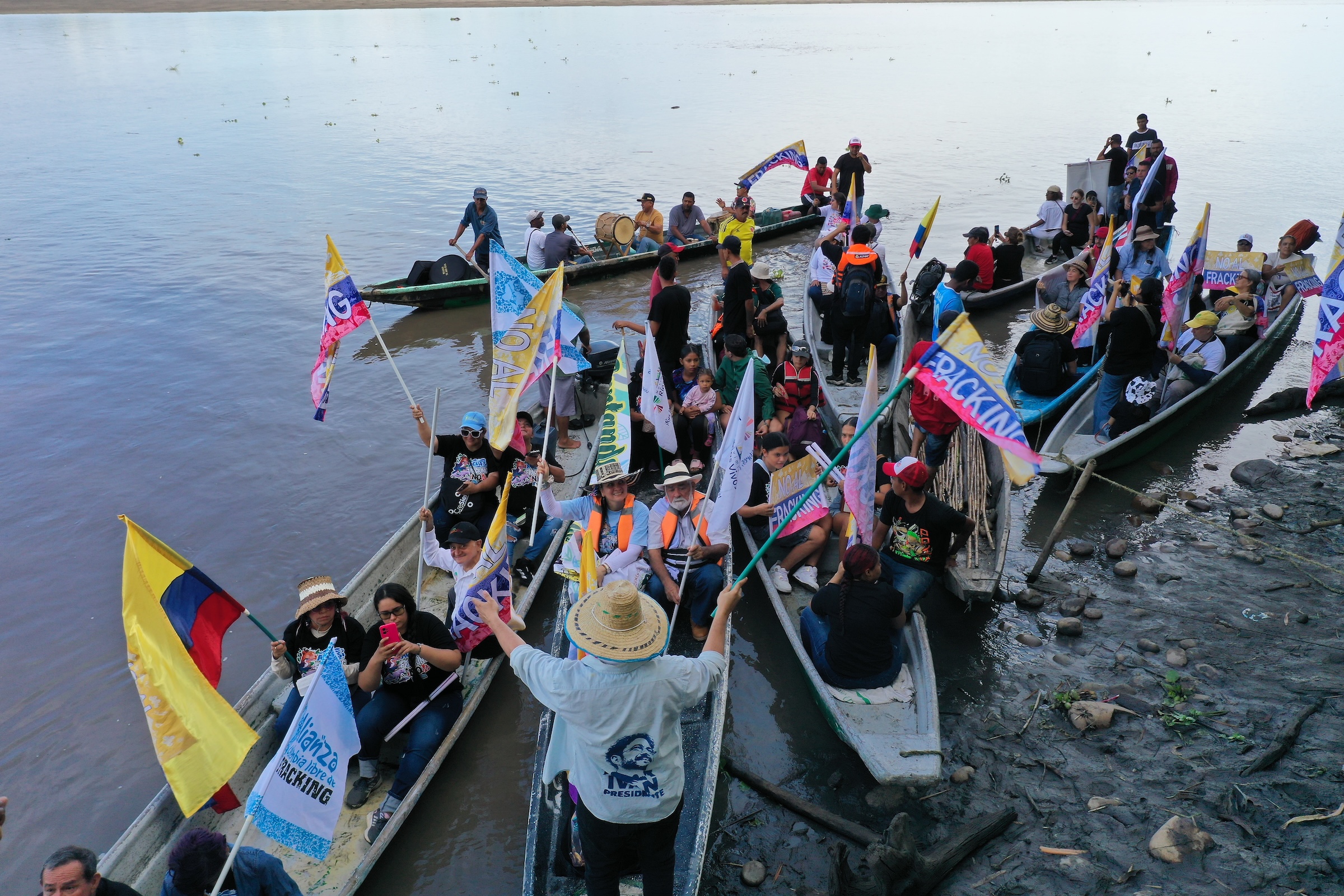
Colombia’s new president has pledged to reopen the door to fracking, reviving plans for two pilot projects in Puerto Wilches municipality that were halted under his predecessor, Gustavo Petro.Supporters say fracking could help shore up dwindling gas supplies, while critics warn it could expose communities and ecosystems to environmental risks and prolong the country’s reliance on fossil fuels.Puerto Wilches’s wetlands and waterways support communities and threatened wildlife, including West Indian manatees, Magdalena River turtles and Magdalena catfish, raising concerns over water use, wastewater, and other impacts from fracking.The debate reflects a broader tension in Colombia’s energy transition, with renewable energy expanding rapidly even as delays and declining gas reserves fuel calls for continued investments in fossil fuels. PUERTO WILCHES, Santander – On the banks of Colombia’s largest river, the town and the wider municipality of Puerto Wilches sit amid a maze of wetlands and floodplain lakes in the Middle Magdalena Valley. Residents spend weekends at riverside swimming spots known as balnearios and nearby waterfalls, while local fishermen still cast their nets each morning. Since about 2018, however, the municipality has been a focal point in Colombia’s debate over how to balance energy security, environmental concerns, and the transition away from fossil fuels. In 2021, Puerto Wilches was chosen for two pilot projects to test whether fracking, a method of extracting oil and gas trapped in shale rock, could be done commercially in Colombia, targeting shale formations beneath the region. Then-President Gustavo Petro later halted the projects, arguing that Colombia should move away from fossil fuels rather than expand oil and gas production. But that policy could soon be reversed under the new government of right-wing populist Abelardo de la Espriella, who during his campaign pledged to “fully open the door to fracking.” De la Espriella and other fracking supporters say the practice could help shore up Colombia’s gas supplies. According to the National Hydrocarbons Agency (ANH), the country’s proven gas reserves will only last another 5.9 years at the current production rate and with no new discoveries. Critics, however, warn that fracking could expose communities and ecosystems to environmental risks while also deepening Colombia’s reliance on fossil fuels, just as the country has been accelerating its clean energy transition. The Middle Magdalena region. Image courtesy of AguaWil. “Everything that surrounds this municipality would be affected by fracking,” said Jorge Ardila, a Puerto Wilches local and member of the Committee for the Defense of Water, Life and Territory (AguaWil). “We have to resist it — and defend the wealth of our territory, including its cultural heritage, wildlife and natural environment.” Fracking, or hydraulic fracturing, involves injecting high-pressure fluid into shale rock to release trapped oil and gas not easily accessible by conventional drilling. Although widely practiced in countries such as the United States and Argentina, in Colombia fracking has never moved beyond the pilot stage. President de la Espriella has dismissed environmental concerns related to fracking, comparing it to a civil engineering project. He argues that, just as a properly built bridge should not fail, fracking carried out correctly should not pollute. But many researchers, environmentalists, and residents disagree that the risks can be so easily contained. They’ve raised concerns that these projects could affect sensitive ecosystems and the species that depend on them, including feeding and breeding sites for the West Indian manatee (Trichechus manatus), as well as the critically endangered Magdalena River turtle (Podocnemis lewyana) and endangered Magdalena catfish (Pseudoplatystoma magdaleniatum). A 2026 study surveyed the area of the proposed fracking pilots in Puerto Wilches and recorded 50 reptile species, including endemic and poorly known species. The authors said conservation measures are already needed because of threats to local populations, including livestock farming and oil-palm cultivation. Water has become one of the most contentious issues, especially with more than 36,000 people living in the Puerto Wilches municipality. While fracking is often linked to concerns about groundwater contamination, many researchers say the risks are more complex than fluids migrating from fractured rock into drinking-water supplies. “There is a huge vertical distance between where the shale is and where the groundwater aquifer is,” Dan Soeder, a geologist and author of the book Fracking and the Environment, told Mongabay by phone. “The fluid just doesn’t move up because it’s against gravity.” But according to Soeder, this doesn’t rule out other environmental risks, particularly from surface spills, wastewater management, and water use. “The first question is, where are they getting the water from? The second question is, what are they doing with the wastewater?” he told Mongabay. Residents of the municipality of Puerto Wilches are concerned about how fracking will impact waterways and ecosystems. Image courtesy of Alianza Colombia Libre de Fracking. Fracking requires large volumes of water. According to Colombia’s Ministry of Environment, a single well can use up to 38,000 cubic meters (10 million gallons) of water — roughly 15 Olympic-sized swimming pools. Wastewater from fracking can be difficult to treat or reuse because it often returns from the well mixed with salts and other substances from underground formations. Managing it safely remains a key challenge. One of the biggest unknowns is what commercial fracking would actually look like, including how many wells could be drilled and what the cumulative impacts would be. For some experts, that uncertainty is precisely why the pilot projects were proposed. Two research pilot projects, Kalé and Platero, were planned in the Middle Magdalena Valley by Ecopetrol, Colombia’s state-owned oil company, together with U.S. major ExxonMobil. The ANH, the national regulator, awarded contracts in 2020 and 2021 for the projects, designed to assess the environmental, social, and economic impacts of fracking. Kalé obtained an environmental license in March 2022, but no hydraulic fracturing had begun by the time the new government at the time of Gustavo Petro moved to halt the projects later that year. “The pilots, in principle, were looking to establish baselines for biodiversity, noise pollution, dust, surface water and groundwater,” said Flover Rodriguez-Portillo, executive director of the Colombian Association of Energy Geologists and Geophysicists (ACGGP). “It is very difficult to protect something you don’t know, and very difficult to manage risks you don’t know. There is no better way to manage and protect a territory than by knowing it.” A history of extraction Others, however, argue that pilot projects in areas like Puerto Wilches still have implications for local communities. “Puerto Wilches is not a laboratory,” said Juliana Mendoza, a geologist and member of the Alliance for a Fracking-Free Colombia. “It is a territory where communities depend on the water cycle — fishermen and farmers — and it is already affected by a long history of oil extraction.” For residents, opposition to fracking is also linked to decades of experience with the oil industry. “Puerto Wilches’s relationship with the oil industry could be described as unequal rather than reciprocal,” said Ardila from AguaWil. Although oil has been extracted in the municipality for more than 50 years, he said, many residents feel they’ve seen few benefits from extraction and are concerned about further projects. “The issue is that commercial fracking is already legal. Pilot projects are not even necessary anymore,” Ardila said. Many Colombians are concerned about the environmental effects of fracking. Image courtesy of Alianza Colombia Libre de Fracking. Under the Petro administration, fracking pilots remained suspended. Colombia, however, has never formally banned fracking. The regulations allow it to remain in place, meaning the new government could seek to revive it without needing Congress to pass a new law. Beyond the concerns of local communities, the debate over fracking has also become a question of how Colombia balances energy security with its transition away from fossil fuels. As Colombia’s proven gas reserves have fallen to their lowest level in nearly two decades, the country has become increasingly reliant on imported gas to meet demand. Supporters argue that developing new domestic sources could reduce that dependence. “There is an entire chain of economic activity that could be affected by declining reserves and growing imports,” said Rodríguez-Portillo from the geologists’ association. “Many industries in Colombia depend on gas. We use it for fertilizers, bakeries and transport. It’s what keeps Colombian society running.” However, even if Colombia moved ahead with unconventional gas extraction, production would not begin immediately. Developing commercial fracking would require years of exploration, licensing, and infrastructure construction, meaning it would not provide a quick solution to declining reserves. There are also questions over whether the depleting reserves necessarily mean Colombia must expand unconventional gas production. Colombia has identified more than 10.5 trillion cubic feet of contingent gas resources, according to the ANH, much of it offshore. However, these resources are not yet counted as proven reserves and would require further exploration and development before they could contribute to supply. Andrés Camacho, the former minister of mines and energy under Petro, said the country’s energy outlook has changed significantly since the fracking pilots were first proposed. “We are now at a point where reserves could increase significantly due to offshore discoveries. The challenge now is to ensure they come into production as soon as possible,” he said. Camacho said he’s also concerned that the change of government could slow down the energy transition. “In Colombia, the right-wing sectors are not directly [climate] denialist, but there is a discourse of delay,” he said. “What they seek is to maintain dependence on fossil fuels and to slow the pace we have tried to give the transition.” At his inauguration in August, de la Espriella said he supported an energy transition toward “efficient and diversified energy sources”. A month later, he criticized the policy of his predecessor, who cut back on signing new exploration contracts as part of his energy transition strategy. “That is not energy transition but energy dependence, which is what no policy of this government will accept,” de la Espriella said at the swearing-in of the new president of Ecopetrol. “My government is fully reopening the path of exploration and the signing of new contracts, including fracking, whatever it takes, as I said during the campaign, with absolutely every criterion of environmental responsibility,” he added. Children paint murals in Puerto Wilches. Water ecosystems are an integral part of local life here. Image courtesy of AguaWil. He also called for an end to what he described as “environmental hysteria” surrounding the activity, and backed measures by the environment ministry to speed up licensing procedures. But the Stockholm Environment Institute (SEI), a globally leading scientific authority on climate change and the energy transition, has raised concerns about the debate over the dependence on gas. “The dominant framing portrays an imminent crisis in gas supply, calling for urgent action to avoid shortfalls,” the SEI noted. “This generates a greater risk of fossil gas lock-in.” Critics argue that developing a new unconventional gas industry would require years of investment in wells, pipelines, and associated infrastructure, potentially extending Colombia’s dependence on fossil fuels even as it seeks to expand renewable energy. But Colombia’s energy transition is advancing — and its dependence on fossil fuels is declining. In 2025, coal production fell to its lowest level in 22 years, while for the first time the country generated more electricity from solar power than from coal, according to the Mining and Energy Planning Unit (UPME) under the Ministry of Mines and Energy. By September 2025, around 3.1 gigawatts of solar and wind capacity had been added to the electricity system, according to the ministry. Yet the transition has been far from straightforward. Major projects have faced delays linked to permitting processes, transmission infrastructure, and social conflicts. For de la Espriella and other supporters, fracking is not a substitute for Colombia’s energy transition, but an additional source of energy that they argue is needed to strengthen supply while that transition advances. For communities where fracking could take place, however, the question is whether greater energy security is worth the environmental and social risks of expanding extraction in their territories. Banner image: Residents in the Medio Magdalena region protest against proposed fracking. Image courtesy of Alianza Colombia Libre de Fracking. Citations: Rojas-Morales, J. A., Salazar-Guzmán, A. M., & Nieto, F. J. (2026). Annotated checklist on non-avian reptiles of Puerto Wilches, Middle Magdalena River Basin, Colombia. Biota Colombiana, 27, e1274. doi:10.21068/2539200x.1274 Pan, S., Zhang, Y., Lu, P., Yang, D., Huang, Y., Wu, X., … Guo, D. (2025). Environmental impacts of shale gas development on groundwater, and flowback and produced water treatment management: A review. Sustainability, 17(11), 5209. doi:10.3390/su17115209 FEEDBACK: Use this form to send a message to the author of this post. If you want to post a public comment, you can do that at the bottom of the page. Credits Topics
Colombia’s new government backs fracking as debate over energy future heats up
Full Article
Original Source
Read the full article at News →KhanList aggregates and links to publicly available news content. We do not host full articles from third-party sources. Always verify important information with original sources.