
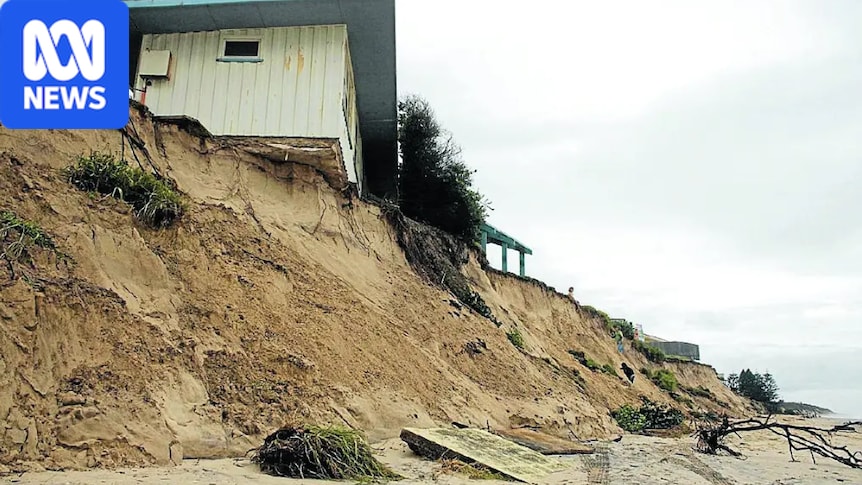
Greg Dickson might enjoy enviable ocean views, but he also faces the prospect of seeing his home washed away by the sea.His house, which sits atop the dunes at Old Bar South on the New South Wales Mid North Coast, has been identified by the MidCoast Council as being "at immediate risk" of coastal erosion.But the council's Old Bar Manning Point coastal management plan (CMP) is based on a strategy of "managed retreat".That means it will let the coastline erode naturally, without investing in permanent infrastructure to protect homes."It does put a stress on the people that live here, knowing council is not going to come and help if there is any sort of natural disaster," Mr Dickson said."I'd be right, but there's a lot of people along here who are pensioners, and that would be a disaster to them."Greg Dickson's Old Bar beachfront property is underpinned by geofabric sandbags. (ABC Mid North Coast: Emma Siossian)MidCoast Council is the first in the state to gain NSW government certification for the sort of large-scale coastal retreat it has planned for the Manning Point and Old Bar villages.Its manager of natural systems, Gerard Tuckerman, said in the short term, fewer than 20 homes in the area were vulnerable, but by 2100, several hundred could be at risk.He said the council's decision to opt for a coastal retreat was backed by the latest science and extensive community consultation since 2008.Gerard Tuckerman says the managed retreat "buys time". (ABC Mid North Coast: Emma Siossian)"We know sea-level rise is increasing, as that's what the data is saying," Mr Tuckerman said."Generally, it's about 1 metre a year of erosion over the 20 to 30 years."Managed retreat is about buying as much time as we can for our community, so residents can invest in geotextile sandbags to protect their property, which can work well for quite some time."One of two houses at Old Bar demolished after storms destroyed foundations in 2014. (Supplied: MidCoast Council)Several homes in Mr Dickson's street have already been lost to storms and severe erosion events.A row of three homes was demolished in 2008, and another two in 2014 after their foundations crumbled.He said the council should invest in large-scale sand replenishment rather than providing sandbags and a licence to shift sand to the dunes."Let's work out a plan to put the sand back rather than just retreat beyond the streets that we live in," Mr Dickson said.Old Bar resident Greg Dickson wants council trials of sand replenishment, not compensation. (ABC Mid North Coast: Emma Siossian)The council said it had explored a range of protection options over the years, including taking sand from an estuary at Farquhar Inlet to pump onto Old Bar Beach in 2010.Mr Tuckerman said that option would have cost the council $147 million at the time and involved pumping 1 million cubic metres of sand, enough to fill about 400 Olympic-size swimming pools.He said the process would have had to be repeated every decade.Mr Tuckerman said engineers also rejected building a seawall at Old Bar South, as it would damage the beach and the cost would far exceed the value of the protected properties.A row of beachfront homes at Old Bar was demolished after storm damage in 2008. (ABC News)"The wider community really value the beach and that's for recreation on the beach, walking the dog, going for a swim," he said."The beach won't exist if you rock wall it or put in groynes, and as these types of engineering solutions are incredibly expensive."We have found no way they can be funded."How common is coastal retreat?A Department of Climate Change, Energy and Water spokesperson said 27 CMPs had been certified, but MidCoast was the first to adopt "managed retreat" on this scale.Each council can produce several localised plans to manage different coastal zones and individual estuaries.Once a plan is accepted by the minister and certified, the NSW government commits to matching council spending on mitigation measures.Councils including Byron and Port Macquarie Hastings are in the final stages of developing several location-based CMPs.Chloe Dowsett says there are rules on development near the beach in Byron Bay. (Supplied: Byron Shire Council)Byron Shire Council's coastal and biodiversity coordinator Chloe Dowsett said there were 60 years of studies informing its plans for erosion hot spots.Since 1988, no new development has been permitted within a 20-metre distance of an erosion escarpment, and existing consents cease if the escarpment reaches that distance from a building.Ms Dowsett said managed retreat was already embedded in the council's planning guidelines for new developmentsSandbags protecting dunes on a Byron Bay beach. (ABC North Coast Bruce Mackenzie)The dunes of the main beach at Byron Bay are reinforced by sandbags below revegetation plantings."We've always really tried to kind of seek for those more nature-based solutions or soft solutions as well, knowing that the coast comes and goes, we need to give it that space," Ms Dowsett said.Ben Foster says there is time to plan for sea-level rises. (Supplied: Port Macquarie Hastings Council)Port Macquarie-Hastings Council expects to gain CMP certification in 2027 for its plans.The council's coast and estuary coordinator, Ben Foster, has ruled out managed retreat in the current 10-year program, but said it could be required in the following decade.Mr Foster said the council would work closely with residents in at-risk locations to see "whether it is feasible to stay in place and mitigate through engineering options, or whether we have to look at a relocation and retreat strategy like MidCoast has".Are governments moving fast enough? A 2023 Intergovernmental Coastal Hazards Working Group report found up to 274,000 Australian homes and 8,600 commercial buildings might be affected by sea-level rise and stronger storms by the end of the century.Griffith University research fellow Anne Leitch is the project manager for CoastAdapt, an Australian online science-based knowledge hub of the latest coastal risk data, tools and case studies.Her work connects her to councils grappling with coastal management planning.Anne Leitch led several sessions at the Climate Adaptation Conference in Newcastle in October 2026. (ABC Newcastle: Bridget Murphy)"Coastal management planning is slow and climate impacts are happening faster than we were expecting," she said.Ms Leitch said managed retreat was "a big call" for a council to make, requiring early community consultation."Defending and protecting is very expensive; it's a big cost up front," she said."Relocating communities is also a big cost up front, but hopefully it will mean they can spread that cost out over quite some time."It can give councils, communities and state governments time to plan and move communities."Severe erosion threatened the beach cafe at Byron Bay in 2020. (ABC North Coast: Bruce MacKenzie)
Coastal council decides 'managed retreat' is way to deal with erosion
Full Article
Original Source
Read the full article at Abc →KhanList aggregates and links to publicly available news content. We do not host full articles from third-party sources. Always verify important information with original sources.