
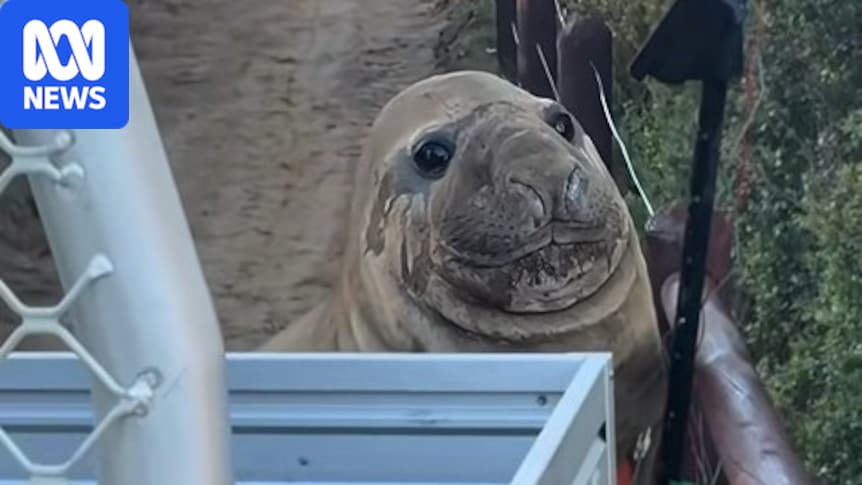
Neil the seal could be relocated to Tasmania's west coast — or a remote island — if "unacceptable" risks arise during his visits, according to his new management plan.The plan, released yesterday, also considers vaccinating Neil against the H5 strain of bird flu if federal authorities approve a vaccine for mammals.The 1,000-kilogram southern elephant seal has been visiting Tasmania twice a year since his birth on Turrakana/Tasman Peninsula in October 2020.His bollard-bashing, fence-crushing, traffic cone-chewing antics have turned him into a social media sensation.Neil the seal is expected to grow much larger as he matures. (Supplied: Sam Volker Photography)Some of his visits, particularly when he hauls up at suburban locations, have attracted large crowds, requiring traffic management and 24/7 security.The management plan, which also applies to other elephant seals, "seeks to balance animal welfare with public safety".It outlines a four-step "escalation framework" in which the levels of intervention increase as the risks rise."In every instance, management efforts will prioritise Neil's protection from harm and his conservation as a wild marine mammal," the plan states.Authorities have pleaded with crowds to keep their distance from Neil. (ABC News: Mitchell Woolnough)The first step is described as "non-intervention and site management".It applies when Neil hauls out in secluded areas with limited public access, and community interactions can be managed through education and communication.The second step is "on-site management".It applies when Neil arrives in an area with high levels of public activity and interest, including near roads and other critical infrastructure.In such situations, fencing, barriers and temporary closures may apply.Neil's visit to a Hobart beach in June for his annual haul-out attracted much attention. (ABC News: Ebony ten Broeke)Authorities may also use non-violent "hazing" methods to encourage Neil to move to other areas.These include "crowding boards" and "temporary-stress deterrence techniques", including "controlled, visual, tactile and vocal stimuli", where appropriate.The third step is the use of "seal enrichment" devices, which would be used concurrently with other management options.Neil with his enrichment toy provided by the Marine Conservation Program in 2025. (Supplied: Marine Conservation Program, NRE Tas)These enrichment devices are essentially big toys for Neil to play with, with the aim of reducing his tendency to interact with — and damage — public infrastructure.The management plan notes that while previous devices "elicited positive responses, sustained interest was not achieved".The plan says design drawings and fabrication for a new "custom-made enrichment object featuring dynamic movement features and appropriate sizing" have been commissioned.Relocation a 'high risk' last resortIf the first three measures fail to reduce risks to "public safety, animal welfare or critical infrastructure", the fourth and final step listed in the management plan is "relocation"."Relocation involves sedation (overseen by a veterinarian), mechanical lifting and transportation of Neil to a suitable alternative location by either road or vessel," it states.Neil was relocated when he was much smaller, but the plan says given his current size, relocation would only be considered in "exceptional circumstances"."Relocation is a high-risk management option, and it should only be considered where risks cannot be adequately managed through lower-level responses."If relocation happens, the plan says one possible action could be to transport Neil to the state's west coast."Sedation, followed by transportation by road and relocation by vessel to a suitable, remote area on mainland Tasmania, e.g. west coast, noting that this is unlikely to prevent Neil from subsequently returning to more populated areas."Another scenario that was outlined in the plan refers to an island off the south coast of Tasmania."Sedation, followed by transportation by road and relocation by vessel to a suitable offshore location, e.g. Maatsuyker Island," it states."The presence of other elephant seals near the release site should be confirmed to increase the chances of Neil remaining at the relocation site."Stimulation gained from intraspecific interactions may encourage Neil to return to a relocation site on a regular basis."Graphic showing the 2026 size of Neil the seal, as compared to a full-grown male elephant seal at 12 years old, with an adult male human for scale. (ABC News: Hamed Akrami)The plan says it adopts an "adaptive management approach" that can be improved by any lessons learned during haul-out events.It makes no reference to euthanasia.H5 bird flu vaccination optionThe plan notes the vulnerability of elephant seals to the H5 strain of bird flu, which arrived in Australia in June, and reached Tasmania in August.Researchers believe the virus caused the deaths of 13,000 baby elephant seals on Heard Island in the Southern Ocean last summer.Neil's situation is somewhat different, given he is not part of a herd which would ordinarily act as a transmission pathway.However, the management plan includes steps to prepare for a potential vaccination of Neil if it is considered necessary."If a mammal vaccination is approved, any decision to vaccinate Neil would be informed by the best available scientific evidence and expert veterinary advice and would be subject to all necessary approvals."Neil's antics have made him popular around the world. (Supplied: Sam Volker Photography)The plan outlines the "preparatory activities" that NRE may undertake to support "timely decision-making" should vaccination become a viable option.These could involve seeking relevant "ethical, regulatory and permitting approvals" in advance of potential need and assessing "practicality, risk and likely effectiveness", it says."Vaccination would only be considered where the anticipated risk to Neil from H5 bird flu is assessed to outweigh the risks associated with vaccination and administration, and where vaccination is considered feasible, safe and likely to provide a meaningful management benefit."Even electrified fencing was not enough to deter Neil during a recent visit. (Supplied: Declan Coffey)NRE said Neil recently spent six weeks in the state's south-east without attracting any notable attention from the public or media."Neil was healthy and in good condition, and was quietly observed by the local community," an NRE spokesperson said."Neil has not been sighted for several days, so has likely returned to sea to forage for food, having had the time and space to rest."
Neil the seal plan includes 'relocation' scenarios, vaccination options
Full Article
Original Source
Read the full article at Abc →KhanList aggregates and links to publicly available news content. We do not host full articles from third-party sources. Always verify important information with original sources.