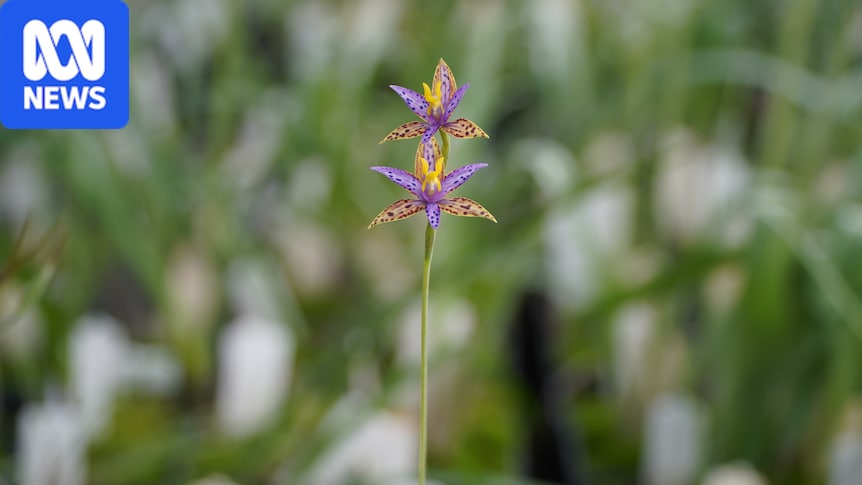
One of the world's rarest plants, the iconic Western Australian Queen of Sheba orchid, may have been saved from the brink of extinction after conservation scientists made a breakthrough using a cloning technique.There are less than 30 Queen of Sheba orchids left in the wild, found by the coast between Perth and Bunbury in south-western WA.The conservation status of the critically endangered orchid is so precarious, every known plant is fenced off and under constant CCTV surveillance.The first Queen of Sheba orchid to flower from a cloning program at Kings Park. (ABC News: Samantha Goerling)But a team from the Botanic Gardens and Parks Authority (BGPA) at Kings Park has taken a major step in securing the plant's future.Senior plant breeder Digby Growns said it was all down to a new propagation technique done in a laboratory."The technique is called somatic embryogenesis and it's a cloning technique so we can go from a single seed which is really, really small and generate as many plants as we want," he said.Digby Growns is delighted by the success of the cloning program. (ABC News: Samantha Goerling)"We've now got over a thousand plants from that single seed and that's really making our ability to do research on this plant and hopefully put it back in the wild a reality."Like 'birth of my first child'Until now, it has been incredibly difficult to conduct research that could help save the orchid, because of how few plants remained, and a low survival rate."From the seed that you do germinate, maybe one in 20,000, one in 50,000 seeds will actually grow up into a mature plant," Mr Growns said.The propagation method had previously been used in BGPA's ornamental plant breeding program, and five years ago it was first applied to the Queen of Sheba.Cloned Queen of Sheba orchids in a petri dish. (ABC News: Samantha Goerling)"So far we've been really kicking goals and we think this will be the solution to saving this plant from becoming extinct," Mr Growns said.The very first plant produced this way has now flowered."It's like seeing the birth of my first child. It was fantastic," Mr Gowns said.Bigger, faster flowering orchidsIt was not just the brilliance of the bloom that had the team excited.Orchid research scientist Belinda Davis said the orchid flowered in a little over three years."That's half the time that they were previously taking through conventional propagation pathways," she said.Belinda Davis is working to secure the future of WA's threatened and endangered orchids. (ABC News: Samantha Goerling)"We can also produce plants with tubers that are ten times the size, so we're producing really robust plants that survive better once they make it out into the wild."Before translocating plants into the wild, there is more research that needs to be done on pollinators, and fungus."A lot of our terrestrial orchids have a single fungus that each of them uses, so it's really vital for germination and also really important that it stays with the orchid because it re-establishes each year," Dr Davis said."In the lab, we've been able to grow fungi … the important next step beyond this work is now getting that fungi introduced and really happy, and both plant and fungus working together."The team plans to use the cloning technique on other species in its orchid program, which is working to bank seeds from all 44 threatened orchid species.
Cloning technique could save rare Queen of Sheba orchid from extinction
Full Article
Original Source
Read the full article at Abc →KhanList aggregates and links to publicly available news content. We do not host full articles from third-party sources. Always verify important information with original sources.