
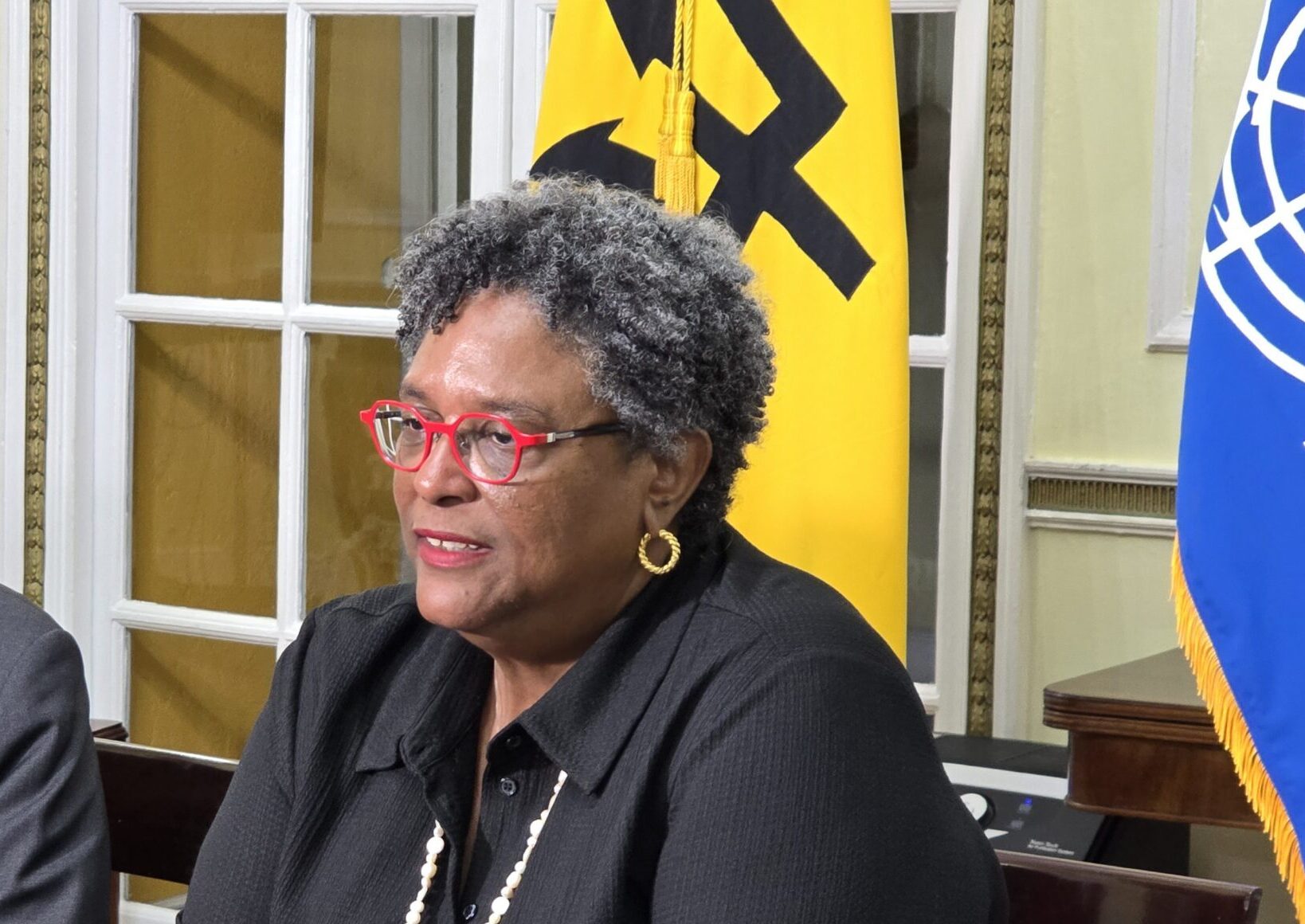
UN Secretary-General António Guterres and Prime Minister Mia Mottley gave their comments following COP31. (Photo by: Lourianne Graham) Small Island Developing States cannot afford for international climate negotiations to stall, with United Nations Secretary-General António Guterres and Prime Minister Mia Mottley warning that failure to take urgent action on climate change will have serious consequences for vulnerable countries. Guterres spoke at a press briefing with Mottley at Ilaro Court on Sunday, hours after the UN’s COP31 climate conference closed in Antalya, Turkey, without a final agreement. Expressing disappointment about the breakdown in talks, he said governments had failed to demonstrate the ambition needed to address the crisis. He said: “I am deeply disappointed that COP 31 has ended without agreement on an overarching outcome. “At the moment when the climate crisis is accelerating, governments fail to rise to the level of ambition this crisis demands.” Small Island Developing States, including Barbados, were among those most affected by a crisis they had contributed little to creating, he said. You Might Be Interested In “It is especially fitting to say this from Small Island Developing States because countries like Barbados are on the front lines of the climate crisis. “Small Island Developing States have contributed little to the climate crisis. Yet they are paying among the highest prices to stronger storms, rising seas, damaged economies, and mounting costs to protect their people.” The secretary-general warned that temperatures were breaking records and the world was on course to exceed the 1.5-degree threshold. “Here in this region and around the world, temperatures are shattering records. Climate extremes are intensifying. And science tells us that we are now on course to overshoot the 1.5 degrees.” He urged countries to do everything possible to limit the extent and duration of the overshoot and bring temperatures back below 1.5 degrees before the end of the century. “That means confronting the root cause of the climate crisis, fossil fuels,” he said. “The continued addiction to coal, oil and gas is fuelling climate chaos, exposing economies like Barbados to price shocks and undermining energy security.” He added: “We cannot put out the fire while pouring fuel on it.” Guterres called for a just and orderly transition away from fossil fuels, alongside greater investment in renewable energy and reductions in methane emissions. “We must accelerate the transition away from coal, oil, and gas in a just, orderly, and equitable manner,” he said. “And renewables offer a path to energy independence, affordable power, and stronger economies.” He also called on developed countries to deliver climate financing, particularly for adaptation, saying countries that had contributed least to the crisis should not be left to face its worst consequences. “That is climate justice.” Mottley acknowledged the failure of the negotiations but said countries must not abandon the fight against climate change. She said: “We’ve not gotten the financing or the pledges that we’ve wanted, but we have not given up.” The lack of commitments on methane reduction was particularly disappointing, she said, given the potential to slow global warming while research into decarbonisation technology continued. “We have not gotten the commitments to methane that we need, knowing full well that methane is the one thing that can allow us to be able to buy time to continue the research in decarbonising technology which ironically can create the path for fossil fuel companies to have irrelevance without harming the planet and with methane controlled by them.” Mottley suggested that oil companies could also benefit financially from reducing methane emissions by preventing gas flaring and repairing leaking pipes. She noted that satellite technology could help identify the sources of methane emissions. “That is why we say it buys us time and, quite frankly, the oil companies make money when they don’t flare gas and make money when they fix the pipes that are leaking gas into the atmosphere.” Scientists believed those measures could help reverse global temperatures by as much as 0.3 to 0.5 of a degree, she said. The prime Minister malso criticised the omission of references to oil, gas and coal in the COP31 declaration, warning that climate change would continue regardless of geopolitical disagreements. “The climate crisis does not negotiate with geopolitics and the notion that we want to deny its existence does not stop the floods from happening, does not stop the hurricanes from coming.” Mottley warned that Caribbean countries would face increasing difficulties with the cost and availability of insurance as climate-related risks intensified. “The worst part of it as well is that for us in the Caribbean, the cost of insurance as well as the access to insurance will become more and more of an issue and as I’ve said over and over where things are uninsurable, they are uninvestable. She maintained that the failure to reach an agreement in Antalya did not remove governments’ existing climate obligations. “Let us be clear, the failure of the negotiators does not cancel the obligations that each of us still has as governments. The Paris Agreement still stands.” Mottley also pointed to the International Court of Justice’s position on climate change, saying its findings had established grounds for further legal action if governments failed to resolve their differences through diplomacy. Meanwhile, she said Barbados’ fossil fuel import bill had increased by BDS$246 million during the first nine months of the year, highlighting the economic implications of continued dependence on fossil fuels. Looking ahead to COP32 in Addis Ababa, Ethiopia, Mottley called for greater public participation in the climate campaign, urging people worldwide to make their voices heard. “We want the people of the world to speak. And we want you to raise your voices. Don’t let it come through leaders like myself and others.” This campaign hoped to mobilise 1.5 billion voices over the next 12 months to influence governments and climate negotiators. Mottley stressed that the 1.5-degree target represented vulnerable countries’ ability to survive. “1.5 is not simply a number; it represents for us the ability to survive.” (LG)
Climate fight must continue despite COP31 failure -Mottley
Full Article
Original Source
Read the full article at Barbadostoday →KhanList aggregates and links to publicly available news content. We do not host full articles from third-party sources. Always verify important information with original sources.