
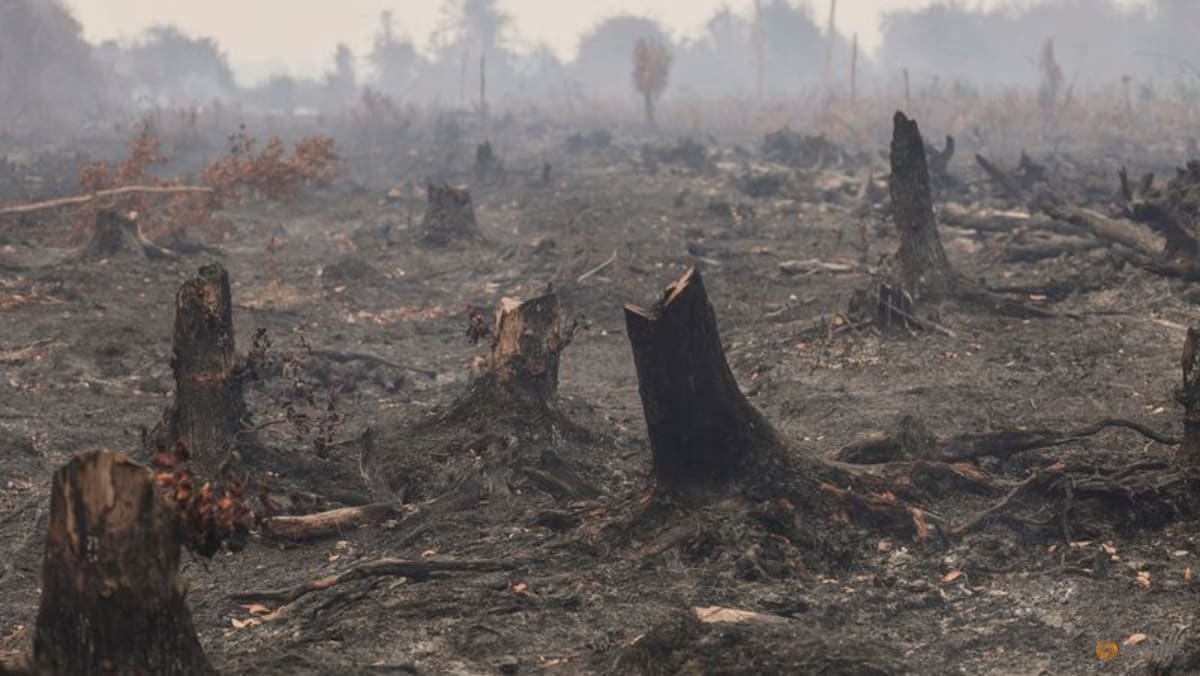
JAKARTA: At first glance, the plan looked simple.Indonesia has millions of hectares of land that have lost their biological productivity, economic value or ecological functions, degraded by forest fires, floods, logging and unsustainable farming practices.At the same time, the world’s fourth most populous country wants to achieve food self-sufficiency to feed its 290 million people. Southeast Asia’s largest economy also wants to boost biofuel production and reduce its dependence on imported energy amid disruptions to global oil supplies.So why not turn these degraded lands into productive farms and plantations to grow food crops and feedstocks for biofuels? That way Indonesia does not have to clear primary forests to make way for new plantations.That is the idea behind a proposal being explored by President Prabowo Subianto’s administration, said Hashim Djojohadikusumo - the president’s brother and Indonesia’s special envoy for climate and energy - at the 31st UN Climate Change Conference (COP31) in Antalya, Türkiye. “Indonesia is committed to accelerating economic growth while strengthening food and energy security, creating jobs and developing higher-value industries,” Hashim said in a speech on Nov 12. “We are also accelerating the transition to cleaner energy and improving productivity on degraded land. Furthermore, in pursuit of food self-sufficiency, our government has decided not to expand agricultural activities into forested areas, particularly primary forests.”Hashim first conveyed the idea during another summit in Jakarta on Oct 7. “We are moving towards energy self-sufficiency through biofuels with B50 and B100. We want to use degraded land, degraded forests and damaged forests, not primary forests,” he said then, referring to the different percentages in biodiesel blends. “According to the government, Indonesia currently has 12.7 million hectares of damaged or degraded forests.” Trucks with palm oil fresh fruit bunches are parked in a queue at a palm oil factory in Siak regency, Riau province, Indonesia on Apr 26, 2022. (File photo: Reuters/Willy Kurniawan) The B50 programme, which took effect on Jul 1, requires all diesel sold in Indonesia to be a blend of 50 per cent biodiesel derived from crude palm oil (CPO) and 50 per cent conventional diesel.The government aims to eventually expand the programme to B100, which would use 100 per cent palm oil-based biodiesel.But while the plan appears straightforward on paper, it could prove far more complicated on the ground. Similar initiatives in other countries have yielded mixed results, with experts warning that not all degraded land is suitable for agriculture.Experts and environmentalists whom CNA spoke to also argue that some areas, particularly fire-damaged peatlands and forests in flood-prone watersheds, should be prioritised for ecological restoration rather than converted into plantations.WHAT’S BEEN DONE ELSEWHERE? Brazil has had some success converting degraded pasturelands into agricultural hubs by offering incentives and low-interest loans to farmers to grow commercially valuable crops such as soybeans, corn and other grains without clearing native vegetation.In 2010, the South American country launched a nationwide programme to recover 30 million hectares of degraded pastures by 2030, with the broader aim of boosting agricultural production while curbing deforestation. That goal was increased in 2023 to 40 million hectares by 2033.But rehabilitating degraded land is neither quick nor cheap. It can take years and substantial investment to correct soil acidity, replenish depleted nutrients and rebuild soil fertility. Brazil's Ministry of Agriculture and Livestock estimated that achieving the 40 million hectare target would require around US$120 billion. Even then, results have been mixed. While some degraded pastures have been successfully converted into productive farmland, others have proven too costly to rehabilitate to make agricultural production commercially viable.Meanwhile, Indonesia has yet to set a target or timeline for its proposed agricultural expansion on degraded land. However, the Forestry Ministry has estimated that restoring 12 million hectares of degraded land would cost around US$42 billion.Dwi Andreas Santosa, a professor of agriculture at IPB University near Jakarta said restoring degraded land requires not only costly technology but also sustained rehabilitation efforts over many years. “Can the government provide such long-term technical and financial assistance, particularly to smallholder farmers,” he said.“Without such support, large corporations with greater financial resources could dominate the programme, prioritising lucrative cash crops such as oil palm over food crops needed to achieve Indonesia’s food self-sufficiency goals.” A worker harvests palm oil fruit at a small-scale farm in Musi Banyuasin, South Sumatra. (Photo: CNA/Wisnu Agung Prasetyo) RESTORATION VERSUS CONVERSIONAccording to government data, Indonesia lost more than 2.63 million hectares of primary forests between 2016 and 2024, driven by logging, agricultural expansion, forest fires and other factors. Indonesia has not released its 2025 and 2026 figures, but with thousands of hectares of forests and peatlands burned this year, scientists warn that the country's degraded-land problem could worsen.Meanwhile, thousands of hectares of primary forests were also cleared in the country’s easternmost island of Papua and the Indonesian side of Borneo in recent years to make way for the government's food estate programme.The food estate programme was initiated in 2020 during the Joko Widodo presidency which converted 770,000 hectares of forests, peatlands and other types of lands for the production of rice, corn and other crops. Prabowo, who was backed by Widodo during the 2024 presidential election, has pledged to expand the programme, with plans for around 3 million hectares of new agricultural land developed in various parts of the country.Following Hashim’s remarks, environmental groups called for the government’s food estate programme to be cancelled and for forests already cleared under the initiative to be restored back to their natural state through replanting native vegetation or plants. “If the government genuinely acknowledges that food security does not require clearing more forests, then that principle must be put into practice, as the food estate programme has clearly driven deforestation, environmental destruction and the dispossession of indigenous communities,” said Refki Saputra, a forest campaigner at Greenpeace Indonesia. This image provided by Mighty Earth, shows newly cleared land to make way for the Indonesian government's food estate project to produce sugarcane-derived bioethanol, rice and other food crops, in Jagebob district in Merauke, Papua province, Indonesia, on Mar 17, 2025. (Photo: AP via Mighty Eareth/Yusuf Wahil) Meanwhile, experts are calling for fire-damaged land to be restored back to its original state rather than converted into plantations.“Forest protection cannot be separated from how the surrounding landscape is managed,” said Mahawan Karuniasa, an environmental science expert at the University of Indonesia.Scientists say restoring damaged peatlands is particularly urgent because these ecosystems are interconnected, allowing fires to spread rapidly through dried-out peat. When they burn, they can also release vast amounts of carbon dioxide that have been stored underground for centuries.Fire-damaged land can be restored through a combination of measures including rewetting the peatlands, replanting native vegetation, restoring soil fertility and through measures that prevent recurring fires. Indonesia's forest and land fires burned an estimated 2.8 million hectares this year, according to independent monitoring platform Nusantara Atlas - an area roughly 38 times the size of Singapore.In an article published by The Conversation, four scientists from the University of Sydney, the Center for International Forestry Research, Universiti Malaysia Terengganu and Indonesia's Gadjah Mada University, estimated that the recent fires which blanketed the region with thick haze released 370 million tonnes of carbon dioxide into the atmosphere, equivalent to the annual emissions of about 97 coal-fired power plants. Although peatlands accounted for just 20 per cent of the total area burned, they were responsible for 80 per cent of the estimated carbon emissions."The carbon released in 2026, particularly from peatlands, may not be replaced for hundreds of years. Serious restoration efforts are therefore essential to prevent these carbon losses from becoming an environmental debt passed on to future generations," the scientists wrote. Peatlands act as natural carbon stores, accumulating partially decomposed vegetation over thousands of years. When they burn, this stored carbon is released into the atmosphere as carbon dioxide, contributing to global warming, while replenishing the lost carbon can take centuries. Boys sit on a wooden jetty along the Kahayan River as haze from wildfires shrouds the area in Palangka Raya, Central Kalimantan province, Indonesia on Oct 23, 2026. (File photo: Reuters/Usep Hariadi) On Sep 24, Prabowo ordered the establishment of a new National Peatland and Mangrove Management Agency (BPGMN) and inaugurated forestry expert Satyawan Pudyatmoko as its head and Major General Sriyanto as his deputy on Oct 15.Following his appointment, Satyawan said the agency would prioritise restoring water levels in drained peatlands to reduce fire risks and exploring agricultural commodities that can grow in wet conditions."The president has directed us to manage peatlands through BPGMN, so that when extreme dry seasons occur, as what we are experiencing now, fires can be minimised and prevented from disrupting people's lives or harming public health," Satyawan said. CAREFUL PLANNING NEEDEDDeputy Coordinating Minister for Food Hanif Faisol Nurofiq said on Nov 6 that the government was still identifying which degraded lands were suitable for the plan.“We are continuing to analyse the land, but the process is far from straightforward. We need information from multiple sources to identify suitable locations with a reasonable degree of precision,” he told reporters.“President Prabowo has given us clear instructions not to touch natural forests. His directive is unequivocal: no more natural forests are to be converted. We are therefore relocating proposed development areas to land that has already been degraded.”Mahawan of University of Indonesia said the government study should not only focus on the degraded land’s commercial viability but also which restoration techniques and technology they should use for each area. “With the right technology and management practices, land that has genuinely lost its ecological functions can be used to support food and energy production while also improving environmental conditions,” he said.“Conversely, without proper assessments, such development could lead to the loss of vegetation cover, declining soil fertility, disruption of water systems, increased carbon emissions and a heightened risk of floods and fires.”
Can Indonesia turn over 12 million hectares of degraded land into food and biofuel farms?
Full Article
Original Source
Read the full article at Channelnewsasia →KhanList aggregates and links to publicly available news content. We do not host full articles from third-party sources. Always verify important information with original sources.