
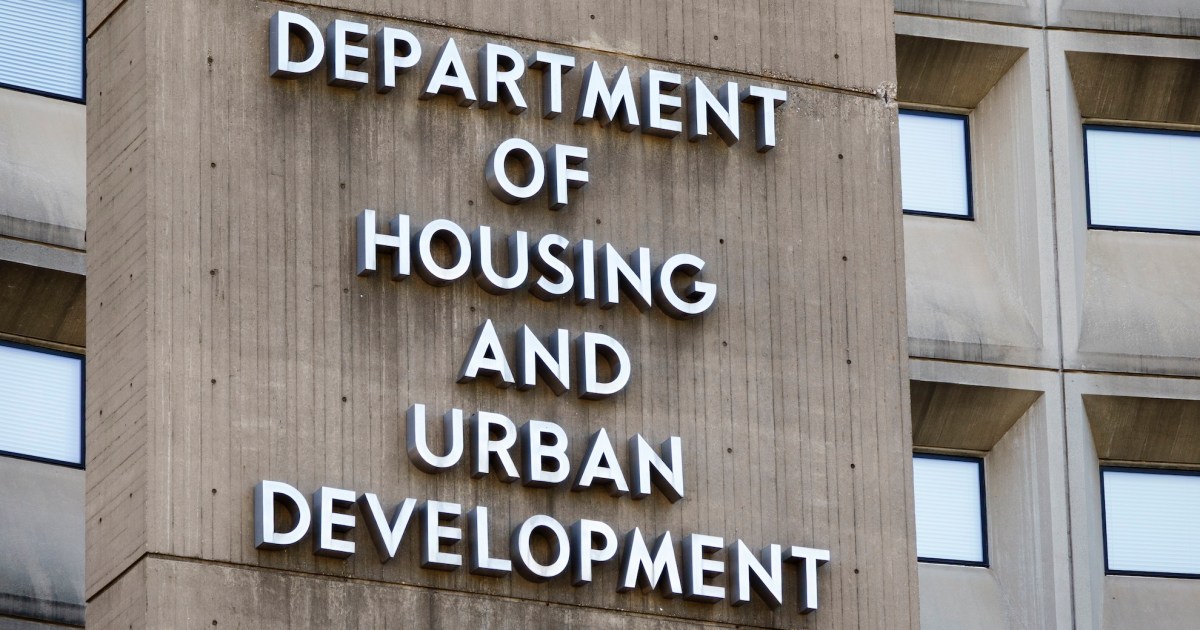
The United States Department of Housing and Urban Development building in Washington, DC. Kevin Carter/Getty Get your news from a source that’s not owned and controlled by oligarchs. Sign up for the free Mother Jones Daily. A Department of Housing and Urban Development rule that could force thousands of mixed-immigration-status families to either move out of their homes or separate has been hit with further legal challenges: one filed by a group of cities facing affordable housing shortages, including San Francisco and New York, and the other by twenty states and Washington, DC. The rule, set to take effect in early December, would deny housing assistance to any tenants who live with people who don’t verify their immigration status, potentially affecting more than 20,000 households that currently receive federal support. The lawsuits argue that the HUD rule violates a provision in the Housing and and Community Development Act that Congress established to prevent family separations. And the cities suing, which include among others New York, Los Angeles, San Francisco, Seattle, and Boston, say the rule will increase homelessness and further strain their local resources, including shelter, temporary housing, and eviction support geared towards low-income families. HUD Secretary Scott Turner has claimed that the rule closes a “decades-old loophole” and “guarantees only American citizens and certain eligible noncitizens will reside in HUD-funded housing.” Last week, tenant groups and individual tenants in Los Angeles filed a separate lawsuit challenging the rule, arguing that it would leave tens of thousands of citizens, including many children and people with disabilities, without housing support, by effectively evicting their family members without sufficient legal status who also serve as caretakers. On Friday, I reported on that lawsuit, speaking to 66-year-old María José, who is able to live with and care for her disabled husband thanks to current HUD policies: Undocumented immigrants and those with temporary legal status are not eligible for federal housing support. Still, for decades, many have been able to live alongside their documented family members who do qualify for help. Generally, mixed-status families pay more for housing than other beneficiaries—when providing subsidies, HUD only counts the family members who agree to verify their legal status. Maria José, for instance, says she pays a flat, monthly rent with help from her son, while her husband, who is the beneficiary, is only required to pay 30 percent of his monthly income. The new rule…would get rid of this prorated option and require that all public housing assistance applicants and recipients verify their immigration status or lose support. The policy change, the Center on Budget and Policy Priorities estimates, could push out nearly 80,000 people across the country out of their homes, including 36,900 children. Most are part of Latino households. Los Angeles housing advocates involved in the suit expressed concern for the 1,700 mixed status families who could be forced to seek new housing by the rule, and the limited support they would be able to access, given the city’s large unhoused population and a local affordable housing shortage of hundreds of thousands of units. In their lawsuit, the plaintiff cities further detailed the impact that they anticipate on their resources and already limited ability to provide housing support using local funds. San Francisco, which is leading the suit, faces an increasingly strained housing market. Its 2026 count found 465 unhoused families in the city, a 15 percent increase since 2024. The city has hundreds of families on waiting lists for its supportive housing programs. And the demand for resources is so high that on average, families have to wait more than a month for a spot in a shelter. “If the City were to replace federal assistance with local subsidies,” the lawsuit says, “it would cost approximately $40,000 per family per year (or more than $8 million annually for 202 mixed status families).” In Boston, which is also suing, the demand for affordable housing is so high that the city says it has already conducted 29 housing lotteries this year, with more than 40,000 households competing for 505 units. The city estimates that more than 500 mixed-status families would be displaced as a result of the rule. Even at the federal level, the cities say, resources could become strained. In its own reports, HUD has acknowledged that verifying recipients’ immigration statuses and carrying out evictions would incur significant costs. Those costs would cut into HUD’s budget, and the agency estimates that about 31,000 fewer individuals would receive housing assistance under the new rule, assuming all mixed families leave the program. “Housing assistance is not an entitlement in the United States,” the report says, acknowledging that HUD would house fewer people for the same costs under the new rule. Mixed families, according to the agency’s data, currently make up less than one percent of households receiving support.
Cities and States Sue to Block HUD Rule Against Mixed-Status Families
Full Article
Original Source
Read the full article at Motherjones →KhanList aggregates and links to publicly available news content. We do not host full articles from third-party sources. Always verify important information with original sources.