
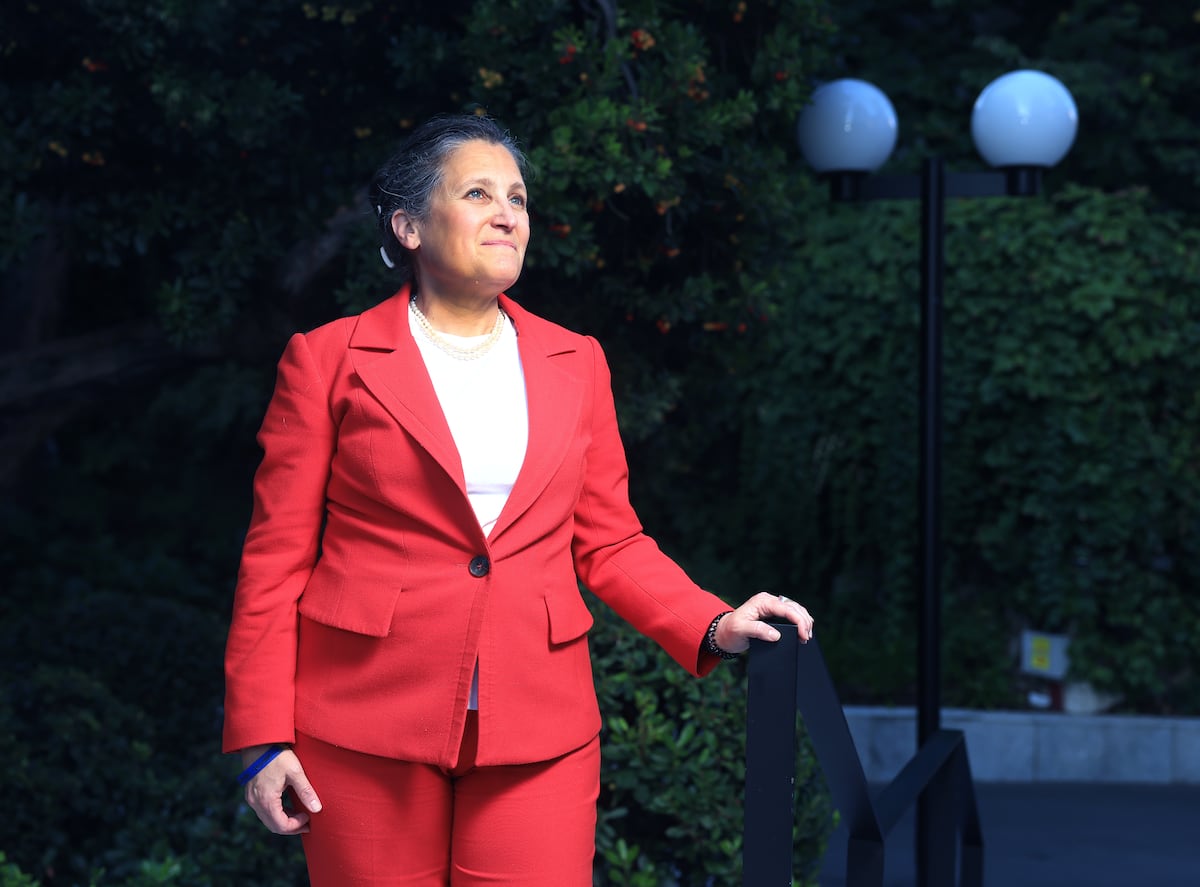
Chrystia Freeland, 58, has lived many lives in one. Born in Peace River, Alberta, she worked as a journalist at the Financial Times, where she was the outlet’s chief correspondent in Moscow, Eastern Europe, the United Kingdom and the United States. She entered Canadian politics in 2013, when she was first elected as a member of parliament for the center-left Liberal Party. Later, after Justin Trudeau’s victory in 2015, she served as minister of international trade, minister of finance, minister of foreign affairs and, finally, as deputy prime minister. Freeland competed against Mark Carney for the nomination in last year’s Liberal Party leadership elections. And, after losing the vote to the current prime minister, she moved into academia — first at Harvard, now at Oxford. The daughter of a Ukrainian mother (she speaks the language fluently and her three children have Ukrainian names), Freeland is also one of Volodymyr Zelenskiy’s top economic advisers.This interview took place after a conference at the Ramón Areces Foundation, in Madrid. It was the same day that her latest book was released: Unreliable Boyfriend: An Insider’s View of Dealing with a Chaotic Superpower, Plutocrats, and Other Complicated People (2026). In it, she recounts her wild years in politics, during which she became a favorite target of Donald Trump’s ire. He hurled all sorts of insults at her: “Nasty woman,” “totally toxic” and “terrible person,” among other pleasantries.Question. How do you deal with someone like that?Answer. I have sort of a double-barreled view. It’s important to stand up to the United States, and I think that it’s also important to be open to the possibility that America returns to the liberal democratic fold.Q. Quite a few countries have capitulated to Trump, including several European ones. A. Yes, I agree. And it’s a big and historic mistake. That’s why I give [Spanish Prime Minister Pedro] Sánchez and his government real credit for standing up to the United States: Spain is the European country that has taken the clearest position. The response to the tariffs and the challenges to the sovereignty of Canada and Europe have resulted in a united retaliation. If that had happened, we wouldn’t be seeing everything that has followed. The way President Trump behaves is to push you as far as he can. And, when [his] outrageous actions got results, we shouldn’t be surprised if this was then followed by even more outrageous actions.Q. Remember that photo from last year, at his golf club in Scotland? When he posed with Ursula von der Leyen, president of the European Commission? A. There’s a quote from [former European Commissioner] Thierry Breton in my book that I really like: “We were told humiliation was the price we had to pay for stability. But if we don’t push back now, we will get humiliation and instability.” A lot of leaders think they’re smarter and more sophisticated than Trump; that they can have a meeting with him and have a little joke and can kind of trick him. And the reality is that he’s the one who’s tricking them.Q. It’s become a pattern. A. It’s a very understandable mistake... and very easy to make. It seems like a mature person should swallow their pride and, for example, accept a 15% tariff. “So what?” they think. “It doesn’t seem like much... we can survive and, in exchange, we’ll have a good relationship [with the U.S.].” The problem is that, if you compromise, the next day, you’re faced with a territorial claim over Denmark. And, the day after that, you have a war in Iran, and you’re being attacked for not joining it. And then, the day after that, you have Trump siding with Putin in a war which is existential for Europe. Q. In the book, you write: “We are living in a time of three big fights: the fight between democracy and dictatorship, the fight between people and plutocrats, and the fight between global alliances and predatory isolationism.” Are we losing all three battles?A. I’m not sure we’re losing. But we’re not winning, either.Q. That’s an optimistic way of looking at it.A. I’m optimistic by nature, but I don’t think we’re totally losing. People thought Ukraine would fall in three weeks — and it’s still there. That’s a tribute to Ukraine, but also to Europe. Viktor Orbán’s defeat [in Hungary] is another example of how liberal democracy endures. And we’ll see what happens in the midterm elections [in the U.S.]. But the things I really worry about are Russia, China and the absence of a united Western alliance. Without that, among other things, it’s impossible to rein in the oligarchs. That’s why it’s so important to fight for liberal democracy in the U.S., but as long as the Americans aren’t part of that effort, we’ll fail.Q. You’ve said that U.S. democracy is on life support.A. That’s obvious. We’re seeing American law enforcement terrorize American people with total impunity. We’re seeing the creation of masked paramilitary forces. We’re seeing a group of people actually in government who refuse to accept the results of the 2020 election. We’re seeing blatant corruption which goes unpunished. And we’re seeing America siding openly with dictatorships and explicitly menacing the sovereignty of democratic allies. It’s appalling.Q. The polls point to a resounding defeat for Trump on November 3. If he loses both houses of Congress, his domestic power will be limited, but he’ll still have a free hand when it comes to foreign policy. Could that be even more dangerous?A. It could be, that’s true. But what I hope to see is increasing resistance within the United States, including within the Republican Party. There’s a good chance that will happen, because many traditional Republicans disagree with a lot of what he’s done. And they’ve gone along with it because of fear and self-interest. But if they feel that the president is no longer able to deliver at the ballot box, there’s a chance he’ll start losing significant support in his own party. And that could function as a restraint.Q. Is Brussels’ offer for Canada to become an associate member of the European Union viable?A. I think so, and I hope so. In my dream scenario, we would have an alliance that would include the EU, Canada, the United States and the CPTPP countries [the Comprehensive and Progressive Agreement for Trans-Pacific Partnership]. It would not be a supranational entity, like the EU but I would like to see a much closer economic and security partnership among the world’s democracies. That’s what we need. Q. Isn’t that wishful thinking, given the current situation?A. If you had asked people in 1940 if, 40 years later, you would have an economic and political partnership between Germany and France, a military partnership between the United States, Germany and France, as well as a military partnership between the United States and Japan, no one would have thought it was possible. The post-war period — especially in Europe — is a story of miracles: it’s astonishing how we went from the situation in 1939 to that of 1991. Anyone who imagined it would have been considered a mad fantasist, but it actually happened. It’s a mistake to put limits on our dreams.Q. Are Trump’s policies allowing China to expand its influence and fill the power vacuum? A. Yes, absolutely. The biggest winner from U.S. behavior is China. Russia is also a winner, but the way that Europe has united weakens Russia’s victory. America’s traditional partners are seeking a balance and, therefore, are getting closer to China. It can be dangerous, but it’s understandable. And countries that are not America’s traditional allies are also seeking a balance. That’s great for China. And the other thing that’s great for China is that there’s no moral high ground for America to claim right now.Q. As an adviser to Zelenskiy, how do you assess the recent “energy ceasefire” announced by Trump?A. Nothing that he puts forward is credible.Q. He’s also demanding elections: he says that “it’s time for Ukraine to get a new president.” A. It’s appalling, it’s absolutely appalling. The only positive thing is it will make President Zelenskiy more popular in Ukraine.Q. How do you assess the US-Russia diesel agreement?A. It’s a betrayal and a gift to Putin. What’s especially shocking is that it isn’t economically significant for the U.S. But it explicitly shows that Trump is siding with Putin. Q. You’ve said that Ukraine is winning the war.A. 100%.Q. Why?A. There was a widespread expectation that Russia would make territorial gains this summer and they haven’t. It’s horrifying what Russia is doing with the strikes on Ukrainian civilians, but that’s a direct result of Russia failing on the battlefield.The Ukrainians have devised a formula that might force Russia to limit its attacks: if they hit your energy infrastructure, you hit theirs. That could serve as the basis for a limited ceasefire.The impact of the attacks on Russian data centers is also very interesting: Russian disinformation campaigns influence us more than we realize, so perhaps the Ukrainians will help us all to have healthier democracies by taking out data centers there. It could be a gift from Ukraine to global democracy.Sign up for our weekly newsletter to get more English-language news coverage from EL PAÍS USA Edition
Chrystia Freeland: ‘China is the biggest winner of US behavior’
Full Article
Original Source
Read the full article at English →KhanList aggregates and links to publicly available news content. We do not host full articles from third-party sources. Always verify important information with original sources.