
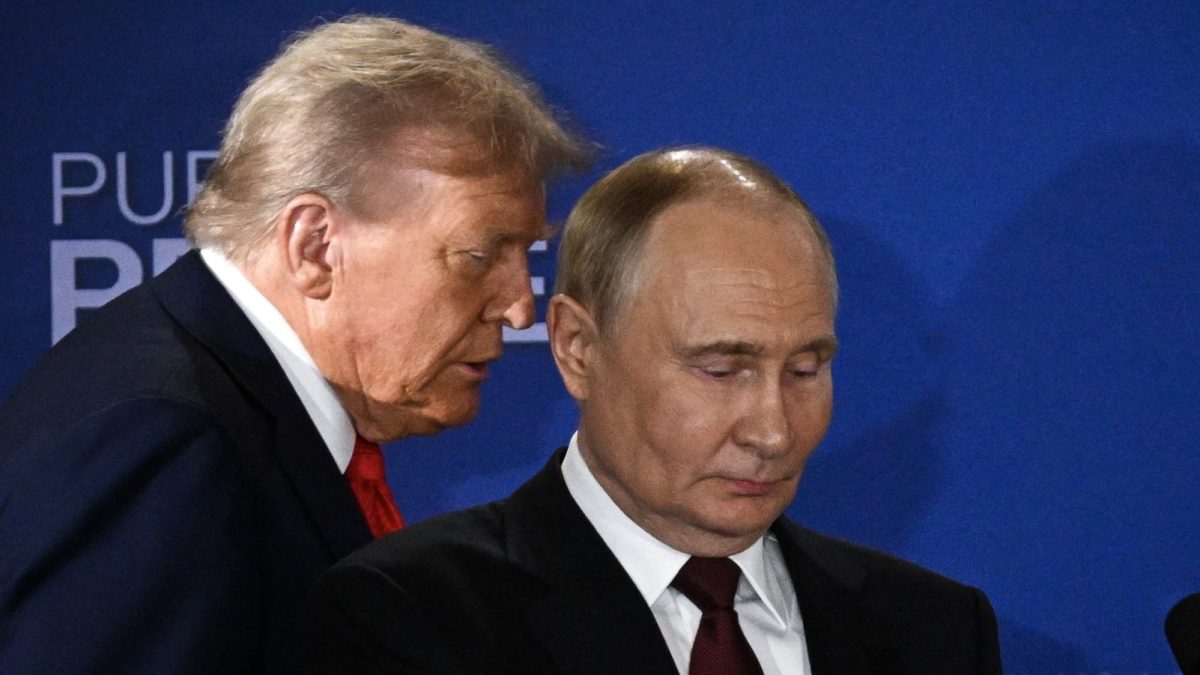
The ceasefire in the Russian-occupied Ukrainian town of Oleshky is good news: good news for the people who will be saved from the danger of death amid desperate shortages of food and fuel. The ceasefire is also good news for Vladimir Putin. Putin will rejoice not because he is a “humanitarian”, as US President Donald Trump’s envoy, Steve Witkoff, described him. Let’s not forget that Putin is wanted by the International Criminal Court for war crimes. Putin will see this as a win because it helps him not only in terms of propaganda, but also in terms of politics in the midst of a war he has never shown any real intention of ending save on his own merciless terms. Shorts First, the propaganda value. The US First Lady, Melania Trump, apparently negotiated the ceasefire. It is she who must take credit for any lives that will be saved. This, after all, was a town where residents were reported to have been reduced in some cases to eating grass – the alternative being walking the “road of death” to the nearest village in search of supplies. The Kremlin is keen to burnish the humanitarian credentials it seems to believe it has. “The main thing is that humanitarian aid is now reaching the people. This is exactly the help that was stated as necessary,” Putin’s spokesman, Dmitry Peskov, said as the evacuation was getting under way. While some residents are naturally sceptical – they have, after all endured years of experience of what the Kremlin’s military machine has done to their region – neither Russia nor Ukraine can afford to question the White House’s contribution, or refuse to engage with it. Recent events have reminded us that Washington will play a key role in deciding the future course of the conflict. Circumstances can change rapidly in times of war, but at present, Putin has more to celebrate than just the propaganda victory of his unlikely portrayal as a humanitarian. Trump’s decision to suspend some sanctions on Russian oil exports – in the hope that increased supply might lower diesel prices in the United States ahead of midterm elections – had already encouraged Putin. It showed that Trump was willing to do business with Russia – a sign that perhaps he sees future US-Russia relations in terms of commerce, not conflict. It is an impression strengthened by Trump’s request – soon ignored – that Russia and Ukraine stop targeting each other’s energy infrastructure. Kyiv’s increasing ability this year to strike at Russian oil refineries far behind the front lines has been its biggest military success. Putin has more to celebrate than just the propaganda victory (Photo: Anastasia Barashkova/ Reuters) After the failure of that “energy ceasefire” there was a greater shock in store for Kyiv: midway through October, Starlink and Starshield – respectively, the civilian and military internet services operated by Elon Musk’s company, SpaceX, were subject to operating restrictions. No one – initially, at least – seemed ready to accept responsibility for the decision. It must, though, have been taken in the US. Musk initially put the blame for the Starshield restrictions on the Pentagon, but has since said his company restricted Starlink, claiming Ukraine had violated civilians terms of service. At the same time, the US paused intelligence-sharing with Kyiv – a vital means of giving Ukraine early warning of Russian ballistic missile strikes, which it is struggling to defend against. And Putin did not hesitate to take advantage, exploiting the US moves by bombarding Ukraine with missiles and drones that it was unable to intercept. During this period, Russia nearly doubled the number of strikes against Ukraine according to analysis from the Centre for Strategic and International Studies (CSIS) reported by the Telegraph. Between 12 and 24 October, Russia launched some 4,003 strikes, compared with 2,527 in the preceding 12 days, CSIS found. Interceptions also dropped, particularly in the days after Ukraine reporting the pause in US intelligence sharing, the report added. When Zelensky warned that “people will die” because of the Starlink disruption, he was right. Trump, Musk or whoever else was responsible, jeopardised the safety of millions of Ukrainians, while at least six people died in Russian missile attacks on Kyiv on 20 October. The systems seem now to be working as normal in Ukraine – for now. But many have seen the move as a warning to Ukraine. Political or commercial decisions might change that once more – perhaps something Putin was hoping to provoke when, on 28 October, he referred to Musk as “a genius”. Witkoff’s compliments to Putin; the suspension of sanctions; to pressure on Kyiv: all are wins for the Russian leader, who – from the Kremlin’s point of view – may point to a brighter future. Why? Because they are also signs of further distance between the US, the UK, and Europe – just the kind of split that Putin will hope to exploit. There seems now to be further evidence of that, with Reuters reporting that the United States has told some European Nato to allies to “tone down” anti-Russian rhetoric for fear it has undermined security on the continent. So while the ceasefire in Oleshky must be welcomed for any lives it will save, it must be seen in context. It is exceptional, and as such, cannot be seen as a sign that the two sides are ready for a wider ceasefire. This is happening because neither Russia nor Ukraine wishes to offend the First Lady. Putin is not ready for peace – and may even be planning to use the pause in fighting around Oleshky to prepare for a renewed offensive in the nearby region. Some reports suggest Russia could use the ceasefire to launch a new attack on Kherson, the southern city Ukraine took back in a dramatic 2022 counteroffensive after it was seized by Moscow in the initial days of the invasion. If such an offensive materialises, it would be yet another sign of the brutal cynicism of Putin’s Russia. But could that finally push the US to punish Moscow? Judging from Trump’s record, Putin probably isn’t too worried.
How Putin is exploiting Trump’s meddling
Full Article
Original Source
Read the full article at Inews →KhanList aggregates and links to publicly available news content. We do not host full articles from third-party sources. Always verify important information with original sources.