
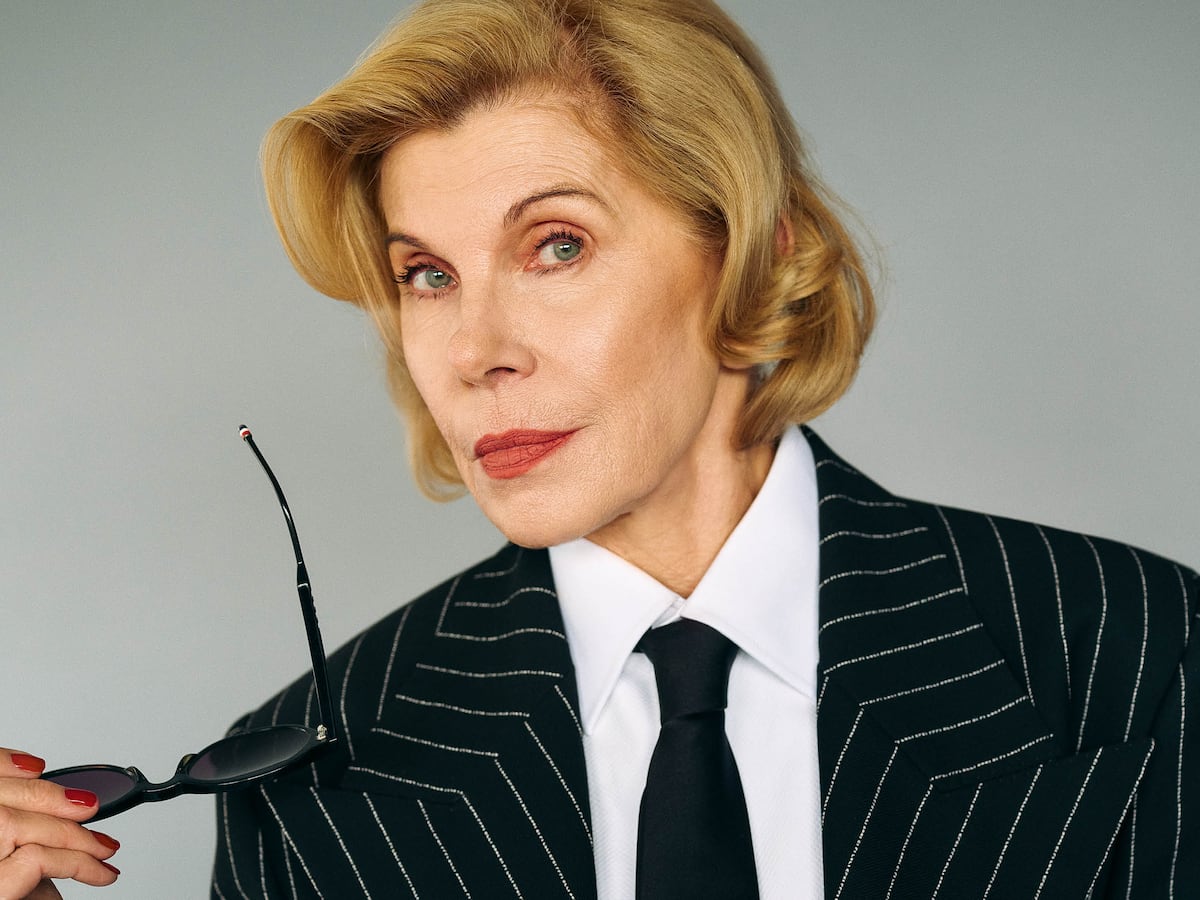
“I remember being so moved by the performance of Plácido Domingo and Sherrill Milnes singing their great duet in Don Carlo [Dio, che nell’alma infondere] that I couldn’t lift my hands to applaud; I was just overwhelmed. I thought that’s the power of what performers can do. They can make people feel the sense of awe, gratitude and wonder that such a thing is possible.” Today Christine Baranski, 74, is a world-renowned actress thanks to her work in film and television. Series such as The Good Wife and The Good Fight have earned her a reputation commensurate with her talent. But when she began her career, she had only one passion: the theater. Juilliard, New York’s prestigious performing arts conservatory, gave her the training she needed to pursue it, while the performances she managed to catch at the nearby Metropolitan Opera, just steps from her school, only deepened her love of the stage. “Don Carlo remains my favorite opera,” she says. “On that occasion, in 1970, I paid for an orchestra seat. Normally, I always sat or stood all the way in the back because I couldn’t afford tickets. Or I would cross the street and see if I could get a free ticket from someone who was giving it away at the last minute, or who would help me get in. The point is, that time I did pay. It was $25, which was a lot of money to me.” Today, 56 years later, with two Tony Awards, an Emmy and dozens of acclaimed performances to her name, she has just premiered the fourth season of The Gilded Age on HBO and is back on stage in Hay Fever, a Noël Coward play currently running at Wyndham’s Theatre in London’s West End. Speaking from her dressing room there, she talks to EL PAÍS.“Every night, when I perform and look out at the audience, they’re smiling ear to ear. I’ve made them laugh for an hour and a half, and that makes me very happy, particularly in a very dark world.”Question. You play Judith Bliss, a retired stage actress. And aside from the occasional special appearance, you hadn’t been onstage in nearly two decades. Why did you decide to return now?Answer. Because I had a window of time. Until now, I couldn’t fit it into my filming schedule. With The Good Wife, The Good Fight and The Gilded Age, I’ve had more than 15 years of continuous television work, interrupted only by COVID and the actors’ strike. And doing a play requires about six months so producers can plan a production and we can rehearse. This kind of theater requires a certain skill set, so when it was offered to me I thought, “Wouldn’t it be wonderful to do a Noël Coward play!”, especially in London, because I’ve never done the West End. And I happen to love London as a city. I shot three movies here: the two Mamma Mia! films and Into the Woods. If I didn’t have family or a career in the United States, I could happily live in London. And well, something similar happens to what is expressed in the final line of the play: returning to the stage has a marvelous resonance given that I really wanted to return to the stage. Q. You were raised in a working-class family of Polish descent in Buffalo, but your grandmother was an actress. Was she the one who sparked his passion for acting?A. I think so. She was a vivacious, flamboyant woman with a wonderful, outgoing and warm personality. I never saw her on the stage — she was no longer acting when I was born — but she did perform with my grandfather. In fact, she fell in love with him at 16 after seeing him in a role at the Polish community theater. We shared a bedroom and it was impossible not to feel that vivacious, wonderful personality; she had a gaiety about her, and her friends were very ebullient. I grew up seeing and hearing Polish music; my parents and grandparents were in a choir. My father wanted me to study ballet, so I started as a child; I continued training in dance, but decided I preferred acting and began acting in high school. Q. I believe one of your fondest childhood memories was going to the theater with your father shortly before he died, when you were eight, and seeing how moved he was. A. Yes. It’s my fondest memory of my father. There were actually tears coming down his face, and he was such a big, strong man. It made a huge impression on me that my father could be so moved by performers. I remember running into his arms after a ballet recital. I had done my little dance with my group and, when it was over, I went into the audience and ran into his arms. Even today I think that I sort of performed for my father and my grandmother. Q. I’ve heard you say that your mother is, to some extent, your inspiration for Agnes, your character in The Golden Age. Why is that?A. My mother was a very strong woman who suffered a lot of very difficult challenges in her life. She grew up in the Great Depression in Buffalo, having to walk to school with newspapers in her shoes and eating nothing but jelly sandwiches. She then lived through the war. She couldn’t marry my father because he went off to war, and when he came back, they had a happy life until he dropped dead of an aneurysm, She was left with two children, aged 10 and eight, and she didn’t even know how to drive. She had to get a job, which she did. It was a very difficult job, involving parts for air-conditioning units, which required enormous concentration and was very tedious. But she managed to pay the bills and raise her two children. I got a scholarship to Juilliard, but she helped me out. Then, she had to cope with the suffering and death of her parents; then she lost my brother, who died at the same age and for the same reason as my father.They had been very close; he took care of her in Buffalo. When he died, I had to move my mother to Connecticut. At age 70, after retiring and having worked for so many years, she was hit with three different forms of cancer. But she died at 85. She was one of those women who just knew how to play the hand she was dealt. She had so many difficulties, but she got through it. She had a great sense of humor too, like Agnes. She was a tough old broad. And Julian Fellowes [showrunner of The Golden Age] admires those sorts of women. So I love bringing that strength to Agnes because I lived with that sort of woman for 18 years before I went to Juilliard. Q. The Gilded Age is a portrait of the origins of the modern world, of the shift from one era to another. Do you think we are now in a similar moment of change? A. I think The Gilded Age is relevant now because we’re in a new era of “robber barons.” We used to talk about millionaires; now we have billionaires. They can’t get enough; they can’t make enough money, and they’re transforming the world whether we like it or not. I don’t think anyone is thrilled about having artificial intelligence centers near their home or about the effects this technology might bring. We’re all fearful of what lies ahead. But it’s created an economic boom in the stock market, and I’m sure a great deal of good will come from it in terms of research, medicine and many other fields. But there’s a sense that we’re going to lose our civilization as we know it. I think that same fear existed back in the Gilded Age; everything happened at breakneck speed under that “move fast and break things” logic. Q. As an actress, are you afraid of AI? A. I don’t wake up in the middle of the night fearful of it, but I can already see what’s happening when I talk with people I work with. The woman who does my wig told me she lost a lot of work because they don’t need actual extras in movies anymore; they can use artificial intelligence to fill in the crowds. I’m trying to protect my own image as much as possible. I don’t want my voice or face to be used without my permission. I don’t want my own clone or anything like that. I remember during a Zoom call a costume designer showed me costumes for an upcoming episode I was working on and said, “Look, this is an AI version of you.” It was jaw-dropping: it was exactly me, but it wasn’t me. I thought, “Oh God, is this the future?” Q. You began your career as a stage actress and were reluctant to become a television actor. What ultimately led you to it? A. I resisted and resisted because I loved my theater life and I always feared getting stuck in a series. But I’d been in a Broadway play [Nick and Nora] that I thought was going to run for a long time and it was a big flop: it closed a week after opening. My late husband and I soberly analyzed what it would cost to educate our girls. So when I was offered Cybill, I accepted. The same team had earlier approached me to do the U.S. version of Absolutely Fabulous with Cybill Shepherd, and the idea of playing Joanna Lumley’s kind of character excited me. That never happened, but Maryann, my character on Cybill, had a lot of Ab Fab in her. No one on U.S. television had played a character like that: she was fashionably dressed, drank several martinis at lunch and was always planning revenge on her ex-husband. Q. In a way, she was Samantha Jones, from Sex and the City, before Samantha. A. Yes, she was the first of her kind, which I really loved. And, of course, Chuck Lorre [the showrunner] wrote me so many great, witty lines. I knew how to handle that material because I had done so much theater: I’d worked with Terrence McNally, John Guare, Tom Stoppard and Neil Simon. And within 13 weeks, I won an Emmy for the role and suddenly my career was transformed. Mike Nichols asked me to appear in The Birdcage, and from there other projects followed. It opened a lot of doors in film. When you reach that level of television fame, countless opportunities appear because millions of people know you. As a theater actress, I was known only in New York. So I will always be grateful that I did Cybill, and I’m glad it ended when it did because I was ready to move on. Q. You made your television debut at age 42. Do you think young actors today are too obsessed with becoming famous quickly? Or does the system push them in that direction?A. It’s something I always discuss with young actors: it takes time; you have to do it for years before you become a skilled theater actor. Juilliard emphasized the ability to play a lot of different characters. But unfortunately, young people feel that their youth — and if they’re attractive, that their looks and sexuality — is a commodity; they think they must get followers, be on TikTok and Instagram, and promote themselves. It’s a world I thankfully didn’t have to deal with. Q. Let’s talk about Diane Lockhart, your character in The Good Wife and The Good Fight. You played the same role for 13 years. Were you ever afraid of being typecast? A. No, not at all. I would say I’ve played a certain kind of woman, but they are precisely the kind I wanted to play. Diane was highly educated, articulate, always impeccably dressed, comfortable living in a man’s world, able to have a drink at the end of the day with her male coworkers. She had a great sense of humor and a sex life. I like playing these kinds of women because when I started portraying Diane Lockhart, these women were underrepresented. I was over 50 when I got the role; it was a supporting part, but she was head of the law firm. I remember telling my agent, “I’ve done enough comedy and enough theater; I’d like a dramatic role on television — an intelligent, powerful woman.” And lo and behold: Diane came into my life. Now, I feel television is filled with such characters. Look at Jean Smart or Alison Janney: they are winning awards and being recognized for work they do well past the age of 50. Why not? With time, we become more interesting, more complex and wiser, so why shouldn’t we bring all that as actresses? They just need to write the roles for us. Q. How was the shift from a supporting role to being the lead on television with the same character? A. It was very graceful because I’d already played Diane Lockhart for seven years, so we knew exactly who she was. The writers picked up the story and had a brilliant idea: to have her lose all her money at the height of her career, when she’s ready to retire in the south of France. With nothing left, she has to go back to work, and the only firm willing to hire her — the only one — was a firm run by Black people. That’s how I got to work with the great Audra McDonald and Delroy Lindo. Having worked with the Kings [Robert and Michelle, the showrunners] for seven years, we already had such a solid working relationship. Also, all this took place during the age of Donald Trump. The writers could explore the story of a woman who, like Hillary Clinton, was educated during the rise of the women’s movement—becoming a passionate, powerful feminist — and suddenly finds herself living in the age of Trump, which pushes her to the limit. On the other hand, her marriage — being with someone of an opposite political ideology — allowed the show to address a whole range of wonderful issues over those six seasons. I still think if someone wants to understand Trump’s first presidency, this is the best series to watch. The story ends with Donald Trump coming down an escalator to announce that he’s running for another term.Q. When Trump won his second election, many of us remembered Diane Lockhart’s look of astonishment in The Good Fight at his first victory. Did the Kings fall short, given the world we live in today? A. They’re remarkable in their ability to not just chase the headlines and be on top of things, but almost to see into the future. Their new series, Cupertino, deals with AI; I can’t wait to watch it. They write about what’s happening right now. The Good Fight, for example, dealt with what was happening in the country. Even The Good Wife was about a woman dealing with her husband’s infidelity; seen today, that seems almost quaint: the idea that infidelity could bring down a political career and be devastating to the wife, but back then, it was. I just marvel at their extraordinary prescience. Q. I have to ask about Mamma Mia 3. What can you tell us? Would you like to be part of it? A. I think we’re all open to participating; we had a great time on the first two films. It’s not a question of availability. Judy Kramer [the producer] — who has become a good friend — is working constantly on making it happen. She’s hired a new screenwriter; that’s all I can say. Now it’s a question of bringing all the pieces together. I love that the films have brought so much joy that people want another one. Q. Photos from the wrap party of the first Mamma Mia resurface online from time to time as a symbol of pure fun. Did you have that much fun on set? A. Yes. I think… well, the first time we were on a couple of Greek islands, and the second time we were in Croatia. When we weren’t filming, we were just being together, having dinners and laughing… we were in a beautiful place. It was a very special time; we had ABBA’s music and, well, we had a wonderful time. I have such happy memories of all the men in the cast: Stellan [Skarsgård], Colin [Firth] and Pierce [Brosnan] were just marvelous. I also adore Meryl [Streep] — we became friends — and Julie Walters and everyone else. Q. You’ve said that people recognize you all over the world for your role as Beverly, Leonard’s mother, on The Big Bang Theory. But if you could imagine being recognized for some other role, which one would you like it to be?A. I’m fond of all the characters I’ve played, but I must say I’m very proud of Diane, because that was 13 years of my life. Actually, young women still come up to me to say I inspired them; they were drawn to her intelligence, her manner and the fact that she was a passionate lawyer. That I would be an inspiration to young women means a great deal to me. Q. You are the epitome of versatility: you’ve done comedy, drama, period pieces, contemporary works, theater, film, and television. What’s left for you to do that you haven’t done yet?A. There aren’t many options left. I will certainly never do stand-up comedy. I don’t know if I’ll ever do a cabaret act. But when I sing — for example, I perform a beautiful French song in Hay Fever — it reminds me how much I love singing. I’d love to sing more and also to return to Shakespeare; I love language and the classic plays. Noël Coward, for instance, is great: he uses the English language so beautifully; his wit and way of expressing things are wonderful. But it would be wonderful to delve into a Shakespeare text; I’ve always wanted to play Cleopatra, the great tragic Shakespearean role. However, time is of the essence. If The Gilded Age continues, I’ll be working again in the spring, which means six months of commitment. Fitting everything in becomes an issue. I wouldn’t be surprised if this is the last play I manage to include in my schedule, given the rehearsals, the 12-week run and all of that. After all, it’s at least six months out of your life that you have to plan for. Q. After such a long career, what advice would you give your younger self if you could? A. I was very hard on myself. And I think being hard on yourself is good because it makes you want to get better, but I used to worry terribly. My mother brought us up to fear money and to worry that we wouldn’t have enough. When you lose your father at the age of eight, an anxiety sets in that things are going to be insecure and your life will never be the same. So I spent a lot of my youth in a state of anxiety. It’s easy to say now that I shouldn’t have been so anxious — I know exactly why I was — but I needn’t have felt it so strongly because actually God’s been very good to me and has taken care of me. I feel very blessed, although truthfully, I spend too much time worrying. I think most people experience this in youth: they feel insecure, that they’re not good enough. I would apologize too much. In fact, it’s advice I give to women: don’t apologize. Stop thinking you’re doing something bad or that you owe people an apology. It is okay to be strong and to say your mind without apologizing. Just say what you mean and mean what you say. CREDITSStyling Fabio ImmediatoMake-up Adam de Cruz (Premier)Hair Declan Sheils (Premier)Nails Jada-Ellize Lorentz (Premier)Set design Joseph BurkeProduction Cristina SerranoLocal production Thea Charlesworth (The Arcade)Set production Claire Nichols and Kate RosewellTailor Takudzwa ChigaduroAssistant photographer Shane Woodward and Martin EitoCreditsDigital assistant Felix Turnbull-WalterStyling assistant Molly EllisonProduction assistant Stef CarliSign up for our weekly newsletter to get more English-language news coverage from EL PAÍS USA Edition
Christine Baranski: ‘I have one piece of advice for women: Don’t apologize’
Full Article
Original Source
Read the full article at English →KhanList aggregates and links to publicly available news content. We do not host full articles from third-party sources. Always verify important information with original sources.