
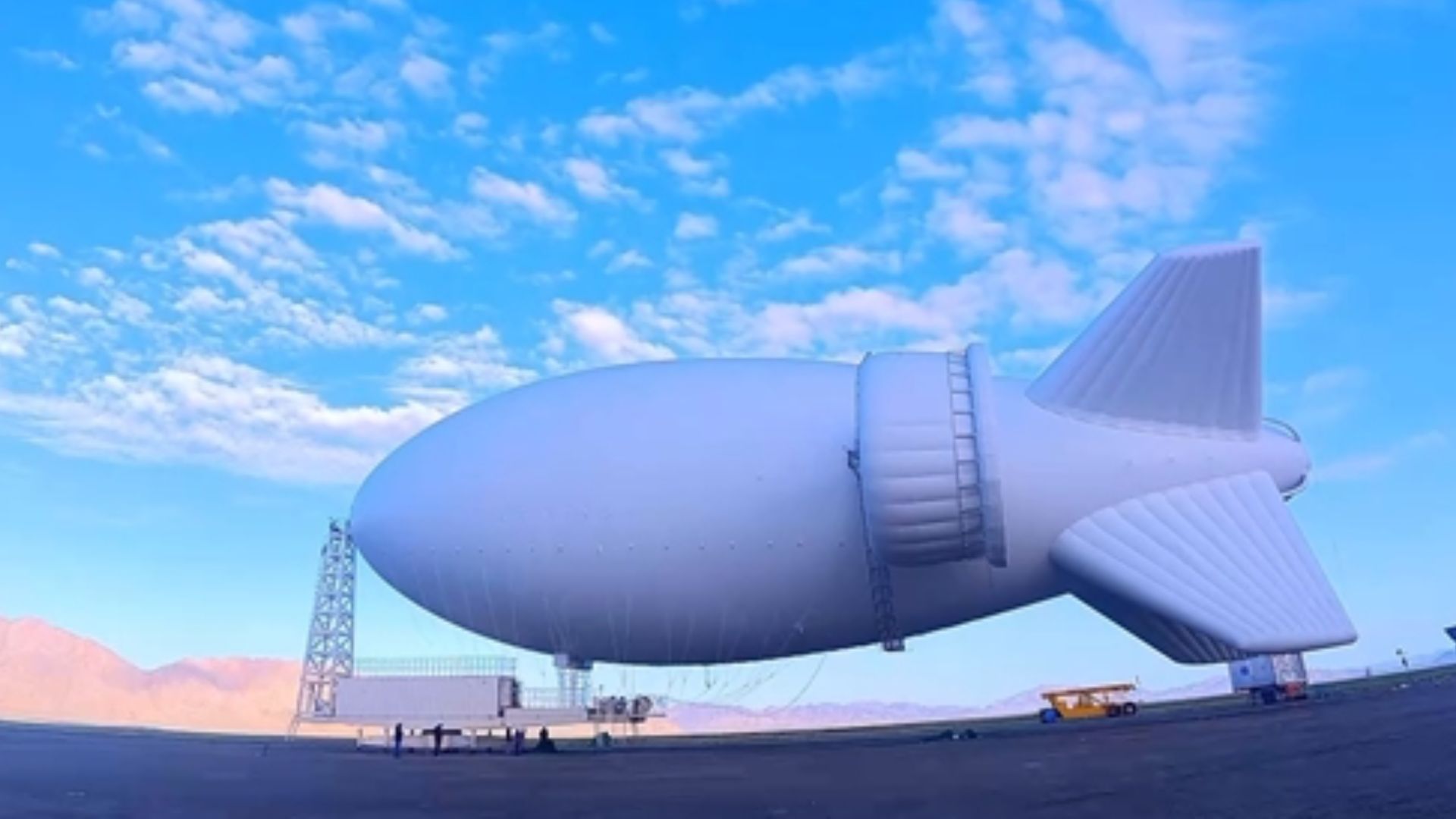
China’s new airborne wind turbine carries generators into stronger high-altitude winds.People's DailyKey TakeawaysLinyi Yunchuan's S4000 uses a helium-filled platform to lift wind turbines to altitudes of up to 2.5 milesThe company is testing whether airborne wind generation can supply electricity closer to urban consumers while reducing land and infrastructure requirements.Commercial viability remains unproven, with generating capacity, operating costs and long-term reliability still to be demonstrated. A Chinese energy technology company has demonstrated an airborne wind power system designed to generate electricity at altitudes of up to 2.5 miles, as it explores an alternative to conventional wind farms. The S4000 Stratosphere Airborne Wind Energy System (SAWES), developed by Linyi Yunchuan, uses a helium-filled platform to lift lightweight turbines into stronger and more consistent winds, with a tether connecting the airborne structure to the ground and transmitting the generated electricity. The company conducted its latest demonstration in Yueyang, Hunan Province, bringing the technology closer to an urban environment after completing a high-altitude flight verification in northwest China back in August. Helium-lifted wind turbines The system’s launch comes after a series of increasingly ambitious tests, with earlier versions reaching altitudes of 1,640, 3,281, 4,921 and 6,562 feet. The S4000 represents the latest stage in that development, although its commercial performance and ability to provide a reliable electricity supply remain to be established. The S4000 uses a large helium-filled airborne structure to lift its generating equipment above the ground. Measuring 220 feet long, 131 feet wide and 75 feet high, the platform resembles a large airship and is designed to carry an effective airborne payload exceeding 2,200 pounds, Chinese media reported. Once airborne, wind passes through a duct in the structure and drives turbines that generate electricity. A tether keeps the platform connected to the ground while also providing a route for transmitting the electricity to users below. Unlike conventional wind turbines, which require tall towers and substantial foundations, the airborne system is designed to operate without permanent structures of comparable scale. Linyi Yunchuan said this could reduce land requirements and make the technology less dependent on local terrain. The company also lists a designed service life of 20 years. However, long-term durability under continuous exposure to high-altitude winds, changing weather conditions, and mechanical stress will need to be demonstrated through extended operation. The latest launch in Yueyang focused on deploying the system under real operating conditions near a city. According to the company, the S4000 had already completed a full flight verification at 2.5 miles in northwest China in August, including ascent, hovering, electricity-generation tests, and recovery. A company executive identified grid connectivity and proximity to consumers as important considerations in the technology’s development. However, the approach introduces its own engineering and infrastructure requirements: the tether must remain structurally stable while transmitting electricity, and the airborne platform must withstand changing wind conditions and remain safely recoverable. Its operation near populated areas will also require careful assessment of airspace restrictions, weather-related risks, and emergency procedures. The company has not provided detailed figures on the S4000’s generating capacity, electricity output during the demonstration, or projected cost per kilowatt-hour. Those metrics will be essential for determining whether the technology can compete with established wind, and solar installations. Airborne wind energy is attracting international interest because winds at higher altitudes can be stronger and more consistent than those near the surface. That could potentially allow airborne systems to generate more electricity without the large towers and foundations required by conventional turbines.Get the latest in engineering, tech, space & science - delivered daily to your inbox.Bojan Stojkovski is a freelance journalist based in Skopje, North Macedonia, covering foreign policy and technology for more than a decade. His work has appeared in Foreign Policy, ZDNet, and Nature.
China’s S4000 airborne wind system reaches 2.5 miles in high-altitude tests
Full Article
Original Source
Read the full article at Interestingengineering →KhanList aggregates and links to publicly available news content. We do not host full articles from third-party sources. Always verify important information with original sources.