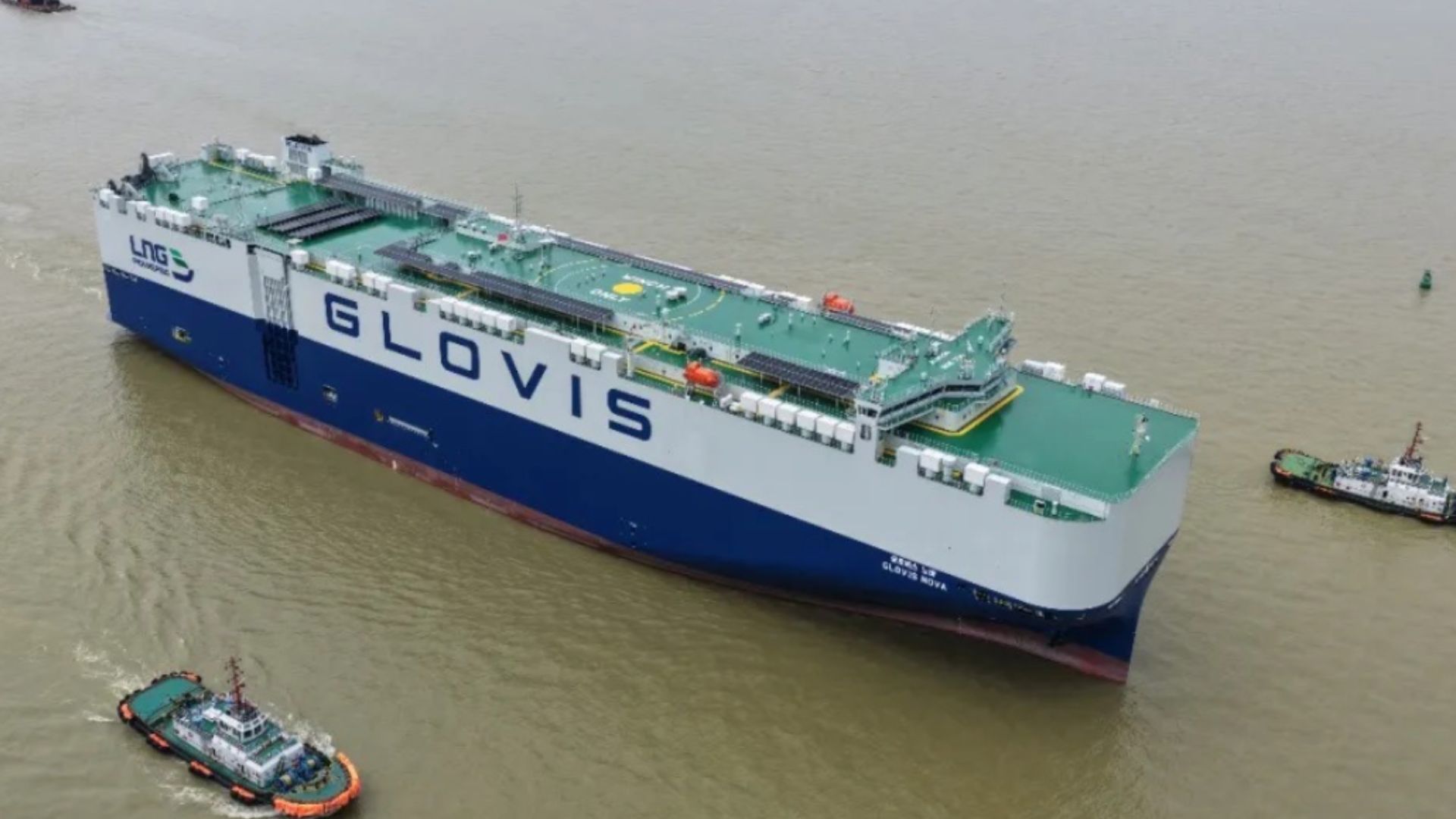
China on Tuesday delivered the world’s first 10,000-vehicle-class car carrier equipped with a photovoltaic power generation system to South Korea’s Korea Ocean Business Corporation (KOBC). Built by Guangzhou Shipyard International (GSI), the ship can carry up to 10,800 vehicles and uses both solar power and liquefied natural gas (LNG) dual-fuel engines to boost fuel efficiency and cut emissions worldwide. The delivery took place through a remote online signing ceremony between GSI and China Shipbuilding Trading Co., Ltd., as KOBC chose a virtual handover instead of an in-person event. According to GSI, the new ship will be leased to Hyundai Glovis for international routes connecting Asia, Southeast Asia, North America, and Europe. Solar power added to large vehicle carrier This new Pure Car and Truck Carrier (PCTC) is the fourth carrier of its size delivered by China, and it is the first in its class to have a solar power system. The ship’s solar system can produce up to 200 kilowatts at its peak and generates about 1,000 kilowatt-hours of electricity daily with 5.5 to 7 hours of sunlight. This power helps run the ship’s operations, lowering fuel use and making the ship more energy efficient. The carrier also uses a dual-fuel propulsion system that operates on conventional fuel oil and LNG. It includes a shaft generator and meets the International Maritime Organization’s Tier III emissions standards. According to GSI, this combination makes it the most energy-efficient vessel in its series. Built for global vehicle transport GSI and the Shanghai Merchant Ship Design and Research Institute worked together to design the vessel. It has been approved by Norway’s Det Norske Veritas and South Korea’s Korean Register, so it can operate anywhere in the world. The carrier is about 755 feet (230 meters) long, 131 feet (40 meters) wide, and has a draft of 34.4 feet (10.5 meters). It can travel at speeds up to 19 knots, which is about 22 mph (35 km/h). The ship’s LNG tanks hold enough fuel for a full trip, so it does not need to refuel during long journeys. Flexible cargo decks The ship has 14 decks for vehicles, with nine fixed and five adjustable. This setup lets it carry passenger cars, vans, heavy trucks, trailers with freight containers, and other large vehicles. In addition to cars, the ship can carry some packaged dangerous goods covered by the International Maritime Dangerous Goods (IMDG) Code. This expands the types of cargo it can transport. Strengthening China’s shipbuilding position This latest delivery adds to GSI’s growing lineup of large vehicle carriers and shows China’s increasing role in building new commercial ships. When Hyundai Glovis starts using the ship, it will help move vehicles between major manufacturing and consumer markets in Asia, Southeast Asia, North America, and Europe. The use of solar power and LNG engines also shows the shipping industry’s wider push to cut emissions while still carrying large amounts of cargo. Recommended ArticlesGet the latest in engineering, tech, space & science - delivered daily to your inbox.A versatile writer, Sujita has worked with Mashable Middle East and News Daily 24. When she isn't writing, you can find her glued to the latest web series and movies.
China delivers world’s first 10,800-vehicle ship with 200 kW solar power system
Full Article
Original Source
Read the full article at Interestingengineering →KhanList aggregates and links to publicly available news content. We do not host full articles from third-party sources. Always verify important information with original sources.