
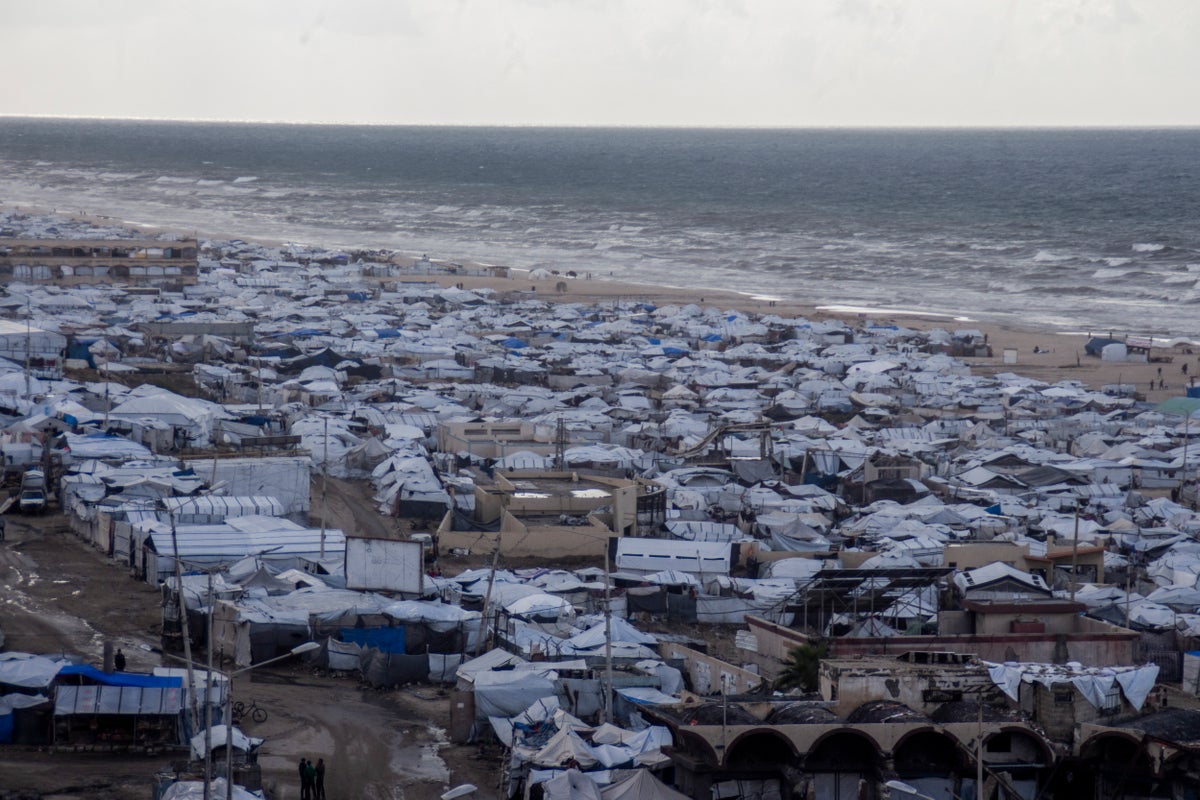
Torrential rainfall across Gaza has caused chaos, the latest crisis to hit the enclave after years of destructive war. Severe flooding has displaced tens of thousands of people, with aid agencies warning the heavy rain in recent weeks has only added to the misery for those forced to live in tents. In Gaza City, displaced resident Mokhtar told The Independent the situation has grown “absolutely horrific”.“The rain has barely begun, but we can't handle it,” he said. “We're drenched, everything is soaking wet. Where are Gazans supposed to go – from tents to where?”Mokhtar’s plea comes after Britain joined Canada, Australia, and Italy in issuing a joint demand for Benjamin Netanyahu’s government to lift restrictions blocking winter tents and critical relief supplies from entering the enclave.Heavy rain has flooded thousands of tents and makeshift shelters across Gaza (AFP/Getty)“150,000 tents and other vital supplies are being held at the border and prevented from entering Gaza,” the four foreign ministers said in a coordinated statement earlier this month. “This situation is entirely reversible – and there is still time to act before the winter fully sets in.”The Independent has approached the Israeli government for comment. Authorities have routinely rejected accusations of obstruction. In a statement posted on X, the military’s humanitarian coordination unit COGAT said it is working to address winter needs, claiming “over 93,000 tents and more than 8,600 trucks carrying winter supplies” have entered Gaza. Sharing the post, Israeli foreign ministry spokesperson Michal Maayan said: “Israel is working to get humanitarian aid into the Gaza Strip. Hamas is stealing that aid in order to feed its terror machine.” But across Gaza, where downpours flooded more than 70,000 tents in 12 hours alone, humanitarian organisations say civilian suffering is being prolonged by Israel’s border decisions.Trucks carrying humanitarian aid are being denied entry into Gaza, according to humanitarian organisations (AFP/Getty)“This is not simply the result of bad weather,” said Ahmad Alhendawi, Save the Children director for the Middle East, North Africa and Eastern Europe. “Tents, shelter kits and fuel are waiting at Gaza’s borders while children sleep in floodwater, because the Israeli authorities are blocking their entry. This is a choice.”During the season’s first major storm, Gaza’s Civil Defence received more than 1,500 emergency distress calls from displacement camps, where floodwater reached as high as 1.5 metres in some areas. The rain destroyed an estimated 6,000 shelters, and killed at least six people – including three children who were crushed to death after a waterlogged sand embankment collapsed near Deir al-Balah.More than 1.9 million Palestinians in Gaza – roughly 90 per cent of the territory’s population – are currently displaced.Some 65 per cent of Gazans live in tents or rudimentary shelters. An estimated 350,000 have no shelter at all. Two thirds of Gaza’s population live in tents, or makeshift shelters (AFP/Getty)The shelter crunch has worsened as the Israeli military advances its “yellow line” – a demarcation established under the US-brokered ceasefire in October 2025. Originally covering 53 per cent of Gaza, the Israeli-controlled zone has pushed further; it now encompasses roughly 65 per cent of the territory, cramming more than two million Palestinians into an ever-shrinking coastal strip. The international backlash follows a rare public rebuke from Donald Trump’s 28-nation Board of Peace – a self-appointed body designed to oversee Gaza’s post-war transition – which declared the crisis an “immediate humanitarian emergency” and warned that Israel’s aid response remains “insufficient”.That came days after president Trump personally telephoned Netanyahu, asking him to move forward with his stalled 20-point Gaza peace framework. The UK, Canada, Australia and Italy have condemned Israeli efforts to block aid entering the Strip (AFP/Getty)According to US and Israeli officials, Washington had avoided pressing Bibi during Israel’s Knesset elections last month – a grace period that ended abruptly after devastating Republican losses in the US midterm elections.But with diplomatic avenues showing little sign of progress, humanitarian agencies warn that Gazans cannot afford a lengthy wait.United Nations relief chief Tom Fletcher has condemned the border delays as “collective punishment,” accusing governments of stalling while families endure freezing conditions.“Foreign ministers and partners have assured me of support, but also repeatedly said that progress would be hard until after Israeli elections,” Mr Fletcher said, referring to Israel’s inconclusive 27 October poll. “Now we’re told to wait for the formation of a government. People cannot wait.”The UN relief chief has described Israel’s actions as tantamount to “collective punishment” (AFP/Getty)Netanyahu’s office and COGAT have continued to defend their handling of winter preparations, insisting that Israel has facilitated the entry of more than 27,000 tonnes of medical supplies alongside shelter equipment.“As long as Hamas remains in power, it will use every dual-use item entering Gaza to entrench its terror regime and expand its military arsenal,” the prime minister’s office said.Israel’s dual-use list changes frequently and has routinely been criticised as a bureaucratic obstacle to limit the flow of aid into Gaza. Items which have been banned from entering the Strip in recent years have included: crutches, plastic children’s toys, sleeping bags, water purification tablets and maternity kits.Relief organisations, however, warn that stocks of tarpaulins and blankets inside Gaza are virtually exhausted.Without immediate clearance to enter Gaza, they warn, preventable deaths in the Strip will mount rapidly in the coming weeks.
‘Children are sleeping in flood water’: Inside Gaza’s escalating floods crisis as Israel accused over aid shortages
Full Article
Original Source
Read the full article at Independent →KhanList aggregates and links to publicly available news content. We do not host full articles from third-party sources. Always verify important information with original sources.