
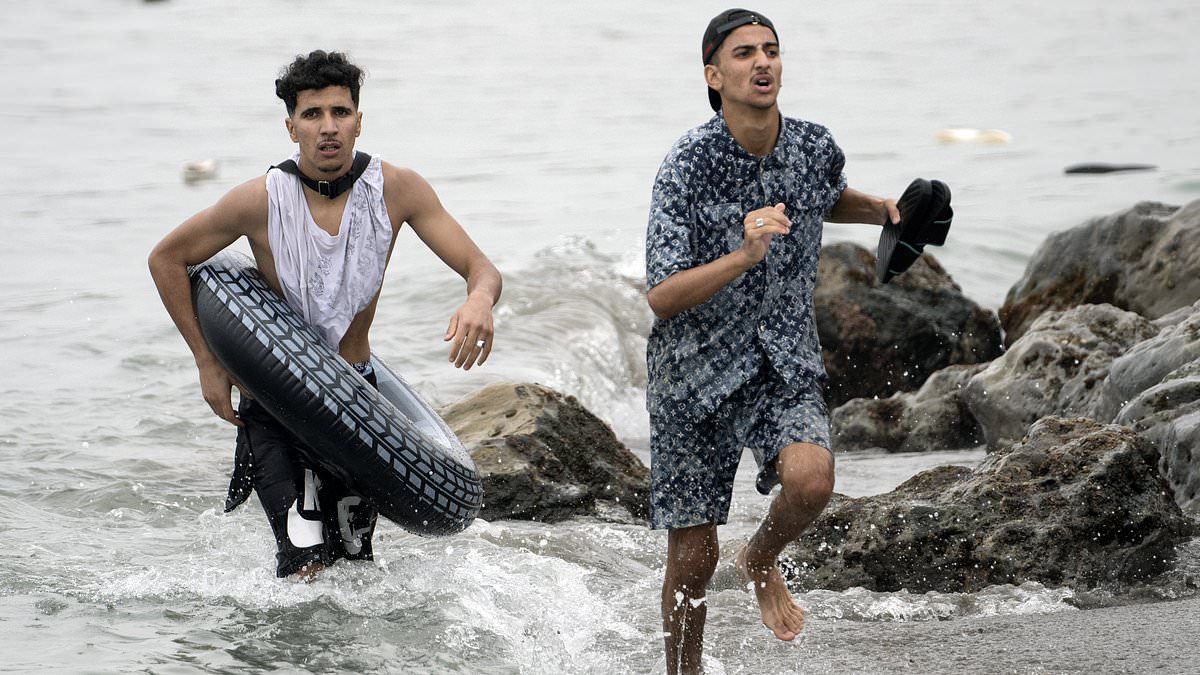
Identical inflatables were distributed before around 80,000 migrants poured into the Spanish territory from Morocco in late July, according to a report. An investigation obtained by Spanish outlet El Mundo found a major logistical effort underpinned the mass crossing into Ceuta, with 10,000 floats used in the operation.The black and white toy inflatables, emulating a car tyre, were piled high on the beaches after the two days of disorder.Spanish police believe that the plastic rings were bought in bulk and handed out to migrants along the coast as part of a coordinated plan for the incursion on July 30 and 31. National Police predict around 8,000 to 10,000 of the identical rubber rings were used during the unprecedented mass border crossing.But the report found the total number could be even higher. Authorities said that aerial imagery of El Tarajal beach indicated that there may have been as many as 30,000 inflatables.They noted that the figure may be exaggerated due to the rings being used more than once, with those who successfully crossed passing them over the border fence to others hoping to follow. The revelations come as the tiny island of El Hierro in the Canaries has become the latest host of Europe's migration crisis, having been overwhelmed by 100 boats carrying nearly 11,000 West Africans within just a few weeks. An investigation by Spanish police found identical inflatables were distributed before around 80,000 migrants poured into the Spanish territory from Morocco in July Authorities believe that the plastic rings were bought in bulk and handed out to migrants along the coast as part of a coordinated plan for the incursion on July 30 and 31It is understood that the large number of inflatables provides evidence for a detailed plan and co-ordination behind the mass crossing. Meanwhile, authorities ruled out the possibility that migrants could have bought the inflatables in border towns, adding local shops did not stock close to the number of rings. 'A single batch was acquired beforehand, distributed locally and then used in a generalised manner,' the report by the National Immigration and Borders Centre (Cenif) said.It pointed out to a 'pre-arranged distribution and use for the mass crossing 'by swimming' at a perfectly determined time and place'. 'The almost exclusive and large quantity of a single model of float, together with the limited number of distributors and points of sale, allows us to rule out a random origin of the stock that appears on those days, in that area (Castillejos) and for that range of quantities (4,000 - 30,000),' the report said. Notably, police figures have not taken into consideration the number of floats abandoned on public roads, swept to sea or left on the other side of the border. It is understood the inflatables, a model called Giant Tyre which is manufactured by a company called Intertex, have a 60 to 90 day delivery time. Many have blamed Morocco for stoking the surge of migrants to try and win concessions from Madrid but Spanish Prime Minister Pedro Sanchez has dismissed this. Migrants who crossed from Morocco into Spain returned to a beach after being expelled from the area the previous day, in the Spanish exclave of Ceuta, on August 21, 2026He said on Monday that no intelligence reports suggested 'any involvement in one way or another' from Moroccan authorities.Mr Sanchez instead pointed to disinformation on social media from Russia and Israel as well as the far right to sow discord in Spain and Europe.Jerusalem and Moscow strongly denied the allegation, while Rabat also refutes claims it orchestrated the mass crossings.The police report said evidence has failed to indicate Moroccan involvement nor motive. The National Intelligence Centre (CNI) instead concluded in a report on November 11 that the spread of misinformation about a relaxed border crossing on social media fuelled the incursion. The debate has sparked a judicial inquiry led by María Tardón, a judge from the High Court, into the mass entry of migrants into Ceuta from Morocco. It comes as prosecutors have said dozens of sexual assaults have been recorded since 80,000 migrants flooded the Spanish territory from Morocco. There have been 23 attacks reported – including nine against children – meaning almost one every day since the mass influx at the end of July. People aboard inflatable boats navigate on the Moroccan side of the new floating barrier deployed by Spain to reinforce security near the border post of the Spanish enclave of Ceuta in AugustLocals warned the situation has 'worsened significantly' in the last month as, while most returned, around 5,000 migrants remain in shanty towns on the beach.Police are grappling with near daily outbreaks of violence while at least two Moroccans have been convicted of theft.Among those suspected of sexual assault there are four Moroccans, three Spaniards and a Belgian.Ceuta's chief prosecutor Silvia Rojas warned migrant girls are 'particularly vulnerable because of their irregular status in the territory'.Ms Rojas said the influx sparked an exponential rise in sexual assault with many victims not filing reports either out of fear or due to their 'current situation'.Between 1,400 and 1,600 of the migrants who remain in Ceuta are children, she said, who are particularly vulnerable.The Spanish Society of Epidemiology also warned of the difficulty in detecting and tackling violence against migrant women and girls.Mr Sanchez is under fire for his handling of the crisis with hard-right opposition Vox saying he has not 'lost control of Ceuta - he has handed it over'.Ceutan local Salvador Ortega told the Daily Mail that things have 'worsened significantly' in the past month.'There is a great deal of tension between the residents and the invaders,' he said.'There have been confrontations between some residents and migrants, as well as incidents requiring intervention by law enforcement and security forces.'Acts of vandalism and episodes of violence have occurred, causing particular concern among the local population.'Mr Sanchez said on Monday that King Felipe VI would visit Ceuta 'as soon as conditions allow', seen as an attempt to assert Spanish authority over the exclave.Morocco has a longstanding claim over Ceuta and its fellow autonomous city of Melilla.The last time a Spanish head of state visited the territories in 2007, Rabat pulled its ambassador from Madrid, suggesting the royal's visit could increase diplomatic tensions.
10,000 identical inflatables were handed to migrants before Ceuta 'invasion' when 80,000 Moroccans flooded Spanish enclave, police report says
Full Article
Original Source
Read the full article at Dailymail →KhanList aggregates and links to publicly available news content. We do not host full articles from third-party sources. Always verify important information with original sources.