
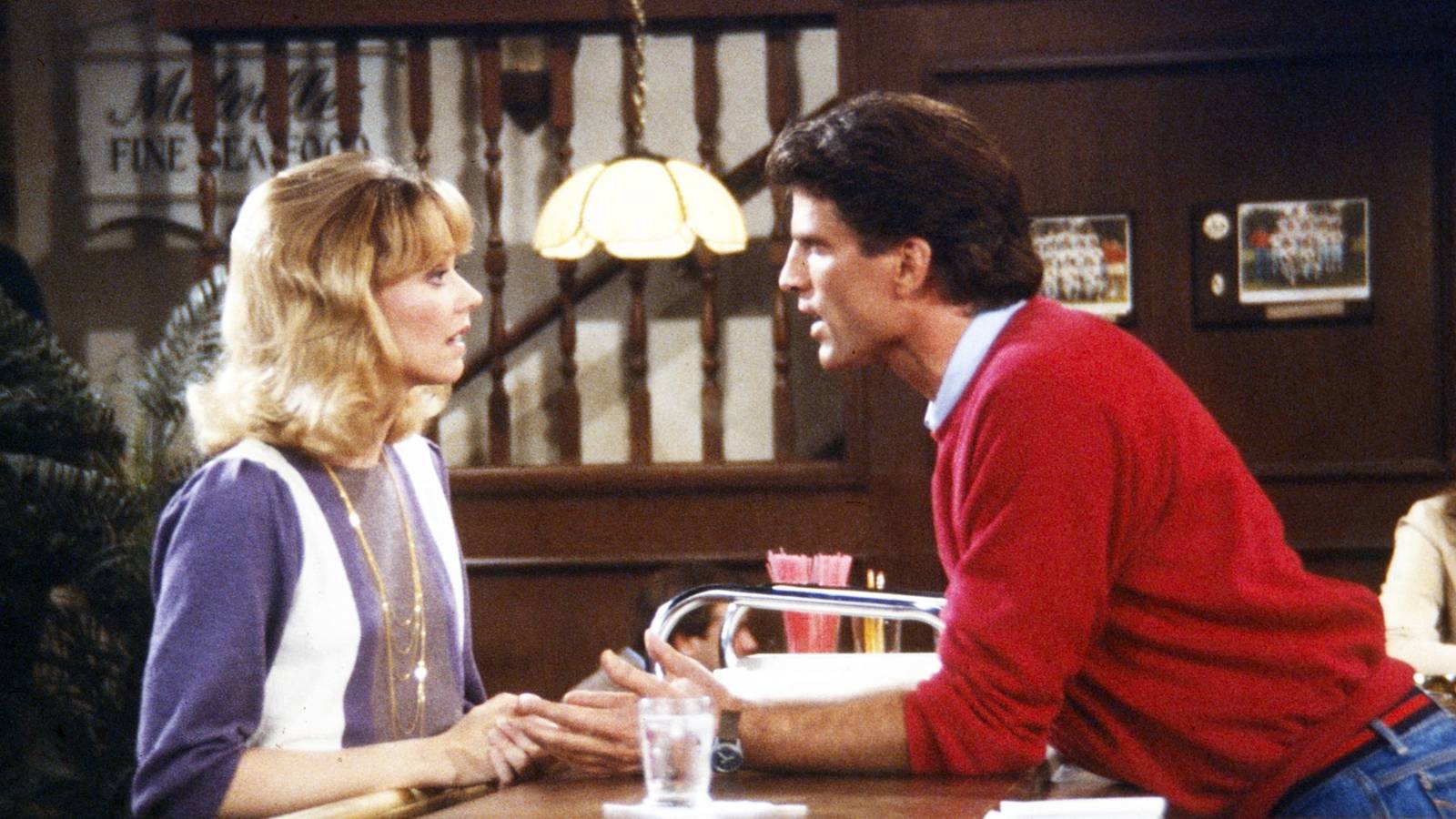
Image courtesy of MovieStillsDb Published Oct 3, 2026, 6:00 PM EDT Cathal Gunning has been writing about movies, television, culture, and politics online and in print since 2017. He worked as a Senior Editor in Adbusters Media Foundation from 2018-2019 and wrote for WhatCulture in early 2020. He has been a Senior Features Writer for ScreenRant since 2020. Sign in to your ScreenRant account While Cheers might never have intended to break up its iconic central couple, this choice still went on to cement Sam and Diane’s shared story as the greatest sitcom romance of all time. Netflix’s Bridgerton franchise has proven to be a massive mainstream success and the small town romance series Virgin River, rather than global mega hits like Stranger Things, Wednesday, or Squid Game, has quietly become the longest lasting original series from the streaming service with eight seasons to date. With these two hits on Netflix and successful romance novel adaptations like Off Campus and Every Year After on Prime Video, viewers might reasonably wonder why romance novel adaptations weren’t more common on network TV in the years before streaming. Similarly, readers might wonder why an article that is ostensibly about the classic sitcom Cheers is opening with a rundown of recent romance novel adaptations that proved successful on streaming platforms. However, these are more closely connected than they might initially seem. As evidenced by Abbott Elementary’s troubled handling of Janine and Gregory’s romance, the structure of traditional network sitcoms makes romantic subplots both central to the success of these shows and, paradoxically, very difficult to pull off successfully. When Diane’s actor Shelley Long controversially opted to leave Cheers after season 5, she accidentally ensured that the show solved this perennial sitcom problem. Shelley Long’s Shock Cheers Exit Saved The Show’s Iconic Romance Credit: ©NBC / Courtesy Everett Collection As surprising as it might sound, Diane’s early exit from Cheers was precisely what made Sam and Diane’s romance perfect. Ted Danson’s womanizing bartender and Long’s fastidious waitress had an on again, off again, “Will they, won’t they” romance that provided the basis for everything from Ross and Rachel in Friends to Penny and Leonard in The Big Bang Theory. Crucially, however, there was one big difference. Almost every later male sitcom protagonist, such as The Big Bang Theory’s Leonard, Friends’s Ross, The Office’s Jim Halpert, and How I Met Your Mother’s Ted Mosby, were portrayed as self-described “nice” guys, whose character arcs were defined by their initially unfulfilled crushes on their show’s leading ladies, and the unrequited pining and yearning these crushes caused. In contrast, like most male sitcom leads from the ‘80s (and into the ‘90s, thanks to shows like Spin City), Sam Malone was an unapologetic lothario. Thus, although he and Diane could never quite get their timing right, there was more of an equal push and pull between the pair. Sam was attracted to Diane when she was inconveniently seeing someone else and vice versa, but the pair almost never admitted their mutual attraction at a time when both were romantically available. This resulted in a romance that was optimized for constant comedic tension, as viewers were left seething with frustration when both obstinate protagonists refused to see what was so obvious to the audience and supporting characters. Eventually, this dynamic would always have needed to collapse. In most sitcoms, such as The Big Bang Theory, Friends, The Office, How I Met Your Mother, Scrubs, New Girl, The Mindy Project, and Brooklyn Nine-Nine, among others, this collapse came when the central couple finally hooked up and got together as an official couple. However, in the case of this iconic ‘80s sitcom, the conflict set up in with Diane’s arrival in Cheers episode 1 came to a close with her sudden departure in season 5’s finale. Sam and Diane’s Tragic Cheers Romance Was Perfect Image via Everett Collection After years of Sam proposing to Diane and Diane turning him down, she finally accepts his offer in season 5, episode 13, “Chambers vs. Malone.” In the season 5 finale “I Do, Adieu,” Sam and Diane are thus engaged when Diane is offered an opportunity to finish her novel and get it published. However, this chance means leaving Sam, the eponymous bar, and her home city behind. At Sam’s insistence, Diane leaves for what she says will be only six months. Sam tells her to have a “good life,” and, to the heartbreak of many viewers, Diane doesn’t return again until the show’s three-part finale some six years later. In season 11, episode 26, “One for the Road,” she and Sam rekindle their relationship for old time’s sake and, swept up in nostalgia, even get engaged again. However, a chance flight delay leads the duo to realize that they were never meant to end up together, and they part ways amicably. It’s a bittersweet and tragic ending to the sitcom romance, and a surprisingly sad conclusion to the most-watched sitcom episode since the iconic anti-war sitcom MASH ended a decade earlier. However, it is also ultimately the only ending that could have preserved Sam and Diane’s eternally unresolved romantic and sexual tension in proverbial amber. Of course, everyone wanted them to get together when she returned for the finale, but no ending could have made more sense than Sam returning to his bar instead. Image via MovieStillsDB Especially when the couple had been apart for six long years before Diane’s sudden abrupt return, undoing their breakup would have felt like a clumsy deus ex machina ending for the classic sitcom. While later, more experimental sitcoms like 2026’s Stuart Fails to Save the Universe might be able to depict parallel realities and multiverses, part of the quotidian charm of Cheers was the show’s low-key, human character drama. Diane’s choice is the right one for her at the end of season 5, even though it is also one that robs her and Sam of their Hollywood "happy ever after" ending. In contrast, almost every other iconic sitcom couple failed to find a conclusion to their relationship that held this tension for good. Many, including Friends’ Ross and Rachel, New Girl’s Nick and Jess, The Big Bang Theory’s Leonard and Penny, and The Mindy Project’s Mindy and Danny, broke up and made up so many times that viewers became annoyed by their indecision. Others, like The Office’s Jim and Pam or Brooklyn Nine-Nine’s Jake and Amy, got together and stayed together, which effectively ended the tension of their relationship. Both of these outcomes sapped the screen romances of the original tension that made them shine, whereas Cheers, by not letting Sam and Diane stay together, kept their story feeling tragically, romantically open til the end. Release Date 1982 - 1993-00-00 Network NBC Showrunner James Burrows, Glen Charles, Les Charles, Ken Estin, Sam Simon, David Angell, Peter Casey, David Lee, Bill Steinkellner, Cheri Steinkellner, Phoef Sutton, Tom Anderson, Dan O'Shannon Directors John Ratzenberger, George Wendt, Michael Zinberg, Andy Ackerman, James Burrows, Tim Berry, Tom Moore Writers David Lloyd, Kathy Ann Stumpe, Jonathan Stark, Tracy Newman, Andy Cowan, Janet Leahy, Sue Herring, Tom Leopold, Chris Cluess, David Pollock, Elias Davis, Elliot Shoenman, Jeff Abugov, Daniel Palladino, Katherine Green, Jeffrey Duteil, Michael J. Weithorn, Joanne Pagliaro, Eugene B. Stein, Kimberly Hill Cast Billie Bird Lillian Miller Kirstie Alley Rebecca Howe Creator(s) Les Charles, James Burrows, Glen Charles
Cheers Deserves Credit For Taking The Romance Risk Most Sitcoms Are Scared Of
Full Article
Original Source
Read the full article at Screenrant →KhanList aggregates and links to publicly available news content. We do not host full articles from third-party sources. Always verify important information with original sources.